April 21, 2013. Day 5. Granada
See Travel Itinerary for a rationale of this trip, and a who’s who of those travelling.

We were up early, breakfasting in a small eatery in one of the side streets behind our hotel, Monjas del Carmen.

Hotel Monjas del Carmen. Access to garage on the left of main entrance.

We were happy with the hotel. The rooms were small by North American standards, but were clean, with comfortable beds, and pleasant bathrooms. Although Granada is a noisy city, the hotel’s location in a cul-de-sac ensured a quiet night’s rest.

The hotel’s central location was perfect. It’s situated at the foot of the hill on which the Alhambra stands, and steps from the Plaza Nueva (21) which, despite its name (New Square) is one of the oldest in Granada. (Bracketed numbers refer to locations on a map by http://www.lovegranada.com/granada/map/

Crossing the Plaza Nueva, you enter the old Moorish quarter of the Albaicín (15), while a little way up the Carrera del Darro street, past the pretty church of Sta Ana (13), you can visit the Hammam El Bañuelo (3), an authentic 11th-century Moorish bath house (to see the baths, you have to pass through the private house of the keeper).

Around the corner from the hotel is the Plaza Isabel la Católica (26). Cross the road –the Calle de los Reyes Católicos- to the Gran Vía de Colón and in five minutes you are at the 16th-century Renaissance Cathedral (2) and its adjoining Royal Chapel (Capilla Real, 32), where the Catholic Monarchs, Ferdinand and Isabella are buried. Across from the entrance to the Royal Chapel is the 14th-century Madrassa (9), a former Muslim university; a few steps further down is the Alcaicería (24). This former Moorish silk market was destroyed by fire in 1850 then rebuilt in the late 19th century.

Alcaicería

Its narrow alleys and numerous souvenir stalls now serve as an exotic and rather kitschy attraction for tourists.

Just off the Alcaicería is the Plaza de Bib-Rambla (25), a large, tree-lined, bustling square ringed by restaurants and shops. The centre is dominated by a 17th-century fountain topped by a statue of Neptune. The square is popularly known as the Plaza de las flores -Flower Square- because of its numerous flower stalls. At one time, it was a much smaller square and the centre of Moorish Granada. Following the conquest of Granada by Ferdinand and Isabel’s armies in 1492, the plaza was enlarged as Christian stronghold over the city imposed itself. Since then, religious processions, jousts, bullfights, fiestas and Inquisitorial burnings have all featured as part of its history.

Other interesting spots within walking distance of our hotel include the Corral del Carbón (5), a restored 14th-century hostelry (later granary, theatre, and coal house –from which it gets its name), and the Casa de los Tiros (33), a Mudejar mansion of the early 16th century (Mudejars were Muslims who remained under Christian rule) located on the edge of the former Jewish quarter known as the Realejo (19, mistakenly written as 17!).

Like surely all visitors to Granada, our first destination was Granada’s showpiece, the Alhambra.

The Alhambra from the Plaza de San Nicolás in the Albaicín

We tried catching a bus (#30) around the corner from the hotel, but each bus was full, so we took a taxi from the stand at the Plaza Nueva. It was inexpensive and worth it, dropping us right at the entrance near the Generalife gardens. We had purchased our tickets beforehand, which we highly advise since we avoided long line-ups, and only a very limited number of tickets is available daily for those who simply turn up.

The tickets assign you a specific time to visit only the Nasrid Royal Palaces, the most famous part of the Alhambra. They constitute a relatively small complex of beautiful buildings within the powerful fortress walls. As for the rest of the Alhambra, you are free to wander, either before or after your assigned time for the royal residences. To buy tickets, either on line or by phone, go to http://www.alhambradegranada.org/en/info/buyalhambratickets.asp. (I phoned, paid by credit card, which I then presented as my confirmation when picking up the tickets.) Don’t be late for the Royal Residences or you’ll risk refusal; the Alhambra web site is quite categorical: You will have no access to the palaces at another time and the tickets will not be refunded.

Before you go to Granada, you should familiarise yourself with the layout of the Alhambra. A very useful map can be found on http://www.planetware.com/map/alhambra-and-generalife-map-e-agg.htm

Margaret and I have visited the Alhambra on numerous occasions, but this was the first time since 1988, when we spent an academic year in Granada. From our house in the Albaicín, we frequently meandered up the Cuesta de Gomérez, through the Gate of the Pomegranates (Puerta de las Granadas) and then up the shady, wooded path to the Gate of Justice (Puerta de la Justicia). In those days this was the only way to access the Alhambra, and is frankly more impressive than the present entrance. The Gate of Justice is imposing; it rises above you and once through the doorway you find yourself in a dim, double-elbowed passage.

Palace of Charles V. © M A Sullivan
Out of the passage, you are once more in bright sunshine, and there looming to your left is the massive Renaissance Palace of Charles V. You can still follow this route to the Alhambra, but once in the grounds you now have to take a fairly long walk to the new entrance near the Generalife gardens to get your entry tickets to the Nasrid Palaces.
Alhambra entrance ticket, September 1959. Cost: 5 pesetas

As for impressions of this latest visit, I found I was comparing it unfavourably with earlier visits. (My first visit goes back to 1959, and I still have the entrance ticket after almost 55 years!) The buildings themselves still enchant, but it was difficult to stand back and simply enjoy the beauty of this remarkable complex with people constantly bustling and jostling for position to take photos or be photographed.

Court of the Lions.

Fortunately, once inside the Royal Residences, we were under no pressure to hurry through, and I was really pleased that the authorities hadn’t (yet) erected barriers or ropes to prevent us getting as close as possible to just about everything (exceptions: the very centre of the Hall of the Ambassadors and the fountain in the Court of the Lions). Without barriers, it’s easier to examine and admire the sophisticated ornamentation adorning the stuccoed walls: the wainscoting of bright, patterned tiles (azulejos), topped by intricate arabesques, and framed by beautiful,cursive Arab calligraphy.

And don’t miss the ceilings: especially the star-spangled wooden ceiling of the Hall of the Ambassadors and the stuccoed “exploding stars” in the Hall of the Abecerrajes and the Hall of the Two Sisters (both in the Court of the Lions)

Hall of the Ambassadors. Ceiling
Another image of cupola of the Two Sisters

The art we see in the Royal Residences is very abstract, based on the Muslim precept that to attempt to portray the world realistically is both to challenge Allah (the only creator) and encourage idolatry. The only exception you can find in the Hall of the Kings (in the Court of the Lions), which was closed for renovations when we were there (although there were photos outside of the paintings).

Alcazaba: Soldiers’ living quarters

Once through the Royal Residences, we wandered at leisure through the Alcazaba (fortress, above), and climbed the Torre de la Vela (watchtower, below) that gives you a terrific panoramic view over Granada.

Granada from the Torre de la Vela.

After that, we went to the other end of the Alhambra, to the Generalife gardens, the summer retreat of the rulers of Granada. It’s a beautiful place to relax among the flowers and greenery, close your eyes and listen to the fountains. There’s water everywhere in the Alhambra, and not just the Generalife: fountains, rivulets that tumble over steps, whispering streams, and reflecting pools.

Generalife Gardens.
Generalife Gardens.
Alhambra from the Generalife

Although fairly tired after sightseeing and side-stepping other tourists, we decide to walk back to our hotel. So it was back to the Gate of Justice and downhill, under the shade of elms and cypresses, and accompanied by streams that gurgled down beside us. Once through the Gate of Pomegranates we were in Cuesta de Gomérez Street. The nature of the street has changed drastically since we were last in Granada, when it was the main access to the Alhambra. Then the street bustled with activity as tourists purchased souvenirs and typical goods from the shops that lined it.

Cuesta de Gomerez.

It’s now a shadow of its former self, although there are still some great shops to buy souvenirs, including some where you can watch artisans craft their elaborately decorated marquetry (e.g. boxes, trays, chairs), wrought-iron work or boldly painted ceramics. Still, ask them how things are going and they’ll shake their heads sadly.

After a lot of comparison shopping, both Andrew and Alex bought lovely marquetry boxes, and Alex also purchased an attractive wrought-iron frame for four ceramic tiles each bearing the four letters of her name.

P.S. If you want to know more about the Alhambra, its history and significance, you can click The Alhambra: Historical Introduction or related web pages in wordpress-103742-391169.cloudwaysapps.com
Image of Charles V’s Palace: http://www.bluffton.edu/~sullivanm/spain/granada/alhambra/alhambraindex.html
Image of Hall of the Two Sisters: http://digital.library.wisc.edu/1711.dl/Arts.CasselmanImage

April 20, 2013. Day 4. Cuenca to Granada.

See Travel Itinerary for a rationale of this trip, and a who’s who of those travelling.

John was up very early, before the rest of us had cleared the cobwebs from our eyes. Before breakfast, he had climbed the high craggy spur behind the parador and taken some terrific photos looking down on Old Cuenca and the gorge. The view below is the best I know that captures Cuenca’s dramatic location between two gorges.

Cuenca: Old Town, footbridge and parador to right of footbridge.
John: I woke up very early and decided to go for a walk up the hill behind the Parador. It took about 40 mins to get to the top (maybe too much dinner the night before!), but the views made it worthwhile. The early sun hits the hanging houses on the other side of the gorge illuminating the entire old town and if you listen carefully, you can hear roosters crowing. While I needed the walk, and it was well worth it, there is a way to drive there from the main road as there is a religious monument there.

Andrew: We had gone to see the hanging houses and to get there we had to walk over this long bridge and … it was a long way do down. The hanging houses were built over a gorge and I just kept thinking how cool they were and how hard it must have been to build them.

Alex: If you stay at the Parador de Cuenca, you can see the hanging houses at the other side of the gorge. There is also a walking bridge you can take to get to them. I really liked the hanging houses because it was very cool to see how they hung over a huge drop.

After a pleasant buffet breakfast, it was time to look at the Old Town. I was rather apprehensive because I knew from my visit with Margaret in 2008 that we had to cross the gorge, trusting in what seemed to me a totally inadequate, narrow iron footbridge, built way back in 1902. I have no head for heights, and the prospect of crossing this 105 metre long span 45 metres above the gorge floor was daunting. With help and encouragement from Andrew and Alex, I managed it, although I swear the thing moved as we crossed, and I had no desire to admire the carefully tended garden plots on the valley floor below. (I know they were there, because I took photos from the other side! See below) Once over, I breathed a sigh of relief and quickly brushed aside the thought that I had to cross it again on the way back!

Cuenca: Footbridge and Casas colgadas from the parador.
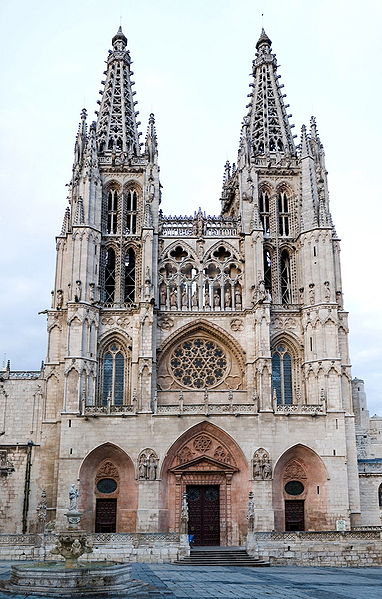
Back on terra firme, we made our way up to the Plaza Mayor.To the right stands the Cathedral, a 13th-century Gothic structure whose façade was clumsily rebuilt after damage caused in 1902. Seen from the square, the whole front looks as if a Hollywood set designer had plunked a Gothic imitation against the front of the church proper, but forgetting to fill in the upper windows and omitting spires, one of the glories of Gothic church architecture.
Cuenca: Cathedral facade.
A little further on, we came to the Mirador de Florencio Canas, a viewpoint directly across from the parador. It’s an excellent place to take photos, including dramatic ones of the casas colgadas and the parador.
Gorge, parador, garden plots from Mirador Florencio Canas
Casas colgadas from Mirador Florencio Canas

I made it back over the footbridge, almost running the last few metres!

From Cuenca, we headed south on the N 420, destination Granada. For a while we followed the Júcar River, gradually leaving behind the mountainous terrain around Cuenca and heading into the great plateau that covers so much of central Spain: the Meseta. We passed La Almarcha, a small town situated at the junction of the N 420 and the main Madrid-Valenca highway. Founded by the Moors, its etymology –“fertile plain”—is a good indicator of the type of terrain we were now travelling through. In the past, this was cattle pasture, but now grows wheat, barley, and sunflowers.

It was a beautiful day as we continued on our way. The sky was a brilliant blue with a few puffs of cloud, the ground covered in spring green, the roadside generously sprinkled with wild flowers and poppies dotting the fields. In a word idyllic!

Poppies near La Almarcha. “Noname” Castle in distance
It was about 20 kilometres past La Almarcha that we had –for me—one of the magical moments of our trip. We suddenly saw to our right a castle silhouetted dramatically on a hilltop a couple of kilometres or so off the road.
Our “Noname” castle near La Almarcha

There it stood in solitary splendour… not another building in sight. We couldn’t resist drawing off the highway and following an unpaved road towards the castle. There were no signs identifying it and we met no one to ask about it.

Alex: There was a ruined castle off the road to Granada that we stopped to look at. There was no name, so we called it “Noname” Castle.** It was on a part of the Don Quixote route. I liked this place because there were tons of flowers and the sight was incredible.

**We have since found out that our “Noname” Castle does indeed have a name: Castillo de Haro, built at the end of the 12th century by Christians to defend their newly conquered territory from the Moors.

With the sun warm on our backs, wild flowers bordering the road, poppies scattered in the fields, and silence in the air, we got out of our van and enjoyed a leisurely walk towards the castle.

Along the way, we noticed a sign on the side identifying the road as part of one of the Routes of Don Quixote, the most famous “son of La Mancha” (the area through which we were travelling). With the castle in sight and the absence of any modern buildings, it wasn’t difficult to imagine our intrepid knight-errant on his steed intent on rescuing some damsel imprisoned in one of those castle towers!

The mound on which the castle stood was much steeper as we approached and we found no easy access to attempt an ascent.

John: This castle was just a great surprise as it seems to have no name. It is located about 20 kilometres south west of La Almarcha. And it dominates the landscape. There is no town around it and the only way up is to take a dirt road and then park and walk up the back to the top. Time didn’t allow for us to go into it so I cannot comment on the inside, but it is definitely worth stopping the car.

Signpost for route of Don Quixote.

Andrew: We saw this ruined castle on the side of the road so we stopped to see it. We couldn’t go up the path to see the castle up close, but as we continued on the path we saw that it was part of the route of Don Quixote, which was really cool

Back in the van, we ventured a little further along the unpaved road where, eventually, we ran into a very modern looking cortijo (farm), at which point we decided to return to the main road and continue our journey. We still had quite a long way to Granada.

Farm or cortijo near Castle of Haro.

Our road (the N420) took us to south west, past Mota del Cuervo and towards Alcázar de San Juan. Just before Alcázar de SJ, we saw a number of windmills at Campo de Criptana which are popularly identified as the ones Don Quixote attacked in the most famous of his adventures (Chapter 8),

Four of the ten windmills at Campo de Criptana.

At Alcázar de SJ, we turned south on the CM 3107. We were now in wine country which continued past Manzanares (where we joined the major Madrid-Andalucía highway, NIV E5) to Valdepeñas, the name by which the wine of the region is commonly known.

Vineyards near Valdepeñas, in La Mancha

Continuing south, we entered the mountainous Sierra Morena, the main geographical division between Castilla-La Mancha and Andalucía. The road cutting through the mountains at the Desfiladero de Despeñaperros (“gorge over which dogs are thrown”) has improved enormously since I first travelled its twisty, dangerous and steep curves. The curious name for the gorge has historical connotation: it alludes to the “infidel dogs” i.e. Muslims, allegedly thrown over the cliffs following their defeat by Christian forces at the battle of Las Navas de Tolosa, a few kilometres south, in 1212. The whole pass now forms part of a large natural park of the same name.

As we moved south, we bypassed Bailén (whose claim to fame is that nearby a Spanish army unexpectedly defeated 22,000 French soldiers in 1808, during the Peninsular War).

Soon we crossed the River Guadalquivir where, in the rolling landscape, we could see thousands and thousands of olives trees arranged in endless rows with almost mathematical precision.
By now we were well in the province of Jaén, one of the major olive oil producing areas in the world, accounting for half of Andalucía’s production, and one third of Spain’s.
Olives in Jaén province

Soon after passing the town of Jaén, perched on a hill to our right, we entered mountainous country again and threaded our way along the narrow River Guadalbullòn valley. We then climbed to the Puerto del Carretero (1030 metres) and entered the province of Granada.

It was late afternoon when we arrived at Granada itself. So far, our GPS (aka “Olivia”) had served us well, but in Granada she met her “match,” or more specifically in the old Moorish quarter of the Albaicín.

Street in the Albaicín.

Despite instructions from our hotel, which required us to skirt the edge of the Albaicín, “Olivia” led us into the narrow, twisting lanes of the old quarter, where after some futile attempts to extricate us, she seemed to give up the ghost. Fortunately, with John’s super driving we managed to avoid scraping the van’s sides against the whitewashed walls (this required our side mirrors to be constantly retracted). After what seemed an eternity of going around and around, up and down, narrowly avoiding pedestrians, other vehicles and walls, Margaret and I recognised one of the streets we had frequently walked along when we lived in the Albaicín in 1987-88. At last, we navigated our way out of the labyrinth, crossed the Plaza Nueva and arrived at the cul-de-sac where our hotel, the Monjas del Carmen was located. Problems over? Not yet!

Alex: By accident we went through the Albaicín to get to our hotel. You could hardly get one car through on two way streets. I liked the Albaicín because it looked so old but comfortable at the same time.

There were no issues with registering in the hotel, no issues with the rooms, but parking…ah parking. The hotel has underground parking, which involves descending a steep, curved ramp. It’s fine if you have a small or medium sized car, but we had a wide, six-seater van.

Hotel Monjas del Carmen. Access to garage on the left of main entrance.
Assured by the hotel attendant that there would be no problem, John started the descent. Once into the curve, it became apparent that there was a problem (or “problema gordo.. muy gordo” “fat… very fat problem” was the expression)! We reached a point of no return, with about a ¼ of an inch to spare on both sides. By now, there was a smell of rubber as John jiggled the van back and forth, accompanied by a fair number of expletives from both of us. I was standing in front of the van (I know… it was a dumb thing to do, but I reckoned that the van would run into the wall before it ran over me, or that is what I tried to explain to Margaret, Leslie, Andrew and Alex transfixed in the van!!). The hotel attendant was somewhere behind the van, and both of us were shouting instructions to John at the same time. How John managed it, I still don’t know, but he did succeed –after what seemed an eternity—in inching the van down without a scratch. Success, congratulations all round, but there still remained the “problema gordo” of getting the van out again. But that was not for two days. Tomorrow, Granada awaited us … the Alhambra, the Royal chapel and the Albaicín (this time on foot!).

For now, it was time to relax and have something to eat.

For two interesting article on olives in Jaen, see http://www.andaluciadiary.com/andalucias-liquid-gold-olive-oil-tasting-in-jaen-province/
http://www.oliveoiltimes.com/olive-oil-basics/world/jaen-olive-oil-center/3857
If you can get hold of the the November 31, 2013, issue of the wine magazine, Wine Spectator, you’ll find an excellent article on Spanish olive oil, entitled “Spain Turns Olives into Gold” pages 42-58.

April 19, 2013. Day 3. Barcelona to Cuenca.
See Travel Itinerary for a rationale of this trip, and a who’s who of those travelling.

We were up early and eating breakfast at Forns del Pi –again—by 7.30.

Deli Enrique Tomás on Carrer del Pi. Barcelona. © Mike Sims.

We also bought some baguettes for lunch to go with some fantastic Jamón ibérico puro de bellota (ham from pigs that roam oak forests) that we had bought the day before at Jamonería Enrique Tomás on Carrer del Pi, just a few steps away from our hotel, Racó del Pi. We planned to picnic somewhere along the road.

Then it was time to call for a taxi to take us to the car rental agency on the Calle de Córcega 293/295, about 15 minutes from our hotels. We had rented a Mercedes Viano van, large enough to carry six, with luggage, comfortably. Both the location and the vehicle turned out to be good choices for us. The agency outlet was very close to the Avinguda Diagonal (Avenue), which led us directly southward out of the city to the main highway to Tarragona. No hassle and no unduly stressful city driving.

It was fortuitous that John, our “designated” driver, had learnt to drive on a gear shift car, because European rental vehicles are not normally available with automatic shift. The van was very comfortable, spacious and with large windows, excellent for sightseeing. John was also pleased that the van had a really tight turning radius, which proved invaluable in the narrow streets and tight corners we encountered in villages and the old quarters of several towns.

With documents signed, everything packed and “Olivia” (our portable GPS from Canada) already calibrated, we were off. Ahead of us a trip of about 550 kilometres to the inland town of Cuenca, where we had booked a night in the Parador Convento de San Pablo (the paradores are a state run chain of hotels).

Our road took us down the Costa daurada/ dorada past towns where tourism has been the major industry since the 1960s, when Northern Europeans flocked southwards thanks to package tours, cheap accommodation and plenty of sun, sand and sangría. The development of former fishing villages into popular resorts brought a lot of much needed money, but in many instances it came at a cost: over development and ugly architecture.

We turned inland just before Tarragona, capital of Roman Hispania Citerior and one of the first major Roman towns in Spain. Its Roman ruins have been have been designated a World Heritage Site by UNESCO.

We next passed Reus, birthplace of Antoni Gaudí (the nearby village of Riudoms also claims to be the architect’s birthplace) and then headed along the A420 towards Alcañiz.

Landscape between Calaceite and Alcañiz

This is a picturesque road, with the landscape changing constantly. Red earth, a patchwork quilt of small fields in fertile valleys below craggy hills, olive and almond groves, rocky terrain interspersed with vineyards, and flocks of sheep.

We arrived at Alcañiz around midday. Overlooking a rolling plain of fertile olive groves and orchards, this historic town is dominated by its castle, which became a parador (Parador La Concordia) in 1968 (http://www.paradores-spain.com/spain/palcaniz.html).

Alcañiz

The castle’s chapel and a tower date back to the 12th century when the town was conquered by Christians from Muslims -called Moors in the Spanish context- and handed over to the Order of Calatrava, a religious order of fighting monks, in 1179. However, the parador rooms are located in an 18th-century addition. In all, a lovely place to take a break, enjoy the view, before moving on.

John: We stopped at the Parador of Alcañiz for a washroom break, but I was very happy to look around. It’s an old castle that commands an impressive view of the town and the surrounding farmland. It is easy to imagine the knights of the time surveying the land with a sense of invulnerability.

Alcañiz Parador Bar

While the view is nice, I particularly liked the serenity of the courtyard…it was cool and silent when we were there. I also liked the bar, not only because it serves libations, but because it has a really interesting Gothic style ceiling, and vivid paintings on the exit wall which gave me the feeling of hanging out with knights.

Alex: There was a very nice parador up in the hills of Alcañiz. I liked it because it looked old and you could see the town very well.

Shortly after leaving Alcañiz, we stopped for our picnic lunch. The bocadillos (baguettes sandwiches) of jamón ibérico de bellota were so tasty, as food eaten casually outdoors always seems to be. A short walk to digest our food and we were off again.

Soon we passed La Mata de los Olmos with a striking octagonal bell tower atop its Romanesque church.

Mata de los Olmos
These octagonal towers are typical of Aragón, and the elaborate, decorative brick work a characteristic of Mudejar architecture. (Mudejars were Moors who remained under Christian rule following their defeat by Christian forces. They did so with the assurance that they could continue to practice their religion. Such Christian tolerance, however, also had a practical purpose: skilled artisans, craftsmen, carpenters, masons, the Mudejars were often contracted as builders due to the shortage of Christian workers in the rapidly expanding Christian areas. Naturally they used materials and techniques they were acquainted with: brickwork with e.g. geometrical patterns, glazed ornamental tiles (azulejos) and elaborate stucco work.)

We had seen similar towers in for example Valdealgorfa, Calanda, Alcorisa, and Alcañiz. Interesting, too, was the number of villages and town we passed with names of Arabic origin; they were very real reminders that the Moors controlled large areas of Spain for up to 800 hundred years (for brief history see al-Andalus). For instance, places beginning with “Al” (Arabic equivalent of the English definite article “the”) or “Cala” (“citadel”) generally indicate former Moorish presence: Alcañiz, Alcorisa, Calanda, Calaceite,

Valdealgorfa

Turning south just after Montalbán, we passed quickly through the former coal mining towns of Utrillas and Escucha. The last mines closed in 2003 and the economy has had to reinvent itself; agriculture here is not much of an option owing to poor, rocky soil conditions.

We were now heading for Teruel about 80 kilometres south. The town was conquered by Christian forces in 1171 during the period broadly known as the Reconquista. It’s a fairly laid back town, and was not overrun by tourists when we were there. It was a beautiful spot to stop and take our breath

Andrew:
We couldn’t find a place to park in Teruel so we got stuck driving down the really narrow streets and it was not that much fun to do with a big van.

We went to Teruel because we wanted to see the Mudéjar architecture for which it is famous. There are four tall Mudéjar bell towers -visible for miles around—that rise majestically over the old town. Miraculously they were not destroyed during the Civil war (1936-39) when Teruel was heavily bombarded in one of the most vicious and hard fought battles during the bitter winter of 1937-38 between Republicans and Nationalists.

The 13th-century towers of the cathedral (Santa María de Mediavilla) and the churches of San Martín and San Salvador, in particular (both 14th century), are breathlessly complex, with intricate recessed brick and richly coloured azulejo patterns, blind multilobed, intertwined arches, and window openings split by one, two or even four slender columns (ajímez). Each tower makes distinctive use of these decorative elements, and each adds a mysterious, exotic quality to the town’s landscape. In addition, the cathedral has a stunning artesonado ceiling (i.e. with sunken panels), unusual in that it also contains a series of paintings of hunting scenes and craftsmen at work.

Teruel Cathedral Tower
Teruel. San Martín tower.

Cathedral and towers are all easily accessible from the picturesque and unusually irregular Plaza Mayor, locally known as the Plaza del Torico (from a pillar in the centre topped by a tiny bull).

Teruel: Plaza de Torico

John: The old town seemed like a labyrinth of narrow roads when we arrived and parking was a nightmare until we found the parking at the bus station (also a good place for a washroom break). The walk over to see the famous towers was not long and while I liked the detailed stone and brick work, the plaza we stopped at was my highlight for Teruel. The different coloured houses as well as the old woodwork holding up the fronts make for an attractive and authentic view of “old Spain”. There is also the prerequisite statue and fountain in the centre of the Plaza. There were cafes at one end, but we were too late in the day for the fresh churros Andrew and Alex were looking for.

Teruel: Plaza Mayor. Detail.

Alex: We went to Teruel to see their famous towers. They looked very pretty. There was also a cool Plaza, and the streets were very narrow.

If you have a romantic streak in you, you will pay homage to Teruel’s most famous couple, popularly known as Los Amantes de Teruel (the Lovers of Teruel). Teruel was traditionally a honeymoon destination for Spaniards, drawn by the tragic 13th-century tale of two lovers, Isabel de Segura and Diego de Martínez, buried in adjoining tombs in the church of San Pedro.

Prohibited from marrying his sweetheart by her father because he was poor, Diego was given five years to make his fortune and prove himself worthy of her. He returned wealthy five years later only to find that Isabel had just been married off to another. That night Diego visited her, asked for a kiss which was refused, whereupon he dropped dead. At his funeral, the anguished Isabel kissed the corpse and promptly died.
San Pedro Church. Tomb of the Lovers of Teruel.

Another, less well known tragic love tale involves the construction of the towers of San Martín and San Salvador. Two Mudéjar architects, Omar and Abdala, fell in love with the beautiful Zorayda. Shortly after, Omar was given a commission to build the tower of San Martín, and Abdala a similar contract for the tower of San Salvador. Zorayda’s father determined that the one who built the better tower would win her hand. Omar, working night and day, was the first to finish. It was a beautiful tower, but it was leaning to one side. Mortified by his error, Omar climbed to the top of the tower and threw himself off. When Abdala completed his tower it was both beautiful and vertical. As a result he won Zorayda’s hand.

It was late afternoon when we left Teruel, and we had 150 kilometres to Cuenca. We took the N330 south, following the Turia River (on its way to the Mediterranean) for about 35 kilometres.

Landscape south of Teruel

The countryside was wild and hilly, and remained so after we turned onto the N420 at Torrebaja. Many of the villages looked impoverished and there were signs that some were semi-abandoned (Casas Nuevas) or abandoned entirely (El Cañizar). Those that showed more evidence of well-being tended to be surrounded by flat, fertile land (e.g. Salvacañete).

Casas Nuevas

By the time we approached Cuenca, we were on the easterly edge of the great meseta, a high plateau that covers much of Castile-La Mancha, the autonomous community we were now travelling in. We were up around 3,000 feet, and the land here was very fertile, with fields green with spring plantings of cereals –wheat, and rye, and sunflowers.

The old town of Cuenca (declared a UNESCO World Heritage Site in 1996) is dramatically situated, straddling a steep spur between the Júcar and Huécar rivers.

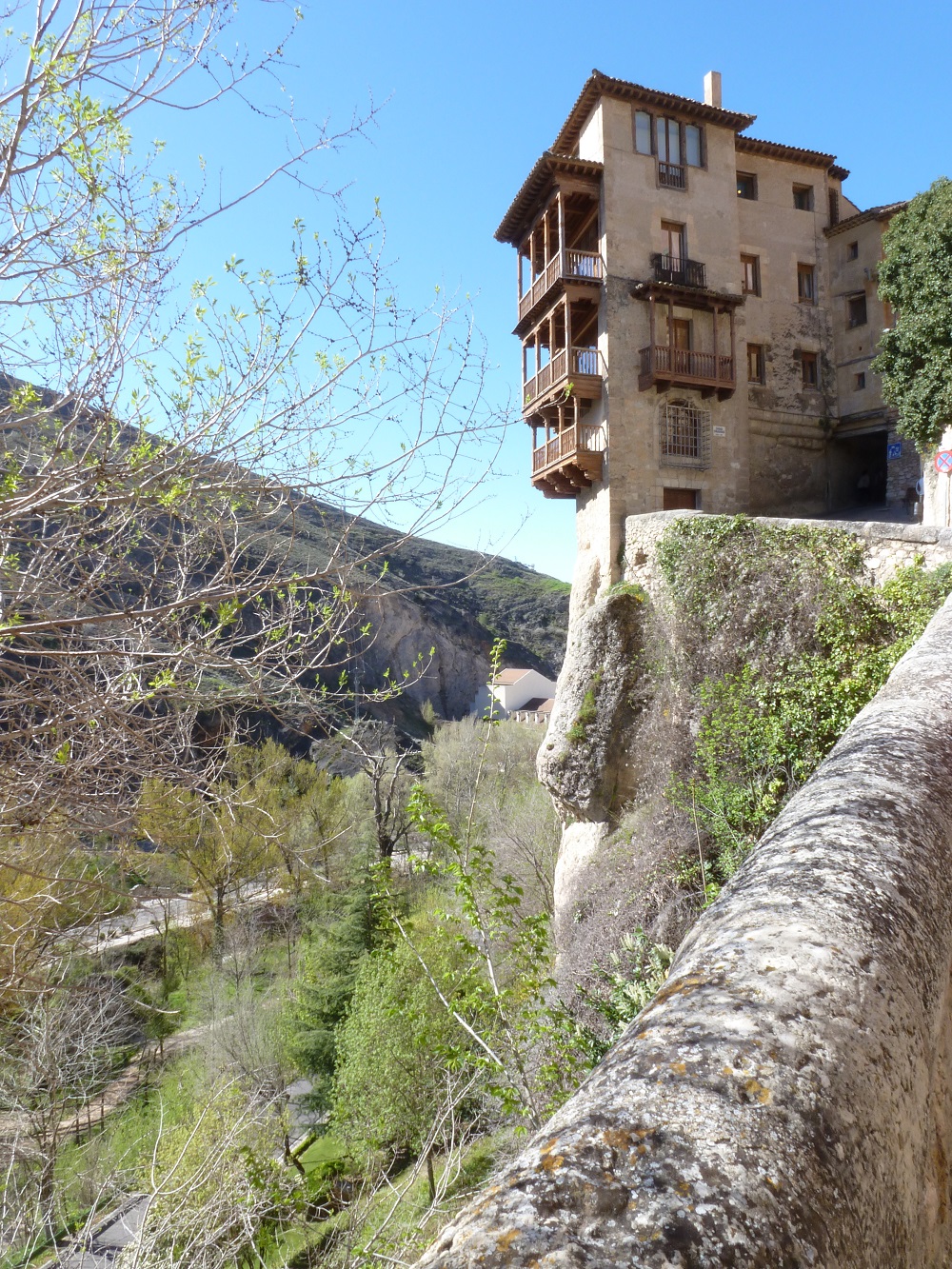
Cuenca: Casas colgadas
One side of the sheer cliffs through which the Huécar passes is famous for its 14th-century hanging houses (“casas colgadas”), some with wooden balconies balanced precariously over the gorge. Living in these is definitely not for the faint of heart. Not that they are now homes; one is an upscale restaurant and others have been combined to house a fine Museum of Abstract Art.

We arrived fairly late in Cuenca, and headed immediately to the Parador Convento de San Pablo, a 16th-century monastery that is across the gorge from the hanging houses, and has a superb view of them (http://www.paradores-spain.com/spain/pcuenca.html).

Cuenca: Parador from the Old Town.
Our rooms, unfortunately, did not look out on the casas colgadas, but on a small, grassy cloister. The main cloister was an intimate, tiled space with a fountain and three elegant, vivid green cypresses; tables, chairs and protective parasols make this an ideal spot for a summer drink. The cloister corridors themselves are wide, and furnished with comfortable chairs in which to relax.

Alex: We stayed in the Parador de Cuenca. I really like the paradors that are very old. This one used to be a convent.

The dining room was very elegant with warm terracotta tiles and a superb coffered ceiling. Dinner was pleasant enough, though not memorable; the buffet breakfast was better. On both occasions, however, we were seated at a table for ten, although we were only six. The staff seemed to have difficulty in adjusting to a request for a table for six!

John:
We arrived in Cuenca in the early evening and took advantage of their indoor parking (for 15 euros), since parking immediately in front of the parador was very limited and vehicles were somewhat at risk of bumps. The parador is a huge building with large dining facilities.

We ate there and while the meal was very nice, I particularly enjoyed the walk outside after dinner. The parador itself was nicely illuminated, but the view of the old town with its hanging gardens was really impressive lit up at night.

Dinner over, we were ready for bed. It had been a long day, and our next day promised to be almost as long, Cuenca to Granada: 452 kilometres. And we wanted to see something of the old Cuenca before we left.

Cuenca: Casas colgadas at night.

Image of Alcañiz: http://en.wikipedia.org/wiki/Alca%C3%B1iz
For those interested, Tarragona and Cuenca are included in UNESCO’s World Heritage Sites while Teruel forms part of UNESCO’s Mudejar Architecture of Aragon:
Tarragon: http://whc.unesco.org/en/list/875
Mudejar Architecture of Aragon, Teruel: http://whc.unesco.org/en/list/378
Cuenca: http://whc.unesco.org/en/list/781

If you want to read an informative article on the future of the paradores, see http://travel.nytimes.com/2013/03/03/travel/spains-paradors-face-an-uncertain-future.html?pagewanted=all

The following are two very interesting blog page about the Lovers of Teruel and the town: the first written by Patrick Walker, who -appropriately- honeymooned there: http://theartichokeadventures.thespanishthymetraveller.com/teruel-love-and-food-in-medieval-times/
The second blog is: http://www.huffingtonpost.com/lori-needleman/spain-teruel-city-of-love_b_1680157.html#s1282880&title=Claustro_de_la
For some excellent photos of Cuenca, see http://www.boomsbeat.com/articles/1849/20140327/35-photos-of-cuenca-spain-an-unusually-well-preserved-medieval-fortified-city.htm

April 18, 2013. Day 2. Barcelona.
See Travel Itinerary for a rationale of this trip, a who’s who of those travelling.

Day 2 in Barcelona began much as day 1: breakfast at Forns del Pi and a leisurely walk up the Ramblas to the Plaça de Catalunya before boarding a tourist bus.

This time, we took the red route which meandered westward before cutting south via the train station (Estació de Sants), the Plaça d’Espanya, Montjuïc (site of the 1992 Olympic Games) and then down to the World Trade Centre on the waterfront. From there it continued past the Columbus statue at the foot of the Ramblas to the Port Vell (Old Port) and the Olympic Port before turning back inland at the picturesque beach, the Platja del Bogatell. From there it wound its way back up through the Barri Gòtic (Gothic Quarter) before ending at the Plaça de Catalunya.

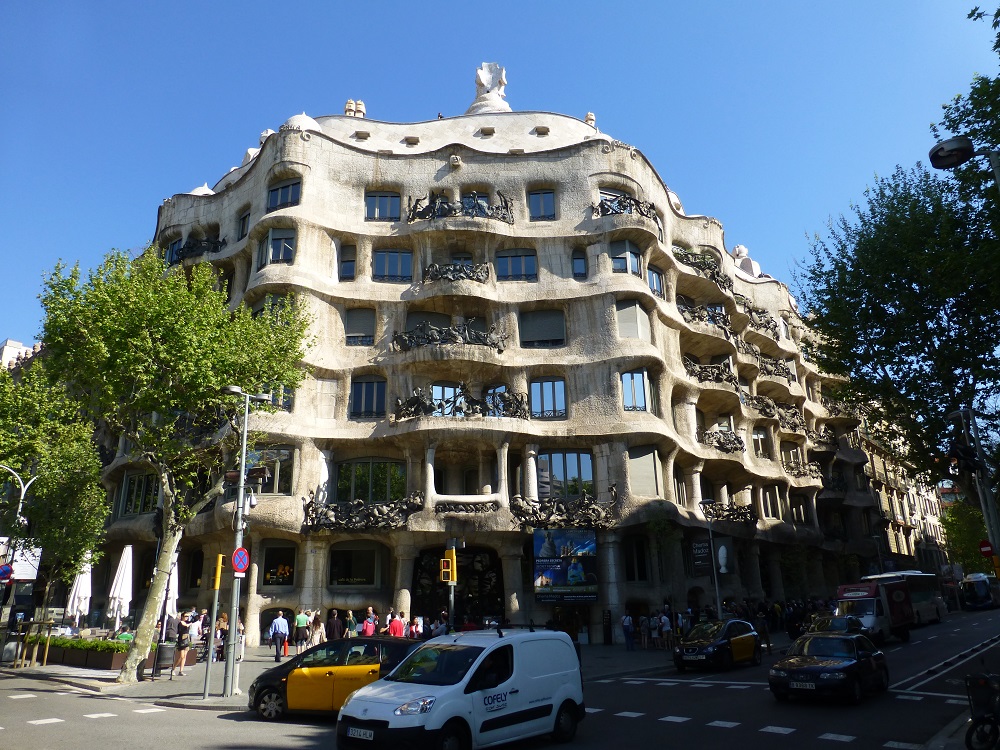
As on day 1, our first stop was on the Passeig de Gracia and again it was a Gaudí building that we wanted to see, this time Casa Milà, more popularly known as La Pedrera (the Stone Quarry). The house was built for wealthy developer Pere Milà y Camps between 1906 and 1910.

Unlike Casa Batlló (1904-06) which was a renovation built for one family, Casa Milà was an apartment block started from scratch. Its exterior is probably the most famous in Barcelona: it’s a corner building of soft honey-coloured limestone that curves around the corner in a series of waves.

Complementing the waves are balconies made up of strands of metal to look like seaweed entangled with crustacean shells. Every balcony is distinct, reflecting the diversity of nature, which does not repeat itself. The windows are large, letting in plenty of light. Gaudí’s love of curves and avoidance of straight vertical or horizontal lines is evident.

This stems not simply from his aesthetic preference, but also from his religious convictions: the imitation of waves with marine-inspired balconies was Gaudí’s way of acknowledging and imitating God’s work in Nature, and God does not do straight lines. Or as he succinctly put it: “Straight lines belong to men; curves to God” (Eaude 96).

Casa Milà or La Pedrera

Inside, Casa Milà’s continues the undulating motif. Indeed, one of the amusing anecdotes related to the house is that Senyora de Milà, perplexed by the lack of straight walls in her apartment, inquired where she could put her dog kennel. Whereupon, Gaudí is said to have replied, “Buy yourself a snake, Madam!” (Eaude 97).

So what did we think of the interior? Unfortunately, we didn’t get to see it on this trip. When we arrived –early in the day—the queue was already horrendously long, and we had a busy day ahead. If only we had booked on-line! (which you can do by clicking http://www.lapedrera.com/en/buy-your-ticket)

May, 19, 2019. For a very interesting piece in English on La Pedrera, its history and its last remaining tenant, see https://elpais.com/elpais/2019/05/15/inenglish/1557913229_654282.html

Back on the bus, we enjoyed the views from the upper deck. It was a beautiful day, and we relaxed watching the world go on its busy way. We decided the next stop would be the Olympic Village up on Montjuïc.

Montjuïc — Jewish Mountain, probably alluding to a Jewish cemetery on the site- is a hill edging the southwest of the old city. One time wooded, its only significant building was an 18th-century castle (built on the remains of a 17th-century fortress); in the 1890s parts were cleared for parkland. However, it was in the 1920s that it underwent a substantial transformation when Barcelona hosted the 1929 World Fair.

Numerous buildings were erected: e.g. the Palau (Palace) Nacional, a sports stadium, the Poble espanyol (a “Spanish village” made up of buildings reflecting the different styles of Spanish regional architecture), a Magic Fountain, and pavilions representing the achievements of the countries participating, almost all European (Japan, the Netherlands, Portugal, the United Kingdom and the United States participated in an unofficial capacity.)

Some of the buildings have survived: the Palau Nacional now houses Catalan National Art Museum (Museu Nacional d’art de Catalunya); the Poble espanyol continues to enchant visitors, and the Magic Fountain still casts its …well, magic

Font màgica: Magic fountain

The 1929 sports stadium was completely renovated for the 1992 Olympics. It was here that the opening and closing ceremonies were held and was the venue for the athletics competitions.

Olympic ring complex: the Anella Olimpica.

Alongside it now, within the officially named Olympic Ring (Anella Olímpica), are a new indoor sporting arena (Palau Sant Jordi), a three-swimming pools complex, a futuristic communications tower by Santiago Calatrava, the National Physical Education Centre, and an Olympic and Sports Museum, named after Joan Antoni Samaranch, the Catalan President of the International Olympic Committee from 1980 to 2001.

Calatrava’s Communications Tower

It was still fairly early in the day when we got off the bus and the Olympic Ring was silent. Already the sun’s heat was reflected off the open area between the buildings. Although the other buildings making up the Ring are regularly used, the stadium looked rather forlorn, its empty stands dreaming nostalgically of the distant roars of crowds. For a while, it was the home ground of Espanyol, Barcelona’s second major soccer team, but in 2008 Espanyol moved to its own ground and the Olympic stadium has since only staged sporadic matches.

Back on the bus, we headed down hill to the port. Suddenly, the sun disappeared as a mist dropped over us, the temperature fell dramatically, and we feared that there might be a change in the weather. The mist was still hanging around when we got to the Columbus statue at the foot of the Ramblas.

Statue of Columbus

It may seem strange to see Columbus celebrated in Barcelona, but the Monument a Colom (Colón in Castilian) was built for the 1888 World Exhibition and commemorates Christopher Columbus’s return in 1493 from his first voyage to America (Las Indias). Although Columbus had received warm receptions in Lisbon, Seville, Córdoba and Valencia, it was in Barcelona that Columbus enjoyed official royal recognition when he was welcomed by Ferdinand and Isabella, the Catholic Monarchs. Prior to a celebratory ride through the streets of the city, the Monarchs invited Columbus to sit beside them (a rare privilege, although his chair was smaller; propriety had to be maintained!) and recount his adventures. Among the “treasures” he brought back were a group of Indians, the first to be seen in Europe.

An elevator can take you up the 60m (197ft) high column. On top is a statue of Columbus, pointing out to sea. Guides love to say that he is pointing in the wrong direction, away from the continent he discovered, when perhaps nothing more was intended than an indication that the sea was where his fame was won.

On to the next stop, the Port Olímpic (Olympic Port), and the sun had reappeared and it was warm again! From the Port Olímpic we strolled along to the Platja de la Icaria (Icaria Beach), a small, protected, family-friendly beach where Andrew and Alex paddled in the Mediterranean for the first time.

Alex on the beach La Icaria
After they had dried their feet, we ambled back to the Port with Frank Gehry’s sculpture “Fish,” commissioned for the 1992 Olympics, rising boldly in front of us. On the way, we took a minor detour: Andrew had seen a Barcelona Football Club shop outlet and couldn’t resist the temptation. About thirty minutes later he emerged with a Barça scarf to add to the cap he had bought the day before at Camp Nou. Barça was playing in the UEFA Champions League semi-final against Bayern Munich on the following week, and he wanted to be prepared!
Gehry’s Fish

Alex: In Barcelona there is a great place to swim, the Platja de la Icaria (Icaria Beach). I really in joyed being there because I did not feel crowded. Also if you went on the red bus and stopped at Port Vell you could get there pretty fast.

John: Having spent a number of hours on the bus seeing the sights of Barcelona, it was really nice to walk along the boardwalk beside the Mediterranean Sea. I had not expected the beaches to be so clean nor the water to be so clear. There are small ports for the boat enthusiasts, but I just enjoyed the chance to get my shoes and socks off and walk on the sand in the Platja de la Icaria, although the water certainly seemed cold. There were many café/restaurants that we could go to, but I was holding off for dinner at the Taller de Tapas.

Our next bus stop was the Barri Gòtic, and we got off not far from our hotels. This old Gothic Quarter with its labyrinthine streets, hidden squares and unexpected corners is a wanderer’s delight. You might suddenly end up on the Ramblas, or the Plaça Reial (Royal Square), or as we did on this occasion, the cathedral square.

Cathedral Square. The steps are a favourite meeting spot.

The Cathedral of St Eulalia is a large Gothic structure built between the 14th and 15th centuries, although its flamboyant facade belongs to the 19th. A favourite place to visit is the cloisters with their 13 resident white geese, said to symbolise the purity of the 13-year old saint martyred by the Romans in 303/4 AD (the 13 may also allude to the 13 tortures she is alleged to have suffered.) Her remains are buried in the crypt of the cathedral.

A quick stop at our respective hotels and then it was off to La Boquería, Barcelona’s famous, must-see market for any foodie. The Boquería is on the Ramblas, towards the Plaça de Catalunya end. As soon as you walk in all the senses are alerted. The eyes feast on an incredible selection of vibrantly coloured foods (fruits, vegetables, fish, meat) arranged with care and artistry, the taste buds begin to salivate, your nose quivers at the array of aromas, and you can’t help touching the delectable displays (you might get frowns from the vendors!). Temptation is everywhere, and you won’t leave without buying something!

Boquería: Dried fruit
Boquería: Vegetables

John: I have always been a sucker for markets, but even if you are not, the Boquería really is a feast for all of the senses. It opens early for Spain…around 9 am, but by 10 it is in full swing. The vendors take a great deal of pride in their displays matching the colours and textures of their wares. Not only does the food look good, but they had every fresh fruit imaginable and the seafood and meat displays demonstrated the variety of gastronomic choices available throughout the city. This market is a must see for any “foodie.”

Boquería: Delicatessen.

Andrew: I loved the Boquería market because of all the different variety of foods and the general business of the place.

After the Boquería, one further thing remained. On our first day, Alex had seen Lladró porcelain figurines in a shop on the Ramblas. Having admired her Mamgu’s (grandmother in Welsh) collection of Lladrós, she was determined to buy a figurine with her own money on her trip to Spain.

She had narrowed her selection to three, and mulled it over while we had dinner at the Taller de Tapas in the Plaça de Sant Josep. Then, quickly, the decision was made and off she went with her dad (between the main course and dessert). Within twenty minutes they were back: mission accomplished, and a proud Alex bearing her own Lladró.

Alex’s Lladró.

Alex: I bought a Lladró in Barcelona in a shop where there were lots of collectibles. I had always wanted a Lladró and I think the one I bought looks like me.

Day 2 had been a long but rewarding day. There was still so much more to see in Barcelona, but it was time for us to move on. Day 3, pick up our rental vehicle and head south.

Image of Olympic Ring Complex from http://en.wikipedia.org/wiki/Anella_Ol%C3%ADmpica
Image of Font màgica from http://en.wikipedia.org/wiki/File:Font_M%C3%A0gica_del_Montju%C3%AFc.jpg
Two very useful books on Catalonia/Catalunya and Barcelona:
Eaude, Michael Catalonia: A Cultural History Oxford 2008
Hughes, Robert Barcelona New York 1992

April 17. Day 1. Barcelona.

See Travel Itinerary for a rationale of this trip, and a who’s who of those travelling.

With only two complete days to spend in Barcelona, there was no way we could do justice to this dynamic Mediterranean port city. So to capture highlights, we decided to take two double-decker bus tours, one each day, and in between stroll through the ancient, twisting streets of the Barri Gotic (Gothic Quarter) and along the Ramblas, Barcelona’s famous, vibrant tree-lined avenue.

We started the day with a great breakfast –including freshly squeezed orange juice- at Forns del Pi, a small bakery in Carrer (Street) Ferran, 12, just off the Plaça del Pi, and the only place in the vicinity that we could find open by 9.00 a.m. Then we sauntered via the Ramblas to the Plaça de Catalunya, the starting point for bus tours.

The advantage of the bus tour was that we could get on and off as we wished spending as much time as we needed in places we wanted to visit. You can pick up tickets at various places (e.g. the Ramblas, the Plaça) or reserve on line and get a discount. Details regarding routes, prices and other very useful information can be found at http://www.bcn.travel/Scroll down to “Our most popular Barcelona Tours & Activities” (FYI, we chose Barcelona Bus Turistic, and were very happy with them).

Initially we bought a one-day ticket at 26 euros (15 euros for Andrew and Alex), and were pleased to find that when we decided to go on the next day, we were charged only 9 euros (4 for Andrew and Alex), i.e. the simple difference between one-day and two-day tickets.

We were impressed by the efficient system ensuring fairness when boarding a tour company bus. Most tourists want seats in the open upper deck for the views. When the upper deck is full, the attendant checking tickets just inside the bus offers remaining passengers the option of the lower deck. These passengers are given first chance to go upstairs at the next or subsequent stops to replace those leaving the upper deck. Only then are newcomers allowed to enter the bus.

For our first day, we took the Blue Route, stopping at three Antoni Gaudí creations: Casa Batlló, the unfinished church of the Sagrada Familia, and Park Güell, and finally at Camp Nou, home to one of the most famous football/ soccer clubs in the world: FC Barcelona or simply Barça.

Although not born in the city, no other artist is so intimately linked with Barcelona as Gaudí (1852-1926). Of his 18 buildings, 12 are in the city and 7 have been designated UNESCO World Heritage Sites (See http://whc.unesco.org/en/list/320 Works of Gaudí on the World Heritage List. UNESCO lists 7). All 3 that we visited are on the list.

Casa Batlló.
Casa Batlló is located on the elegant Passeig de Gracia, the first stop after leaving the Plaça de Catalunya. This part of the Passeig is a focal point of Catalan modernism with strikingly different buildings by contemporary architects, each daring in its way and portraying an iconoclastic/ adventurous spirit breaking with conventions (e.g. compare the Casa Amatller by Puig i Cadalfach immediately to the left of Casa Batlló). Gaudí combined modernism’s variegated decoration –using iron, ceramics and wood- with romanticism’s appreciation of tradition and empathy with nature.

Casa Batlló is actually a renovated apartment block, converted by Gaudí for the textile magnet Josep Batlló in 1904-06. Its façade strikes you immediately with its large undulating windows on the lower level, topped by a wall of multi-coloured mosaics, bold, jutting balconies that look like masks or eyeless sockets, and vertical window dividers on the second and third floors that imitate elongated bones. The locals name it: Casa dels ossos (House of Bones)! Alex’s great name for it: the funky house

Casa Batlló. Facade.

Look a little closer at the centre of the large window: those two long bone verticals are topped by a headless torso with arms folded over the chest. And running down beneath the undulating horizontal frame of the window and into the soft curved sandstone frames of the ground floor are four large nipple-like drips. Dripping blood? There’s a surreal feel to the front, which explains why Salvador Dalí –fellow Catalan and surrealist par excellence—admired Gaudí immensely.

According to the art critic, Robert Hughes, the façade of Casa Batlló was intended to project publicly both Gaudí’s deep Catalan nationalism and religious conservatism. Gaudí allegedly said that the façade portrayed the victory of St George (patron saint of Catalonia) over the dragon. The knobbed outline of the roof represents the scales of the dragon’s back (which is much clearer if you go up to the roof), the masks and boned window dividers are remains of the monster’s victims, and the large window the dragon’s devouring mouth. Above, the tower that protrudes boldly to the left is the tip of St George’s lance, topped by a cross inscribed with the names of Jesus, Mary and Joseph.

Casa Batlló: Roof: Part of the dragon’s back.
John: When I was a kid seeing Barcelona for the first time, I remember liking the exterior of Casa Batlló,but I had no memory of the genius of Gaudí’s interior. Two highlights of the inside for me were: 1. the front room with its ocean wave design and the fact that the window across the entire front could open, bringing the city inside, and 2. the white, clean feelings of the top floor. The upper floors were not nearly as busy as the lower ones so I was able to really to get a sense of serenity and calm when I was there.
Alex: The Funky House…. I really liked the lightwell in this house because the bottom is light blue and the top is dark blue. I thought this was very cool.
Casa Batlló: Upper floor.
Casa Batlló: Lightwell.

Andrew: I really liked the Casa Batlló because the outside looked like bones holding up the house and the dragon on top of the house looked out above the balconies.

Sagrada Familia.
Next we headed for La Familia Sagrada, the building that has become for Barcelona what the Eiffel Tower is to Paris, or the Guggenheim Museum to Bilbao: an iconic feature that immediately identifies the city by its boldness and visionary quality.

Sagrada Familia: Gaudi’s work is in the foreground; modern extension is to the left and behind.
There was a dauntingly “loong” queue when we arrived, so you might think of purchasing your ticket(s) on-line: http://visit.sagradafamilia.cat/?lang=en#tickets and so avoid the queue. If you haven’t got your tickets when you get there, you can use an ATM machine in the Caixa (Credit Union) across the road. That’s how we escaped queuing.

Gaudí neither started nor finished the Sagrada Familia. It was begun in 1882, and he took it over in 1883 quickly stamping his aesthetic personality on it. When he died on June 10, 1926, three days after being struck down on Barcelona’s Gran Vía by a street car, the church was far from finished. It is still under construction as the cranes on the accompanying picture(s) show, with costs being largely defrayed by donations (especially from Japanese) and entry fees; it is scheduled to be completed around 2026.

Gaudí was a devout Catholic, a conservative at odds with the democratic movements of the times and the revolutionary ideologies rife in Barcelona in the late 19th century. The church from the beginning had been conceived as an expression of atonement for these revolutionary sins, and this purpose complemented Gaudí’s religious convictions perfectly. The Sagrada Familia became an obsession, and after 1912, Gaudí dedicated himself entirely to the church’s construction, begging for donations, sleeping for much of the time in his workshop, neglecting his appearance and scarcely eating.

Gaudí’s church is basically Gothic, overlaid with romantic freedom and modernist love of decoration. Romanticism followed several paths: amongst them a search for the medieval past, a reawakening of interest in local traditions, and nature. Gaudí takes the medieval Gothic cathedral as his starting point, and then adds endless structural and decorative elements based on his belief in the sanctity of nature as an expression of God’s omnipotence.

Nature was God’s great creation, His “building” and since God did not “build” in straight lines, Gaudí too shunned straight vertical and horizontal lines. This is one of the most characteristic qualities of his work. The façade and interior of Casa Batlló contain endless curves; just up the road, Casa Milà (La Pedrera) curves around the corner in a series of waves; inside and outside the Sagrada Familia horizontal and vertical structures lean or are broken up by decorative elements drawn from nature.

Casa Milà or La Pedrera

This is especially so in those parts of the Sagrada Familia completed by Gaudí: for example, his exuberant, highly decorative Nativity scene in the east entrance.

Sagrada Familia: East Entrance. Nativity scene.

Compare this with Christ’s Passion scene of the west entrance designed by the Catalan sculptor Josep María Subirachs. The latter’s entrance is simple, with clear cut lines that emphasise austerity, which in fact captures the solemnity of the moment very well.

Sagrada Familia: West Entrance. The Passion or Sufferings and Crucifixion of Christ.
Alex: The upper picture is of the old entrance to the Sagrada Familia. I like it more than the new entrance because of the great carvings and details.

John: The Sagrada Famiilia is such an amazing building that it was hard to pick just one photo from it. I’m lucky enough to have seen a number of European Cathedrals and while each is impressive in its own right, this one really stands out for its use of light and nature. Inside, your eyes are always drawn up the white stone columns to the deceptively simple yet complex roof. While there is no sign of the work being completed, I am really looking forward to seeing the exterior without the cranes.

Andrew: I really liked the inside of the Sagrada Familia and the pieces that caught my attention were the stained glass and the architecture itself. I especially liked the entrance that Gaudí made because everything was put together as one big piece of art.

Sagrada Famila: Stained Glass rear of church
Looking towards the altar

Park Guell.
After the Sagrada Familia, it was back to the bus and on to Park Güell. After being dropped off at the foot of the Carrer Larrard, we picked up some bocadillos (baguette sandwiches) and made our way up the hill to the park.

Gaudí was commissioned in 1902 to create the park by his long-time patron, the wealthy industrialist and Catalan nationalist Eusebi Güell (Gaudí was 50). Güell had travelled widely in France and England, and the park was possibly conceived in imitation of the residential garden cities in vogue in England at the time (hence the English “Park” as opposed to the Catalan “Parc” or Spanish “Parque”). The enterprise didn’t take off but the citizens of Barcelona are better for it. Güell sold the park to the municipality in 1923.

It’s a public park like no other, now enjoyed by barceloneses and tourists both for Gaudí’s quirky designs and a great view of Barcelona.

Güell Park: Entrance
Benches and view of Barcelona. Sagrada Familia to the left.
As soon as you enter, you face a grotto embraced by two flower-lined, curved staircases that lead up to a series of Greek or Roman-style pillars supporting a tile-covered serpentine belvedere. Climb to the top and the belvedere is in fact a large earth-floored square, and the serpentine curves seen from below are edged on the inside by winding benches going around the square. The benches are encrusted with multi-coloured, broken ceramic tiles bearing an incredible number of motifs: e.g. abstract, geometric, floral, vegetative, animal….

Alex: One of my favourite things in Barcelona was the seats in Park Güell because they are so artistic. I also like that they are made of tiles.

Andrew: My favourite part of Park Güell was the tiled seats that were built on a platform where you could see a lot of the city.

Sculpted trees and nature.

Throughout the park, there are hidden corners (some used by musicians when we were there), intimate spaces and everywhere lush vegetation covering the multi-tiered layout. True to his aesthetic and religious bent, Gaudí sought to complement nature which he saw as God’s work. E.g. a sculpted tree arcade, partly entwined by wisteria, seems to grow organically from its natural surroundings.

John: Park Güell was my favourite stop in Barcelona. Maybe because I never knew that it was there. It truly is a gem in the city. I loved the way that the stone work, surrounded by flowers and trees, had no straight lines and created a whimsical feeling.

Tiled benches.

The mosaic benches, created with broken tile, were brilliantly colourful and, with the city as a back drop, make a strong statement. I particularly enjoy the bright blues that are incorporated into the colour scheme. My caution to other travellers is that the bench area is very popular and gets crowded quickly. Also, go early in the day as the bench area has no shade and gets very hot.

Park Güell is a feast for the senses. If you are interested in an academic interpretation of the Park as an expression of Catalan nationalism, read Robert Hughes’s invaluable but very personal views on Barcelona, especially pages 504-12: Hughes, Robert Barcelona New York 1993.

After Park Güell, it was back down the hill and on the bus (bus frequency depends on the season, from 5 to 25 minutes). It was a beautiful day, warm but not hot, and riding on the upper deck was pleasant and refreshing. A free audio with individual headphones kept us informed of interesting sights as we travelled.

After about ½ hour we got off at Camp Nou, home to Fútbol Club Barcelona or simply FCB. Unfortunately, we never made it to the tour because — and this will seem sacrilegious to aficionados of soccer/football—the queues were long, entrance fees fairly expensive (to us), it was late and we were tired after a lot of walking.

Andrew at Barça’s shop in Camp Nou. Future star?

Regrets? In retrospect, yes, especially when Andrew decided that he was a Barcelona fan and bought an FCB cap, scarf, and tile declaring him an “hincha” or “fan” (for which I teased him, because I have been a Real Madrid supporter since I first saw the team in a charity match against Manchester United at the San Bernabeu Stadium in 1959!). Consolation? Yes, it’s a good reason, but not the only one, to go back to Barcelona.

We ended the day, meandering back to our hotels via the Ramblas.

Leslie: I loved Barcelona. Everything. One of my favourite places, though, was The Ramblas.

It was always busy, and full of energy no matter what time of day. It was a great place to walk, people watch and browse the stores and booths along the strip. It was also a great place to see the buskers. We saw some amazing human “statues” as we walked, and I couldn’t believe how still they could be. We had been told to be careful of pick-pockets, yet I never felt unsafe, although we were very careful to make sure we were not obvious targets.

A view of the Ramblas.
Rambling the Ramblas: Alex, Margaret, Andrew.

Ramblas: Andrew and Alex with human statue

John: When we were planning this trip, I had heard that the Ramblas was the most likely place in Europe to be pick-pocketed. Please don’t let that stop you from walking this street because, even if you have no interest in shopping, it is a great place to people watch and to “drink in” the city. Toward the sea, there are a number of buskers who are “statues” and are remarkable in their abilities.

Andrew: I really like the Ramblas because of all the buskers; they were really good. I preferred watching them than going shopping.

A quick break was followed by an enjoyable, relaxed dinner at the Taller de Tapas in the Plaça Sant Josep. Already we were in the mood for next day’s adventures.

April 16th. First Evening in Barcelona.
See Travel Itinerary for a rationale of this trip, and a who’s who of those travelling.

Our first evening in Barcelona and Margaret and I were sitting enjoying tapas in the Plaça Sant Josep Oriol. We were just five minutes off the Ramblas,

Street “performer” on the Ramblas. Imaginatively made up, this modern Don Quixote will move/ perform when money is dropped into the container in front of him.
Barcelona’s famous tree-lined central avenue, with its teeming crowds of Barcelonans, tourists, street performers, booths with sundry goods, and restaurants … a place to see and be seen, buzzing with activity and energy. But after a hectic travel day, we were pleased to relax and people watch in Sant Josep.

Plaça Sant Josep is in the ancient Barri Gotic (Gothic Quarter), adjacent to the Plaça del Pi and is a perfect place to stay in Barcelona. Centrally located, both plaças skirt the walls of the 14th-century Gothic church of Santa María del Pi.

Gothic church of Santa María del Pi

Sant Josep was busy that warm evening but not thronged with people. The outdoor tables of the numerous tapa bars that ring Sant Josep were filled with animated talk; Spaniards love a good conversation over food. Margaret and I were waiting for John, Leslie, Andrew and Alex (JLAA) who had taken a different flight from us and were expected any moment.

As we waited, I thought about the history of Barcelona, capital of the autonomous community of Catalonia (Catalunya in Catalan), Spain’s second largest city (pop. approx. 1,621,000 in 2013) and a major Mediterranean port. It had carried a lot of political clout in the Middle Ages once its primacy over surrounding regions had been established by the evocatively named Guifré el Pelós (Wilfrid the Hairy) in the late 9th century. By the 13th century, Barcelona was the heart of a trading nation with possessions and contacts extending across much of the Mediterranean. Its influence waned in the 16th century with the rise of Castile and was rekindled only in the late 19th century. That was when it became an industrial and cultural hub (e.g. Gaudí and the Catalan moderniste movement) and centre of an increasingly independent minded Catalonia.

Political unrest in the 20th century -particularly the civil war of 1936-39 and General Francisco Franco’s smothering dictatorship until 1975— jeopardised freedom of expression but it did not fundamentally undermine Barcelona’s position as Spain’s major industrial base. Its population increased too as thousands of impoverished Spaniards from other regions flocked to the city in search of work. It also continued to be a centre of artistic expression, e.g. Dalí, Miró, Tapiés.

At news of the death of General Franco in 1975, Barcelonans rushed ecstatically into the streets to celebrate. Since then, Barcelona has become Spain’s most cosmopolitan city. It’s now flourishing with hi-tech and biomedical investments, and received a major boost and makeover when it hosted the 1992 Olympic Games. And in the last few years, the success of its main soccer team, Fútbol Club Barcelona (or simply Barça to aficionados), has projected its image all over the sporting world.

My musings were cut short when JLAA suddenly appeared, hauling their luggage across the Plaça del Pi, having taken the subway from the airport. (Margaret and I took a taxi, and for a reasonable 25 euros it was worth it!) They were staying in Hotel El Jardí, overlooking Plaça San Josep; Margaret and I had opted for Hotel Racó del Pi, about 100 yards up the Carrer (Street) del Pi, mainly because it did not entail climbing a flight of steps before getting to reception. Both were good choices for us and we hope to return there. (As a bonus, Racó del Pi also provided a glass of cava on arrival, and there were apples and nuts available for guests at the reception desk!).

By the time JLAA were settled in El Jardí it was late, but despite their transatlantic overnight haul from Vancouver to Barcelona via London, they weren’t yet ready for sleep. So about 10.00 p.m. -a typical Spanish dinner hour- the six of us were seated in Sant Josep sampling more tapas (patatas bravas: deep-fried potato chunks with spicy sauce, and calamares a la romana: rings of squid in light batter), and reflecting on our respective journeys (Margaret and I were staying overnight near Boston when the tragic Boston marathon bombings occurred).


In Sant Josep: building our strength for the next day with patatas bravas and calamares a la romana and some liquid refreshment. Andrew became a true aficionado of patatas bravas and calamares, sampling them wherever he could during our trip.
We also planned our first day in Barcelona. We were to get up early, have breakfast and then head for the Plaça de Catalunya, about ten minutes away via the Ramblas. Our plan was to take a double-decker bus tour of Barcelona, which gave us the freedom to get on and off at a choice of destinations and at the same time see something of the city between stops. For us this was the most efficient way to get a taste of Barcelona with the limited time available to us (two days).

There are endless web pages and recipes on Google on both patatas bravas and calamares. Here’s one amusing and illuminating read on patatas bravas: http://www.guardian.co.uk/lifeandstyle/wordofmouth/2011/mar/31/how-cook-perfect-patatas-bravas

If the Mediterranean coast is awash with package tourists, travelers in cars and buses, and retirees all seeking the sun, the North Coast has so far been spared the onslaught of mass travel. Made up of the Costa Vasca, Costa Cantábrica, Costa Verde, and the Rías of Galicia, the one thing this coast cannot guarantee is sun. But its extensive beaches, intimate coves, towering cliffs are amongst the finest in the peninsula, and they are not as crowded.

Oyambre Natural Park, between Comillas and San Vicente de la Barquera, Cantabria.

The Cantabrian Sea (or Bay of Biscay), however, is wilder and certainly colder than the Mediterranean, and the winds blowing off the Atlantic can bring a chill to the air. Spaniards from the sun-baked interior are your likely tourists along this coast, although there is now an increase of Europeans who are looking for something more authentically local than what they might find on the Mediterranean costas.

A recently constructed major highway (Autovía del Cantábrico) running along the coast from Bilbao in the Basque Country (País Vasco or Euskadi in Basque) to Galicia will undoubtedly open up the coast even more.

Fishing is a way of life on the coast, although depleted fish stocks and quotas in the Atlantic have reduced the size of the fleets. Still, Spain has one of the largest fishing fleets in the world and Basque, Cantabrian and Galician boats bring in the biggest catches in Spain.

Running along the coast is a narrow, lush green strip backed for the most part by the Cordillera Cantábrica mountain range. “Green Spain,” as it is called, is just that, as bucolic a place as you could hope to find. Here cattle and sheep graze on the emerald coloured slopes, orchards abound and in the heavily wooded uplands and into the mountains there is a wide variety of wildlife: squirrels, deer, chamois, martens, wild boars, foxes, wolves and the endangered Iberian brown bear.

Argonos. Cantabria.

Mountain streams abound and fresh water fishing is popular, particularly trout and salmon. Isolated valleys have allowed the inhabitants to preserve almost intact ancient traditions, even linguistic peculiarities which go back centuries (e.g. Bable in Asturias, which is identified as a “regional language” rather than a dialect). In some Basque valleys contact was historically so limited owing to their isolation that it required some effort for the inhabitants of one valley to understand their neighbours in the next valley.

Spain is the second most mountainous country in Europe, but it isn’t only its mountains that impress. About 40% of Spain’s land mass is made up of a high central plateau (Meseta) ranging from 400 to 1000 metres in height.

Covering Castilla-León, Castilla-La Mancha, Extremadura, and chunks of Aragón and La Rioja, the Meseta is bordered on the north by the Cordillera Cantábrica, split near the middle into northern and southern halves by the Sierra de Guadarrama and the Sierra de Gredos, and rimmed to the south by the Sierra Morena.

Main mountain ranges.

Largely treeless and windblown, the Meseta is blistering hot in the summer and freezing in the winter. During the growing season, the northern Meseta shimmers golden with cereal crops and then retreats to a dusty dryness, while in the southern half vineyards, rows of olive trees and the saffron-producing crocus carpet the otherwise barren plateau.

Flocks of sheep roam large stretches of the Meseta, moving south along ancient rights of way (las cañadas) in the fall and returning north in the late spring. (In October 2000, a shepherd caused traffic chaos in Madrid when he asserted his right to take his flock through the centre following a long-forgotten right of way!)

The stark and arid landscape of the Meseta is often evoked when talking of the Reconquista, the gradual reconquest by Christians of Muslim-controlled land. Its luminous sky magnifies the distance at the same time that it gives sharp-edged clarity to distant objects.

This is the heart of Castile which for so long dominated Spain’s history. “Castile made Spain,” the philosopher Ortega y Gasset once said, before adding “and Castile unmade Spain.” It is the language of Castile, Castilian, that we know as Spanish; it is also the language that passed to the Americas.

The people of the Meseta have been defined as sober, and ascetic with perhaps a touch of visionary madness, in contrast to the exuberant Andalusians, the nostalgic Galicians or the practical Catalans.

It is in the Meseta that Don Quixote, that wonderful and exasperating madman, was born. Here also the mystical St John of the Cross or the visionary and stubborn St Teresa of Avila find their place. But whether mad or mystical, these figures are, in their own way, adventurers, fighters, people of action, characteristics they share with the national hero of Castile, the Cid, or with so many of the conquistadores of America.

Apart from some major cities (Madrid, Salamanca, Avila, Segovia, Burgos, Toledo), the Meseta is sparsely populated. The scattered, earth-coloured villages are often camouflaged in the open plain, and only a church tower –or nowadays a grain silo- identifies their location. With mechanization of the land, many of the villages are now abandoned** or inhabited only by older people, the younger set having either emigrated or moved to the large towns in the 1960s and 70s in search of work.
**March 31, 2019. The matter of abandoned villages has been a major issue in Spain for some time, with political implications. Simply Google: Spain rural depopulation, or see, for example, https://www.euronews.com/2019/03/31/the-revolt-of-empty-spain-why-is-spain-s-rural-world-protesting Click Europe.
Map of Spain from http://commons.wikimedia.org/wiki/Atlas_of_Spain

When Rose Macauley drove down the long Mediterranean coast (“fabled shore,” she called it) in 1949, she commented on the Spanish habit of staring and pointing at foreign visitors owing to their rarity. A few people had discovered the Costa Brava, but beginning in the early 1960s an invasion of Northern Europeans took place.

Attracted by sun, sand, sangría and cheap accommodation and helped by an industrial boom in their countries, British, Germans and Scandinavians flocked to the “fabled shore.” Soon there were other costas: dorada, del azahar, cálida, blanca, tropical, de Almería, del sol, and as more older foreigners started to settle permanently along the Mediterranean a costa geriátrica was mischievously added by locals.

What this invasion did was to change the nature of the Mediterranean coast from a largely fishing and agricultural economy to a long and –unfortunately, for much of the coast— garish vacation and retirement strip. True, it provided much needed jobs for Spaniards.

Construction boomed as hotels and restaurants were quickly built along the costas from the Pyrenees to Gibraltar. But quantity rather than quality marked these early developments, which became a blight in many areas. By the 1970s there was an increase in tourists arriving by car, and a new major highway was constructed, snaking down the Mediterranean coast like a giant scar.

This tourist invasion also had an unforeseen effect: it suddenly exposed Spaniards cocooned in the past from foreign habits and from the sight of young, carefree foreigners, including unchaperoned women in two-piece bathing suits.

Under the Franco dictatorship (1939-75), the wearing of bikinis or two-piece swimsuits was strictly forbidden until the early 1950s. The change came following a famous trip on his Vespa scooter by the mayor of Benidorm -Pedro Zaragoza- to Madrid to petition General Franco himself for permission to allow women to wear two-piece suits. Zaragoza got his wish despite the apoplectic opposition of the bishops of the Catholic church. See http://www.guardian.co.uk/travel/2011/apr/02/benidorm-spain-holiday-new-alicante Giles Tremlett has an excellent chapter dealing with the effects of tourism on the Mediterranean coast, pointedly entitled “How the bikini saved Spain.” Well worth reading.

These Spaniards included not only those living on the coast, but also the thousands of young people who left their conservative, inland villages: young men to work on construction sites and young women to be employed as maids in the booming hotels. These in turn took back to their villages news of what was happening on the coast; the bolder ones might even wear more “fashionable” clothes on a return visit.

Although a cultural shock, the tourist invasion was instrumental in its way in fostering a degree of social sophistication that helped Spain during the transition years following Franco’s death in 1975.

In 1960 some 6 million people visited Spain; in 2007 the number was almost 60 million according to the World Tourism Organization (with headquarters in Madrid), well more than the population of Spain itself. Although other areas have increased their percentage of tourists, the vast majority still head for the Mediterranean costas.

The Mediterranean coast is not all about vacationing visitors, however. With all their tourist attractions, Barcelona and Valencia are also large ports and industrial cities. Vineyards can now be seen inland from Barcelona to Almería; rice is grown in the Ebro delta and south of Valencia (this is the land of the famous rice-based dish, paella).

Valencia is also famous for its oranges groves which add a bright colour to the dry landscape (lemons and peaches are also grown in the region). Much of the irrigation system in this area (called huertas) was created centuries ago by the Moors, and any dispute over water distribution is still governed by the Water Tribunal (Tribunal de las aguas) which meets at the Door of the Apostles (Puerta de los Apóstoles) of the Cathedral in Valencia on Thursdays at midday. All proceedings are oral and no written records are kept!

Not the Wild West, but Tabernas, “on of the homes of the spaghetti western”!

Further down the coast, inland from Murcia and Almería, intensely irrigated acres covered by plastic produce fruit and vegetables destined for the markets of Northern Europe. If you enjoy western movies, you’ll want to drop by the village of Tabernas, about 30 kilometres north of Almería. This is one of the homes of spaghetti westerns made famous by “A Fistful of Dollars” and its sequels. The heyday of these westerns was the 1960s and 70s, but the sets are still there, now converted into a theme park called Mini Hollywood.

The Costa del Sol –which runs approximately from Almería to Gibraltar- was once an idyllic coast of small fishing villages, but it was also poverty stricken. Apart from some British presence in Málaga in the 19th century, and English residents on trips from Gibraltar after the Second World War, foreign visitors were a rarity. That all changed in the 1960s when the Costa del Sol from Málaga to Estepona quickly became an uninspiring strip of resorts catering to package tours on cheap flights, particularly from Britain. Cheap hotels and concrete blocks devoured the coastline where an estimated 300.000 foreigners now live, most of them retired. The British settled here fondly refer to it as the Costa not-a-lota, an allusion to how cheap it is to live here compared to Britain. There are also pockets of substantial wealth (Puerto Banús, for example) and marinas full of expensive boats. The 1980s were a lean period, and a lot of soul searching took place in the face of stiff competition from other Mediterranean countries. Since then there have been improvements (refurbished hotels, promenades, marinas etc), but there’s no escaping the impression that this is the product of the package-tour industry.

The situation has changed drastically for the British retirees on the Costa del Sol following the economic woes of the last few months. The BBC reports (March 2, 2009) that the fall of the pound against the euro has left many many in financial difficulties. But selling their property is not easy either, since the housing market has also collapsed.

Tremlett, Giles Ghosts of Spain: Travels through Spain and its Silent Past New York, Berlin, London 2008.

See http://www.guardian.co.uk/money/2011/apr/02/spain-property-prices-collapse for a perceptive analysis of Spain’s current (2011) housing problems in general.

UNESCO World Heritage Sites in Spain.
Tourism in Spain exploded in the early 1960s when inexpensive air travel, package holidays, a booming economy in the northern Europe and cheap Spanish currency (then the peseta) combined to encourage the northerners to travel south. Spain had all they wanted: sun, sand, and sangría, and it was cheap. The holidaymakers contributed job opportunities for the locals and cultural diversity. For Spaniards -still labouring under General Franco’s oppressive dictatorship—the invasion of their Mediterranean beaches by French, German, Scandinavian and especially British sun seekers was an eye-opener. Casual relationships between the sexes, and unchaperoned women in revealing two-piece swim suits (Dios mío) were enough to send some Spanish clerics and devout Catholics into apoplexy. But the tourist tide rolled on, and it brought in much needed money.

Tourists still head for the beaches, but nowadays many –especially repeat visitors- look for wider cultural experiences. Spain has done much to publicize its cultural heritage, and thanks to a much improved road and rail infrastructure (courtesy of the European Union, which Spain joined in 1986), visitors can now travel quickly and comfortably to virtually all corners of the country.

Most travelers still depend on guide books and on-line sites about Spain (simply google Spain travel guides), but an excellent source generally overlooked is UNESCO’s World Heritage sites in Spain (http://whc.unesco.org/en/statesparties/es). Spain currently (2017) has 45 such sites accepted, and 23 under consideration (see below).

Especially interesting is the wide variety of selected sites. Selection is not based simply on historic significance, but on cultural importance in a much wider sense, e.g. national parks (Doñana), mountains Mont Perdu (in the Pyrenees), a palm grove (Elche), Antoni Gaudí’s architectural works, depleted gold mines and tailings (Las Médulas), the biodiversity of an island (Ibiza) etc.

Las Médulas. Click to enlarge.

Particularly valuable are the detailed descriptions of all the sites; their significance are seen not only in the Spanish context but also, where relevant, in relation to other cultures. To take two examples: 1. the construction of the Gothic cathedral of Burgos cathedral is related to the development of Gothic cathedrals in France;

2. The palm grove of Elche is linked to Arabic culture and North African landscapes.

All sites on the UNESCO list are highlighted on an accompanying map, and well selected photos help strengthen the detailed descriptions. At the end of each entry, there are links to other sites.

Properties inscribed on the World Heritage List as of May 2017: 45.

1. Alhambra, Generalife and Albayzín: Granada Andalusia (1984)
2. Almadén: Heritage of Mercury: Castile-La Mancha (2012)
3. Antequera: Dolmens: Andalusia (2016)
4. Aranjuez Cultural Landscape: Community of Madrid (2001)
5. Archaeological Ensemble of Mérida: Extremadura (1993)
6. Archaeological Ensemble of Tárraco: Catalonia (2000)
7. Archaeological Site of Atapuerca Just east of Burgos: Castilla-León (2000)
8. Burgos Cathedral: Castilla-León (1984)
9. Catalan Romanesque Churches of the Vall de Boí: East of the N 230 road, south of the Pyrenees, Catalonia (2000)
10. Cathedral, Alcázar and Archivo de Indias in Seville: Andalusia (1987)
11. Cave of Altamira and Paleolithic Cave Art of Northern Spain: Cantabria (1985)
12. Cultural Landscape of the Serra de Tramuntana: Mallorca (2011)
13. Historic Centre of Córdoba: Andalusia (1984)
14. Historic City of Toledo: Castilla-La Mancha (1986)
15. Historic Walled Town of Cuenca: Castilla-La Mancha (1996)
16. La Lonja de la Seda de Valencia: Valencia (1996)
17. Las Médulas About 20 kilometres south west of Ponferrada: Castilla-León (1997)
18. Monastery and Site of San Lorenzo de El Escorial: 52 kilometres (32 miles) north of Madrid (1984)
19. Monuments of Oviedo and the Kingdom of the Asturias: Asturias (1985)
20. Mudejar Architecture of Aragón Especially the town of Teruel: Aragón (1986)
21. Old City of Salamanca: Castilla-León (1988)
22. Old Town of Ávila with its Extra-Muros Churches: Castilla-León (1985)
23. Old Town of Cáceres: Extremadura (1986)
24. Old Town of Segovia and its Aqueduct: Castilla-León (1985)
25. Palau de la Música Catalana and Hospital de Sant Pau: Barcelona Catalonia (1997)
26. Palmeral of Elche: Community of Valencia (2000)
27. Poblet Monastery: Just south of the N 240 highway, between Lérida (Lleida) and Tarragona, Catalonia (1991)
28. Prehistoric Rock Art Sites in the Côa Valley and Siega Verde: Straddling the Spanish-Portuguese border, northwest of Ciudad Rodrigo, Castilla-León (1998)
29. Renaissance Monumental Ensembles of Úbeda and Baeza: Andalusia (2003)
30. Rock Art of the Mediterranean Basin on the Iberian Peninsula: Several sites inland from the east coast of Spain, through the Communities of Catalonia, Valencia and Murcia(1998)
31. Roman Walls of Lugo: Galicia (2000)
32. Route of Santiago de Compostela: Aragón, Navarre, la Rioja, Castile-León and Galicia (1993)
33. Royal Monastery of Santa María de Guadalupe: Extremadura (1993)
34. San Cristóbal de La Laguna On the island of Tenerife: Canary Islands (1999)
35. San Millán Yuso and Suso Monasteries: La Rioja (1997)
36. Santiago de Compostela (Old Town): Galicia (1985)
37. Tower of Hercules Lighthouse to the harbour of La Coruña: Galicia (2009)
38. University and Historic Precinct of Alcalá de Henares: About 35 kilometres east of Madrid (1998)
39. Vizcaya Bridge Links the suburbs of Getxo and Portugalete in Bilbao (Bilbo): Basque Country/Euskadi (2006)
40. Works of Antoni Gaudí: Barcelona and vicinity (1984)

Natural
41. Doñana National Park South west of Seville: Andalusia (1994)
42. Garajonay National Park On the Island of La Gomera: Canary Islands (1986)
43. Teide National Park On the Island of Tenerife: Canary Islands (2007)

Mixed
44. Ibiza, Biodiversity and Culture: Balearic Island (1999)
45. Pyrenees - Mont Perdu: On the frontier between Spain and France (1997)

Properties submitted on the Tentative List: 29
• Romanesque Cultural Enclave in the North of Castile-León and the South of Cantabria (1998)
• Bulwarked Frontier Fortifications (1998)
• The Silver Route (1998)
• Mediterranean Wind Mills (1998)
• Greek Archaeological ensemble in Empúries, l’Escala, Girona (2002)
• Wine and Vineyard Cultural Itinerary through Mediterranean Towns (1998)
• The Ribeira Sacra, Lugo and Orense (1996)
• Cultural Itinerary of Francis Xavier (2001)
• The Mediterranean Facet of the Pyrenees (France-Spain) (2004)
. Talayotic Culture of Minorca (2103)
• Mesta Livestock trails (2007)
• Roman Ways. Itineraries of the Roman Empire (2007)
• Ancares – Somiedo (2007)
• Loarre Castle (2007)
• El Ferrol of the Illustration Historical Heritage (2007)
• Mining Historical Heritage (2007)
• Plasencia - Monfragüe - Trujillo: (2009)
• Jaén Cathedral (extension of the Renaissance Monumental Ensembles of Úbeda and Baeza) (2012)
• Valle Salado de Añana (2012)
• La Rioja and Rioja Alavesa Vine and Wine Cultural Landscape (2013)
• Priorat-Montsant-Siurana paysage agricole de la montagne mediterraneenne (2014)
• Site of the Retiro and Prado in Madrid (2015)
• Madinat al-Zahra Córdoba (2015)
• Le Portail du Monastere de Ripoll (2015)
• Turó de la Seu Vella de Lleida (2016)
• Monastery of Santa María de la Rábida, Huelva (2016)
• Risco Caído and the sacred mountains of Gran Canaria Cultural Landscape (2016)
• Church of San Salvador de Valdediós Asturias (2017)
• The Olive Grove Landscapes of Andalusia (2017)

Sources:

UNESCO: http://whc.unesco.org/en/statesparties/es
Image of Las Médulas: http://en.wikipedia.org/wiki/File:Panor%C3%A1mica_de_Las_M%C3%A9dulas.jpg
Image of Burgos Cathedral: http://en.wikipedia.org/wiki/File:Catedral_de_Burgos-Fern%C3%A1n_Gonz%C3%A1lez.JPG
Image of palm grove,Elche: CC BY-SA 3.0, https://commons.wikimedia.org/w/index.php?curid=402879