April 28, Day 12 (1). Madrid. See Travel Itineraryfor a rationale of this trip, and a who’s who of those travelling.
After a nice, leisurely buffet breakfast at our hotel (Hotel los Condes on Calle de los Libreros), we prepared to walk to the Prado Museum, one of the great art galleries of the world and our main destination in Madrid. It was a roughly half hour stroll through the city centre from our hotel. After that, we would go to the Centro de Arte Reina Sofía, a 15 minutes’ walk from the Prado to see Picasso’s masterpiece Guernica.
When we left the hotel, the sky was overcast and there was a chilly wind bearing down from the Guadarrama Mountains to the north, a timely reminder that Madrid is situated about 646 metres (2,120 ft.) above sea level.
Madrid on a Sunday morning is usually quiet compared to week days, but this morning the centre was eerily so: it had been closed to vehicles for the running of the Madrid marathon. Exiting on the Gran Vía was a surreal experience.
The evening before, the sidewalks were packed with people and the road jammed with noisy traffic; this morning the street was silent, with only a few pedestrians like us wandering down the middle of the road. Some pedestrians were taking photos to record this rare phenomenon! The emptiness made me think of a zombie movie; I was half expecting to be accosted by some blood-thirsty creature stumbling out of one of the side streets!
The Gran Vía…empty!
The marathon was in full swing when we crossed the Gran Vía at the Plaza de Callao and the route was lined with spectators.
The marathon at the Gran Vía and Callao.
It struck us that this marathon was a much more light-hearted affair than its famous cousins in Boston, New York or London. There were, of course serious runners, but others were dressed in a variety of costumes, some even pushing children in racing buggies. We later learnt that there were in fact two races, a 10k and the normal 26 mile run.
We waited for a gap between runners to dart across the route and then continued our way to the Prado. It was clear sailing down the Gran Vía to the Calle de Alcalá and then the Plaza de Cibeles, a major traffic roundabout and one of Madrid’s best known landmarks.
In the middle, there is a low circular fountain presided over by a statue of the Roman nature goddess, Cybele, seated on a chariot drawn by lions. The late 18th-century fountain, and indeed the whole roundabout, is invaded by fans of Real Madrid soccer/football team whenever their team wins a league title or the more prestigious European title (Real Madrid has won European title more than any other team).
Plaza de Cibeles, with fountain and behind it the Post Office (sometimes referred to as the”Wedding Cake” building owing to its shape.
The Plaza de Cibeles and the surrounding area were built by Charles/ Carlos III (ruled 1759-88) as part of an ambitious plan to renovate Madrid and recover its status among European capitals. This was important to Charles since Spain had lost a lot of prestige in Europe during the 18th century (for reasons, see Spain 18th century), but it was still the world’s largest empire, and Madrid was its “face.”
Today, Cibeles was empty … no traffic, no crowds, and we were able to wander about taking photos at will. The plaza is surrounded by impressively imposing buildings, including the 18th-century Palacio de Buenavista with beautiful gardens (now housing the Ministry of Defence), the late 19th-century Palacio de Linares (now the Casa de America with paintings by Latin American artists), the Banco de España, and everyone’s favourite, the early 20th-century post office.
Officially called the Palacio de Comunicaciones, it is popularly known as “Our Lady of Communications” because of its somewhat cathedral-like appearance. However, its decorative façade with extensive use of glass, and its various layers, topped by turrets with numerous delicate mini-spires have also earned it the name of the “wedding cake” building, an image which is even more apt now that years of pollution have been cleaned up.
I’ve always had a soft spot for Our Lady of Communications. I first visited it when, as a student in Madrid many years ago, I used to go there to pick up mail at the Poste Restante where mail from other countries could be picked up. It was my contact with home. I’d line up, with my passport, keeping fingers crossed. A letter? Great! Two? Wow. None? Sigh. Tomorrow, perhaps. John: The post office: This is a beautiful building in easy walking distance of our hotel. It looks much more like a palace than a post office and the fact that there were no cars on the roads, owing to the Madrid marathon, made it look even more impressive.
From the Plaza de Cibeles, we strolled down the wide and shaded Paseo del Prado to the Prado Museum.
Paseo del Prado
The 18th-century Neo-Classic building that houses the art collection was originally intended as the National Science Museum but by the time its construction was completed in 1808, Spain was embroiled in its War of Independence(aka Peninsular War) against Napoleon’s French forces. After the war, the building fell into decay until Ferdinand VII (ruled 1814-33) decided to make it the home of the vast art collection gathered by earlier Hapsburg and Bourbon monarchs.
Prado Museum. Main facade.
We arrived quite early at the Prado, and the queue was short. Prices for museums are very reasonable in Spain; for the Prado it cost 42 euros for six of us.
April 27, Day 11. Almagro to Madrid. See Travel Itinerary for a rationale of this trip, and a who’s who of those travelling.
Today was another fairly long day, with stops at Consuegra and Toledo before ending in Madrid, where we had reservations at the Best Western Hotel Los Condes in the centre of the city.
We started our day with an excellent buffet breakfast at the Retiro de Maestre. It was served on the upper floor of the hotel and overseen by the owner, a very warm and attentive lady who assured us that all the food was home-made. Everything was certainly superbly prepared and beautifully presented.
It was a pleasantly sunny spring day with a nip in the air as we left Almagro. We took the CM 4124 through Bolanos de Calatrava to Manzanares, stopping only to take photos of poppy-filled fields. Soon we arrived at the major highway NIV E5 heading north.
Poppies east of Almagro, on CM 4124.
The road here is flat; we were well into La Mancha, the southern end of the Meseta, the dry, high plateau of central Spain dominated by vineyards, sheep (source of the famous Manchego cheese) and corn.
The Meseta east of the NIV E5.
It gets extremely hot here in the summer and in winter temperatures drop below freezing, a drastic change which explains the popular description of La Mancha as “nine months of winter and three of hell.” (La Mancha comes from the Arabic “al-mansha” meaning “dry land”).
At Manzanares we were at the edge of two of Spain’s largest wine regions, La Mancha and Valdepeñas, which together are said to be one of the largest uninterrupted areas under vine in the world. The wines of both areas were for a long time almost exclusively bulk products or distilled for brandy.
Vineyards near Valdepeñas, in La Mancha
Valdepeñas has a better reputation, and is popular in the bars of Madrid. Times have changed, however, and many bodegas (wineries) and cooperatives have introduced new varieties (e.g. cabernet sauvignon), adopted modern methods and are now producing better quality bottled wines (e.g. Bodegas Los Llanos, or Luis Megía or Felix Solís). (There’s a good article on the wines of the area in http://winefolly.com/review/spain-meseta-central-wine-region/)
However, perhaps La Mancha’s biggest claim to fame is the fictional knight-errant Don Quixote, and a whole industry has been built up to take advantage of the knight’s fame. Shops sell figures of both the gaunt Don Quixote and his rotund squire Sanch Panza often on their respective mounts, and a “Route of Don Quixote” will take you along the trail the knight is supposed to have followed. The village of El Toboso (about 50 kilometres/31 miles east of the highway/ motorway) has a large library devoted to Cervantes and Don Quixote, and villagers will even show you the house where the fictional Dulcinea, Don Quixote’s lady, lived!
On our road north, about 36 kilometres/22 miles from Manzanares, we stopped briefly at Puerto Lápice, mentioned in Don Quixote, Part I chapter 2, as the site where our knight possibly had his first adventure.
At Puerto Lápice. Plenty of Don Quixote memorabilia for sale!
Another 17 kilometres/12 miles along, we turned on to the CM 400 towards Consuegra, a go-to place for those who remember Don Quixote’s most memorable adventure: tilting at windmills. There is no evidence that he tilted at these ones, any more than the ones we saw at Campo de Criptana or Alcázar de San Juan (Day 4), but they are well worth a side trip.
Located on the spine of a ridge overlooking Consuegra, twelve restored and whitewashed windmills backed by a 12th-century castle (still being renovated) are a photographer’s dream.
Five of Consuegra’s twelve windmills (restored) with 12th-century castle in the background.
John: Having read Don Quixote, I have an affinity for the old Spanish windmills and I have always loved castles (what boy doesn’t?), so Consuegra seemed like a perfect stop as it provided both. It was really windy there and that made it feel quite chilly in early May, but it was neat to wander the hilltop. As much as your eyes are drawn to the old structures, there is a stupendous view over the vast agricultural lands that surround the small town. It was a short stop, but I certainly enjoyed it.
From the ridge, there is a superb view of the surrounding plain, which at one time produced corn which was then ground by the windmills.
Consuegra: view from the windmills.
You can still find corn here, but there is another more important crop, for which Consuegra has long been famous: saffron**. If you happen to be in the area in October, you’ll find the surrounding plain covered with purple coloured crocuses, the reddish-orange stigmas of which must be very delicately removed by hand as soon as the flowers are picked. The whole harvest season lasts only about 10 days, so it’s extremely labour intensive and whole communities are involved.
**Introduced into Spain by the Moors, saffron (from az-zafaran, meaning “yellow”) is the most expensive of spices, at times even valued more than gold and accepted as currency. About 200 crocus flowers are needed to produce just 1 gram of saffron.You can read an interesting article on saffron at: http://www.theolivepress.es/spain-news/2010/10/10/ it%E2%80%99s-the-season-for-saffron/
On the last Sunday of October, Consuegra celebrates the Fiesta de la Rosa del Azafrán during which a local beauty is crowned, appropriately, Dulcinea de La Mancha. In La Mancha, you can’t get away from Don Quixote!
We spent a delightful hour on the ridge, although by now the sky had become overcast, and the air fairly chilly. Back in our van, we followed the CM 400 to Toledo, 74 kilometres/46 miles North West.
Toledo sits strategically on a rocky bluff over a gorge and is surrounded on three sides by the fast-flowing Tagus River. Historically one of the most famous and important cities of Spain, Toledois deservedly on just about everyone’s visiting list.
We had decided to have lunch at the Parador Conde de Orgaz (state-run hotel) across the river, and enjoy the spectacular panorama of the city. If you have time, you shouldn’t miss this view, even if it means taking a taxi or bus from the town. You don’t have to eat at the parador to enjoy the view, but I think you will be tempted to relax and at least have refreshments on the lawn overlooking the city.
Toledo view from parador.
Our lunch was excellent (white asparagus, cod croquettes, duck, oxtails, followed by strawberries and ice cream). Margaret and I found that our travelling had caught up with us, so we reluctantly decided not to accompany John, Leslie, Andrew and Alex into town. We had previously had many enjoyable visits to Toledo, so instead we relaxed on the lawn. John: We had not planned to spend time in Toledo this year, but a stop at the parador there was well worth it. The parador is located just outside the city on a hill that provides a wonderful view of Toledo. Stopping just for the view would be worth it, but the lunch there is also really good. I had the oxtail stew which was delicious, but I also sampled some of everyone else’s meal and there were no disappointments.
After a few hours of exploration, John, Leslie, Andrew and Alex returned. Both Andrew and Alex had bought some mementos of Toledo steel, for which the city has long been famous. We all agreed that Toledo had been “short changed” by us and promised to return to do it justice.
Our road to Madrid, 70 kilometres/43 miles to the north, was uneventful and Olivia, our GPS, guided us unerringly through heavy traffic to our Hotel los Condes on the Calle de Libreros. The hotel does not have parking, so we unloaded our luggage at the door and found underground parking (Parking Tudescos) within easy walking distance.
By now it was windy and quite cold, but it was only about 7.00 p.m. and too early for bed. Windbreakers on, we walked about 100 metres/110 yards down the mostly pedestrianized Calle de Libreros to the Gran Vía, Madrid’s main boulevard. It was noisy with traffic and the sidewalks packed with people taking their traditional paseo (walk).
Side-stepping our way about 75 metres/82 yards up the Gran Vía, we crossed the road at the Plaza de Callao, and proceeded down the bustling pedestrianized Calle de Preciados, with its wide array of shops, including Spain’s largest department store, El Corte Inglés, with branches on both sides of the street.
Calle de Preciados
We emerged at the busy Puerta del Sol, Madrid’s best known square and Spain’s official “roadway centre,” marked by Kilometre Zero, a spot from which all the roads radiating from Madrid to the rest of the country are measured. On New Year’s Eve, thousands cram into this square for the countdown to midnight, at the same time eating a grape for each chime of the clock.
We zigzagged our way across the square to the Calle Mayor which in turn led us to the large and elegantly arcaded Plaza Mayor, a perfect square built in 1619, reconstructed in 1672 and given its final form in the late 1700s. Once the scene of inquisitorial autos-da-fe and bullfights, its entertainment is now much more peaceful.
Plaza Mayor
On Sunday mornings, coin and stamp enthusiasts trade under the arcades in one corner, cafes overflow onto the cobbles and students and tourists congregate around the 17th-century equestrian statue of Philip/ Felipe III.
On our way back to the hotel, we called in at El Corte Inglés, which has a supermarket one floor down from the entry level. Since we’d had our main meal in Toledo, we bought some snacks to eat back at the hotel. There we ran into three Welshmen (speaking Welsh, my mother tongue) who had come to Madrid to run in the Madrid marathon on the following day, Sunday. A chat in Welsh about our respective visits to Spain, best wishes all round and it was off to bed.
April 26, Day 10 (2) Cordoba to Almagro. See Travel Itinerary for a rationale of this trip, a who’s who of those travelling.
After leaving the synagogue in Córdoba, it was back to our van and on to Almagro where we had reserved rooms for the night. The NIV E5 now followed the Guadalquivir closely. To our left, the Sierra Morena loomed closer, but to the right cereal fields stretched into the distance. We left the NIV E5 at Montoro (about 45 kilometres/ 26 miles east of Córdoba), and turning north on the N 420, entered the foothills of the Sierra Morena.
The N 420 is a much more attractive alternative than the NIV E5 which continues east for some 60 kilometres (37 miles) before turning north at the eastern end of the Sierra Morena. Between Montoro and Puertollano (on the north side of the Sierra), the N 420 is quite wild with no towns or villages … so make sure you have enough gas/petrol in your tank to cover the 107 kilometres (66 miles) between Montoro and Puertollano.
Leaving Montoro, we climbed gradually through extensive olives groves with wild flowers edging the roadsides.
Olive groves noprth of Montoro.
The gentle gradient, the easy turns and the lack of traffic made for a very pleasant ride. As we climbed, the olives gave way to holm oak forests and thick scrub of broom, thyme, heather and other shrubs.
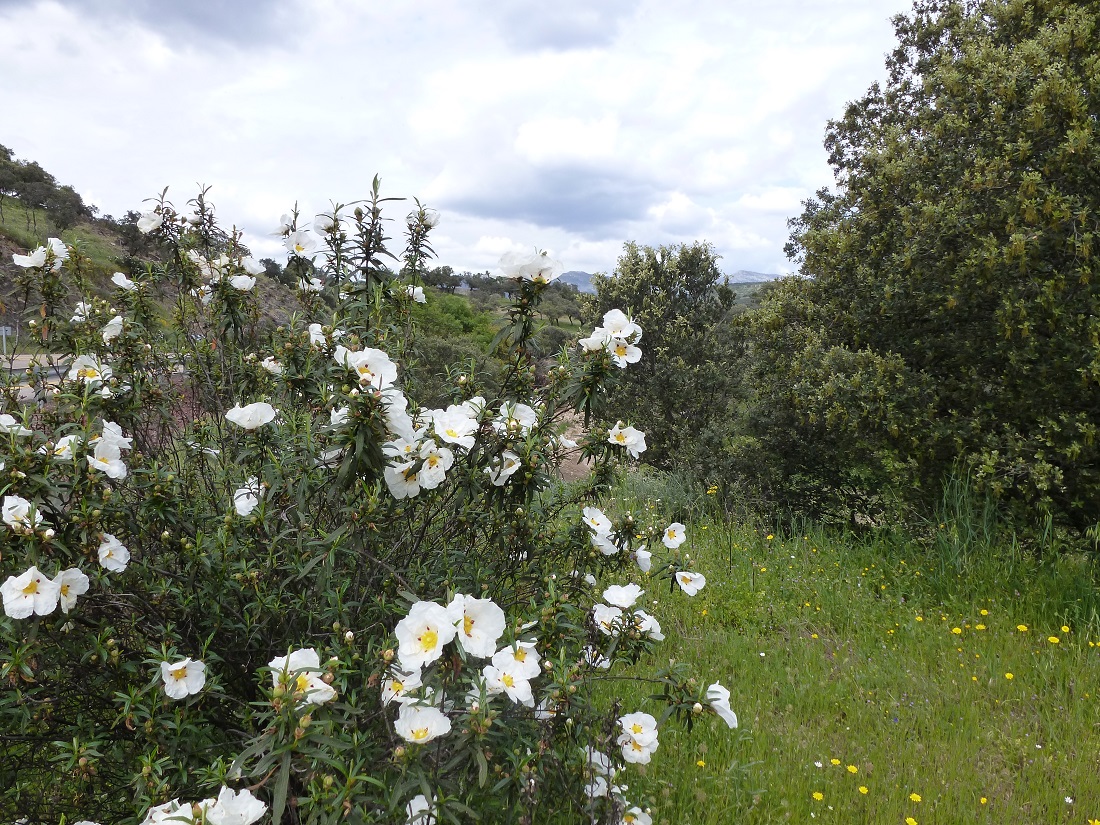
What especially took our breath away were the rock roses (cistus), in full flower; we stopped to admire them (and take photos, of course!).
Cistus on N 420 north of Montoro
After crossing over a few easy passes, we suddenly came to a dramatic view of the Valley of Alcudia, which signalled the end of the Sierra Morena.
Valley of Alcudia.
Another short climb and we were bypassing the unattractive coal-mining town of Puertollano. Shortly after Puertollano, we turned east on the CM 413 and followed it across the fertile plain of Campo de Calatrava to Almagro.
Almagro is a quiet town of around 10,000 inhabitants which scarcely figures on tourist routes and yet is well worth a visit. It was once the stronghold of the powerful order of fighting monks, the Knights of Calatrava, to which its owes much of its noble atmosphere, with old mansions bearing ancient coats of arms edging narrow, cobbled streets. The town also has many churches, convents, and monasteries.
Margaret and I had stayed a couple of times in the luxurious, ivy-clad state-run Parador, a 16th-century Franciscan convent in a quiet corner of the town.
This time, however, we chose the Retiro del Maestre, a boutique 26-room hotel on Calle San Bartolomé, in the historic centre of the town and only about 5 minutes’ walk from the stunning Plaza Mayor. The Retiro de Maestre ranks amongst the best of the many excellent hotels we stayed in on this trip. Attentive personnel, spacious and tastefully decorated rooms, all mod cons, a beautiful inner patio, lots of atmosphere (and photos of bullfighters who had stayed there) and a large underground garage. For 130 euros per room, including breakfast and garage, it was a great find.
Patio at Retiro del Maestre Hotel
As soon as we were settled in, we headed for the Plaza Mayor, Almagro’s main attraction and one of the most unusual squares in Spain.
At one end of the square, you’ll find the local town hall, and at the other end, through which we passed, there is a small park with a statue of Diego de Almagro (1478/9-1538), conqueror of Chile.
Rectangular in shape, it seems less Spanish and more northern or central European in character. The explanation goes back to the 16th century when the wealthy Fugger brothers, German/Flemish bankers to Charles/ Carlos V were given rights to develop the nearby mercury mines of Almadén. The Fuggers established Almagro as their base and brought with them fellow countrymen and commissioned the building of the square.
16th-century square in Almagro.
The square’s distinctive features are the green-coloured, two-storeyed wooden, enclosed balconies that frame the two longer sides of the square. The balconies are supported on stone pillars behind which a walkway provides much needed shade from the searing summer heat, and protection from the winter cold. Lining the walkway are all kinds of little shops and bars that spill out into the square.
Almagro square with entry to the Corral de Comedias (17th century theatre) to the right.
Halfway along one of the balconied sides of the square is one of the jewels of Almagro, a small 17th-century theatre, the Corral de Comedias, and Spain’s only surviving theatre from its Golden Age (16th and 17th centuries)
Originally the open courtyard of an inn, its whereabouts was unknown for a long time and was only discovered in 1950. Now renovated, it puts on Golden Age plays during the Festival of San Bartolomé at the end of August and beginning of September; at other times its stages a variety of entertainment
Corral de comedias in Almagro.
We spent a couple of hours in the square, enjoying in particular the sight of families taking the evening paseo (walk) and children playing in all corners. This was heartening in times when TV, social media and other activities constantly challenge the tradition paseo.
One tradition for which Almagro has always been famous is intricate hand-made lace embroidery, possibly a legacy of those 16th-century Flemish settlers. When Margaret and I first visited Almagro we saw groups of ladies seated at their doorsteps doing lace work while watching their children (or grandchildren) and catching up with local gossip. It was a social activity notably absent on this visit.
Lace embroidery in Almagro
When we asked about this, we were told that it was a dying art, that people were otherwise occupied, and that young people were sadly no longer interested in keeping it. The few who still practice the art now do so indoors. You can still see how it’s done in a couple of places e.g. on the Calle de San Agustín, just off the town hall end of the square, and close by there is an excellent Lace Museum (Museo del Encaje).
John: Almagro: if you did not know that you were in a town in Castile, you would swear that this plaza was in a small town in northern Europe. The colours and the open wood structures with their overhangs reminded me of some place in the Netherlands…somewhat appropriate as it was built by bankers from there in the 1600s. Along with the buildings, I enjoyed seeing a lady doing the hand-made lace embroidery. I could not get over the speed that she was working or how she was able to keep organized with so many threads on the go. We ate at one of the many cafes around the plaza and watched the families out for the evening.
On the square, opposite the Corral de Comedias, there is an excellent shop, Artes El Villar, where you can buy all kinds of exquisite lace embroidery. On past visits, we have bought several beautifully embroidered table linen sets there. After buying some more table linen, we enjoyed a pleasant meal on the terrace of a nearby bar in the square, watching children at play. It was late by the time we got back to our hotel. It had been a long and busy day and we were ready for bed. Our street was quiet and the hotel pleasantly warm and inviting. We were soon asleep.
April 26, Day 10 (1) Carmona to Córdoba See Travel Itinerary for a rationale of this trip, a who’s who of those travelling, and our itinerary.
We left Carmona, taking the NIV E5 along the broad, fertile Guadalquivir valley to Córdoba, 105 kilometres (65 miles) to the east. The river was away to our left, too far to see. This flat countryside, known as La Campiña, is dotted with agricultural towns. Surrounding the towns is a patchwork of cereal crops, much of it belonging to large latifundia (estates) whose origins go back to the 13th century when nobles were granted large tracts of land as reward for helping defeat Moorish forces. Most of these lands later became entailed estates, i.e. they could not be broken up.
Most interesting on this road were La Luisiana and La Carlota, two towns founded in the 18th century as part of a programme of agrarian reform. Their primary purpose was to repopulate uninhabited areas of royal land in Andalucía and improve agricultural production which the landed gentry weren’t interested in developing. A secondary objective was to reduce banditry on the main Madrid-Seville road, along which bullion from the Americas travelled. The really intriguing aspect of this programme was the arrival of thousands of German and Flemish Catholics, encouraged by the Spanish Crown with offers of free land, houses, tools, cattle and seeds. To avoid growth of large landholdings, the new owners were prohibited from increasing or dividing their property.
A dozen such towns (aka colonies or settlements) were established, from La Luisiana to La Carolina on the south eastern edge of the Sierra Morena, all distinguished by their rectangular streets, and simple churches and houses. They are a good illustration of attempts at social planning by Enlightenment thinkers in the 18th century. The project had mixed success; about half of the northern Europeans found the heat of Andalusia too much and left (the area between Seville and Córdoba is one of the hottest in Europe). Spanish families came to replace them, but there still remain descendants of the German and Flemish pioneers, as attested by surnames still found in the areas.We arrived at Córdoba by about 10 a.m., crossed the Guadalquivir at the Puente (Bridge) San Rafael and quickly found a place to park just outside the old walls (look for P signs). Margaret and I knew that there were severe restrictions on traffic in the old town, with collapsible pillars in the middle of street entrances to cut off entry to unauthorised vehicles.
Still, we were only about 15 minutes away from the Mezquita, Córdoba’s Great Mosque, and one of the greatest architectural and cultural legacies left by the Moors in Spain. It was consecrated as a cathedral after the conquest of Córdoba by Christian forces in 1236.
The mosque: west wall.
As a bonus, the walk to the mosque took us through the old Jewish quarter, the Judería. We decided to get to the mosque as soon as possible, and leave the leisurely walk through the Judería for our return to our van.
Patio de los Naranjos.
Margaret, John and I had visited the mosque numerous times, but for Leslie, Andrew and Alex, it was a new experience. We bought our tickets in the Patio de los Naranjos (Courtyard of the Orange trees), where ablutions were once carried out by Muslims before entering the Mosque.
Although we were there fairly early, there were already lots of visitors crowding the ticket office. Once inside the mosque, however, it was easy to find space and quiet. The only places where crowds gathered were in front of the mihrab, the niche on the qibla wall indicating the direction of Mecca**, and the 16th-century Christian cathedral (actually choir and chancel) sitting right in the centre of the mosque.
**In this mosque, however, the qibla faces Damascus, home of the exiled Abd al-Rahman I, who arrived in Córdoba in 756AD.
Many people have disapproved of the Christian choir and sanctuary built in the centre of the mosque in the 1520s, claiming that its structure has spoilt the integrity of the mosque’s design.
Church and mosque together
There’s little doubt about that, but there’s no other building in the world that allows us to see so graphically the difference in the architectural practice of two major religions. The nomadic background of the early Muslims in Arabia and the lack of stone building material might have something to do with the horizontal structure of mosques, although general opinion is that their design was inspired by the simple rectangular form of Muhammad’s house, which also served as a mosque. Churches emerged basically from the Roman basilica, a rectangular civil structure used for meetings, e.g town halls or courts of justice.
By chance, the differences in height between church and mosque tell us something of their respective congregations; in the increasingly higher churches from Romanesqueto Gothic, there is a strong element of pride, a kind of reaching for the heavens; the low-lying mosque reflects the idea of submission before Allah enshrined in Islam (Muslim means one who submits him/herself to Allah). The mosque/cathedral of Córdoba does in the religious sphere what the two palaces of the Alhambra in Granada do on the secular level.
Every time we have visited the mosque, Margaret and I have found it a very tranquil place, and this time was no different. Leslie observed that she too felt the same and, to her, the mosque was a much “warmer” building than the immense cathedral in Seville, which we had seen the day before (Travel. Day 9). The mosque is also huge, in fact larger in area than Seville’s cathedral, but being low slung it is more intimate. The open arches lent an air of weightlessness and freedom as we walked unimpeded in whichever direction we chose, unlike a church where our steps are directed towards the altar. The differences between the mosque and the cathedral (and the numerous side chapels incorporated in the outer walls) do not point to the superiority of one over the other; they indicate different roads taken to reach the same God. The mosque of Córdoba represents a unique spot where those roads meet.
The interior of the Great Mosque, Cordoba’s greatest attraction. Completed under al-Mansur.
We were in the mosque well over an hour, but the time sped by. Back outside, we turned left, crossed the Patio de los Naranjos and exited by Puerta de los Deanes to the Calle de Torrijos. Here we headed left, down the slope, around a tall pillar bearing a statue of St Raphael, patron saint of Córdoba, and past a late 16th-century triumphal archway (Puerta de Felipe/ Philip II) and onto Córdoba’s ancient Roman bridge. Actually the bridge, now closed to vehicles, has been rebuilt so many times that the only Roman thing left is the foundations.
At the far end of the bridge is the 14th-century crenellated Torre de Calahorra, housing a museum. Inside, life in 10th-century Córdoba is recreated through audiovisual displays. The museum’s founder and director was a Frenchman, Roger Garaudy, one time French Catholic senator, then Protestant, then Communist and finally Muslim.
If you look downriver as you cross the bridge, you can see remains of old Moorish watermills that were used for grinding flour and watering the gardens of the Alcázar de los Reyes Católicos. You can see the walls of the Alcázar across the road to you right as you look at the mill ruins.
Water mill (the wheel can be seen in the greenery) with Alcázar in background.
After reaching the Torre de Calahorra, we wandered back over the Guadalquivir, which looked quite muddy. By now we were hungry, and I wanted to see whether a bar that I had frequented when I spent time in Córdoba was still there. We retraced our steps along the Calle de Torrijos and turned left past the Hotel Maimonides. In the past, Margaret and I have stayed a few times at the Maimonides. Although the rooms are a little small, it is clean, comfortable, convenient and reasonably priced, and on each occasion we were fortunate to have rooms looking out on the mosque and its belfry right across the road (depending on your sleeping habits, you might find those rooms noisy since this intersection is very busy, and Cordobans go to bed late).
Once past Maimonides and the many souvenir shops selling leather and filigree goods for which Córdoba has been famous since Moorish times, we were in the Judería. We did the tourist thing and looked at some leather shops, and then hunted for the bar. Fortunately, I have a fairly good sense of direction, and it didn’t take long to find it: Taberna Rafaé on Calle de los Deanes, 2. It hadn’t changed a bit … very much a local bar less frequented by tourists. I had liked the food there, fulsome with little fuss. We all decided on take-out Spanish omelette bocadillos, and they didn’t disappoint … big chunks of omelette in crunchy, chewy baguettes, all washed down with cold bottled water.
As we ate, we wandered through the labyrinth of narrow, white streets for which Córdoba’s Judería is well known.
Street in La Juderia.One of the favourite “photo ops” in Cordoba. The Calleja de las Flores with a view of the Renaissance belfry that replaced the minaret in the 16th century.
As in Seville’s Judería, we glimpsed beautiful, flowered patios behind wrought-iron doorways, and heard the occasional murmur of a fountain. Eventually, we found our way to the 14th-century synagogue, one of only three remaining in Spain.
Córdoba: Synagogue entrance.
It’s on the Calle de los Judíos, but you have to be alert because its entrance is very small so you might easily miss it. Inside, it’s tiny and although some attempt was made to control entry, it was crammed with tourists.
After the synagogue, we returned to our van; it was time to head for Almagro, where we had accommodation reserved for the night. For other places to visit in Córdoba, seeVisiting Córdoba.
April 25. 2013. Day 9 (2). Seville. See Travel Itineraryfor a rationale of this trip, and a who’s who of those travelling. For Day 1 in Seville, clickhere
For a quick lunch, we bought ham and cheese bocadillos and ate them under the shade of some trees.
Our next destination was the Alcázar or Reales Alcázares, a Moorish palace and garden with added Gothic, Renaissance and Baroque elements. Its most famous part is the 14th-century Palace commissioned by Pedro el Cruel (ruled 1350-69) and carried out by Mudéjar artisans (Muslims living under Christian rule), some of whom may have earlier worked on theAlhambra Palaceof Granada. The Reales Alcázares were one of Pedro’s favourite residences where he spent time with his mistress, María de Padilla (both are now buried in the cathedral). (Another favourite residence of the king was his palace in Carmona, now the parador where were staying.)
Unfortunately, when we got to the Alcázar, there was a very long line-up and it was warm and the prospect of queuing at least an hour in the heat was daunting. So regretfully we gave it a miss. “Too many tourists,” we said, well aware of the irony of our comment. The number of tourists at this time of the year (end of April) was a major surprise for us. We had expected that by avoiding the high summer season we would meet relatively few visitors. But in Barcelona, and Granada, and even Cuenca, we had run constantly into long line-ups, and now in Seville at both the cathedral and the Alcázar we were faced with discouraging queues. (PS Statistics show that a record number of foreign tourists visited Spain in the first six months of 2013).
Instead, we decided to walk to the Plaza de España, which impressed us when we passed by it in our horse and carriage ride earlier. It took us about 20 minutes, wending our way through the Alcázar gardens and around the former tobacco factory, an impressive 18th-century neoclassic building, now part of the University of Seville, and on to the Avenida Isabel la Católica.
The Plaza de España was built to house the Spanish Pavilion for the 1929 Ibero-American Exhibition, and borders the North West end of the beautiful María Luisa Park. It was the centrepiece of the Exhibition, meant to impress visitors with a stately display of Spanish enterprise at a time when Spain was no longer an important international player. The Plaza was fairly empty when we were there, but it’s easy to imagine it full of people during the paseo, the traditional walk between 7 and 10 p.m. in Andalusia. It’s a beautiful setting to see and be seen. Looking at it from the centre, we all agreed that this square was truly beautiful.
Plaza de España.The large fountain in the middle of the square adds a cooling touch, and I imagine that in high summer, when the temperatures can pass 40 Celsius, simply the sound of the water can be refreshing.
Here you have to forget the idea that all “plazas” are “square” (the usual translation). The Plaza de España is semicircular, the outer side consisting of a stunning, curved, brick and tile building, with two ornate “wedding-cake” towers closing off each end. In the middle, two smaller versions of the end towers flank the central, main building. Running along the lower floor are a series of open arches or arcades that lighten the long structure and give it an exotic, flamboyant air.
Plaza de España
Adding to its beauty is a canal that follows the curve of the “square” with an elegant balustrade on its outer side and shrubs and flowers on the inner side. As we got closer, we realised that there were people boating on the water, creating a kind of mini-Venice scene for me, even to the point of having a couple of bridges that could be taken for imitations of Venice’s famous Rialto bridge.
Plaza de Espana. Canal and bridge.
By the time we had wandered around the square and taken some photos, we were ready to sit down, and we found just the place… a series of stunningly tiled benches running along the base of the building. Backing each bench are colourful ceramic depictions of historic scenes from towns in each province of Spain in alphabetical order, beginning with Alava and ending with Zaragoza. On the ground, in front of each bench, there is a tiled map of the province where each town is located. The ceramic tiles (azulejos), so typical of Seville and Andalusia, also appear on the main building, the balustrades and the bridges, bringing a unifying element to the square.
Plaza de España. Ceramic bench. Scene depicts Ferdinand and Isabella receiving Columbus on his return from his first trip to Las Indias (The Americas).
Plaza de España. Ceramic work detail.
It was time to move on, back to the ancient Barrio de Santa Cruz, aka La Judería, the old Jewish quarter just off the cathedral.
Street in Barrio de Sta. Cruz
The Barrio is a tangle of narrow streets opening to intimate squares; there are churches, restaurants and numerous tapa bars. Some of the streets are so narrow that you can walk along them touching both sides. Others are wider and lined with orange trees which offer year-round shade since they don’t lose their leaves. Windows are full of flowers, especially geraniums, and if you look through the open doorways, you can see gorgeous patios with walls festooned with potted flowers and in the centre quite possibly a small tinkling fountain surrounded by plants. This is where Sevillanos retire during the heat of summer. Lower windows are regularly covered with beautiful wrought-iron grilles (rejas), where in the past it was common to see a young man (novio), during the evening hours, paying court to his lady (novia) chastely seated in the shadows inside. In many ways, this is “romantic” Seville, not far from Carmen’s tobacco factory and, appropriately, where you will find a statue to Don Juan, the archetypal seducer (in the Plaza de Refinadores).
Church of Sta. Cruz from La Giralda.
We soon got lost in the labyrinth, but that is part of the magic of the Judería now, where every turn is a discovery. But if you are looking for something specific, such as the house of one of Seville’s most famous painters, Bartolomé Murillo (1618-82), you might feel frustrated since the names of some streets are difficult to locate.
Pulpit from which Vicente Ferrer, main instigator of the 1391 pogrom preached, in the Patio de los Naranjos.
Romantic Barrio de Santa Cruz also has a sinister side. In 1391 it witnessed an outbreak of anti-Semitism that culminated in a pogrom leaving thousands of Jews dead and thousands displaced and traumatised. Attacks on juderías spread rapidly throughout the country, and large numbers of demoralised or terrorised Jews saw no recourse but to convert to Christianity. Almost overnight the judería of Seville, one of the largest and most active in Andalusia, became a shadow of its former self. Later, in 1481, Seville saw Spain’s first “auto-da-fe,” the public burning of six alleged heretics at the hands of the infamous Inquisition.
Our walk back to the van, parked under the Plaza de Armas bus station on the banks of the Gudalquivir River, took us past the cathedral and the Real Maestranza, the famous bullring.
The bullring from the Giralda.
We stopped for a moment, to imagine the spot where Carmen met her untimely death at the hands of her spurned lover, don José, while her current lover, the matador/ torero Escamillo was acclaimed by the crowds.
Seville La Maestranza Bullring. http://virtourist.com
Our return to Carmona was uneventful, except for a large roundabout which had traffic lights within the circle itself. That, and the disconcerting habit of Sevillanos, to dart across the lanes in the circle to get off, elicited more than one expletive!
Back in Carmona, Margaret and I went to the patio for a relaxing cup of tea and delicious chocolate cake, while John, Leslie, Andrew and Alex made their second trip into old Carmona.
Carmona. Parador patio where we had our tea and chocolate.
Margaret and I were still sitting there when JLAA returned. Andrew and Alex were ready for their tea and cake, which didn’t surprise us; tea time is a well established ritual in our house.
April 25, 2013. Day 9. Carmona Seville. See Travel Itineraryfor a rationale of this trip, and a who’s who of those travelling.
We were up early for a buffet breakfast in the parador’s dining room. Paradores typically serve hearty and generous breakfasts, just what we needed before heading for Seville. But we surprised by a long line-up at the door, something we’d never experienced in our years staying at paradores. It turned out that there was a package tour staying at the parador, a new phenomenon in the state-run hotels we were told.
When the paradores were established in the 1920s, they were intended to attract more affluent Spaniards to visit lesser travelled areas of Spain and thereby provide a boost to the local economy. They specialised in renovating historical buildings, especially castles, which proved a master stroke. Who doesn’t like staying in a castle! With the explosion of foreign tourism in the 1960s, they continued the same policy, with wealthier foreign visitors added to their clientele. Now, with Spaniards cutting back on travel and fierce competition with boutique hotels (many also in historical buildings), the paradores are in catch-up mode. If you are interested in the future of the paradores, see http://travel.nytimes.com/2013/03/03/travel/spains-paradors-face-an-uncertain-future.html?pagewanted=all&_r=0
We finally got our table, enjoyed our breakfast, then set off for romantic Seville, the city of the archetypal lover, Don Juan, and the iconic temptress, Carmen. We wanted to park as near as possible to the Torre del Oro (Gold Tower) on the banks of the Guadalquivir River. Happily, the helpful personnel at the desk in the parador suggested parking under the Plaza de Armas bus station.
We took the N-IV, a flat road cutting, at first, through fields of wheat, sunflowers, and orange and olive groves. As we approached Seville, we met the inevitable urban sprawl that accompanies large cities … nothing romantic about that. Following the instructions given to us in Carmona, and helped by “Olivia” our GPS, we found the bus station without much trouble.
Guadalquivir River and promenade.
It was just over a kilometre from the Torre del Oro, and we strolled to along a beautiful, tree-lined riverside promenade to get to it. We were so busy looking at the river traffic and the brightly painted buildings on the other bank that we missed the 18th-century Plaza de Toros –Spain’s oldest and one of its most prestigious bullrings- across the road from the promenade. Luckily we caught it on the way back to the van.
The promenade is part of a massive sprucing up of Seville, which began when it was chosen capital of the autonomous community of Andalusia in 1982. Then in 1992 it hosted Expo 92, and large sums of money were invested in cleaning up the city and on its infrastructure: new bridges along the river, bus stations, and railway station to accommodate the super-fast AVE train from Madrid (completed 1991), and an upgraded international airport.
Since we were last in Seville, it has become something of a “green city.” In 2007 a major pedestrianisation of the centre was undertaken, and bike-sharing -with dedicated bike lanes—and a sleek tram line were inaugurated. Two years later a subway line was opened connecting the centre with the southern and western suburbs and more lines are planned to be in operation by 2017. Also, you can rent an electric car. However, Old Seville is made for walking, and if your time is limited –as it was for us- most of what you will want to see is within easy walking distance from the Torre del Oro.
Looking at the twelve-sided Torre del Oro standing alone near the busy intersection of the San Telmo Bridge and the Paseo de Cristóbal Colón (Christopher Columbus), you might wonder what purpose it once served.
Torre del Oro to the right. The modern Pelli tower to the left has been criticised for spoiling Seville’s skyline.
It was in fact built in the early 13th-century by the Almohadsfrom the Morocco as part of their defence system when they established their capital of al-Andalus in Seville. It was originally linked by chain to a similar tower on the other side of the Guadalquivir, in order to control river traffic and access to the inner harbour. Its name derives from the golden tiles (azulejos) that used to decorate it. After a colourful history and threats of destruction (which was prevented by popular opposition), it has become, like the Giralda Tower, one of the iconic symbols of Seville, and its future seems secure. Now it houses a small maritime museum.
Crossing the road, we headed for the cathedral. On the way we saw several horse carriages –all shining immaculately and with colourful blankets for added comfort — and decided spontaneously to take a 50/60-minute tour.
It was a lovely, warm day, and the chance of seeing something of Old Seville while relaxing in a buggy was appealing. Five of us shared the carriage and John sat alongside the driver. It’s amazing how calm the horse was on those occasions when we entered traffic, even when negotiating busy roundabouts.
Seville: Our horse and carriage.
The ride first took us past the luxurious Hotel Alfonso XIII, into the María Luisa gardens and then on to the Plaza de España. All three were built to receive visitors for the 1929 Ibero—American Exhibition.
Seville: Hotel Alfonso XIII.
The hotel was commissioned by the king himself to accommodate royalty, heads of state and other VIPs, and is still considered one of the most prestigious hotels in Spain. The façade is regal and impressive, a combination of classical Renaissance style and Moorish tile work and arches; both feature prominently in the history of Seville.
The María Luisa park was actually a development of a pre-existing smaller park donated to Seville in 1893. It’s huge, with numerous avenues, arbours, ponds and tiled fountains, and pavilions (many originally built to house displays from the various Latin American countries taking part in the Exhibition).
Mudéjar pavilion in Parque María Luisa.
What particularly appealed to us was its lush vegetation of magnificent palms and orange trees, plane trees and magnolias, as well as its flower beds and fountains. Every now and again, we spotted parakeets and peacocks, and lots of doves, and the ponds were home to ducks and stately swans. It’s easy to see how popular this park is as an escape from the searing heat of high summer; it’s an oasis that enchants with varied colours, the tinkling of water, the chatter of birds and cooing of doves, and the aroma of oranges or flowers. There is no better way for you to experience the sights, sounds and aromas of the park than in an elegant horse carriage
Mudéjar pavilion in Parque María Luisa.
There was no time for the carriage to stop at the stunning Plaza de España which runs along one end of the María Luisa Park (familiar perhaps to fans of Star Wars Part I). Time was getting short, and our driver was going to drop us off at the cathedral. On the way, we passed the University of Seville, the main building of which is an enormous 18th-century neo-classical structure that once was the Royal Tobacco Factory, still believed to be one of the oldest industrial buildings of its type in existence in Europe. Aficionados of opera may recall that Bizet’s fictional Carmen, the fiery Gypsy, was a tabacalera (cigar maker) in this building before her death outside Seville’s bullring.
At the cathedral, we said good-bye to our driver and the horse, stretched our legs and got ready to enter the largest Gothic church in the world. Actually it is the largest church in the world, larger than St. Paul’s in London or St. Peter’s in Rome, according to a copy of a certificate from the Guinness Book of Records, proudly displayed near the entrance.
The cathedral was started in 1402, replacing the 12th-century Almohad mosque, and took over a hundred years to complete (in fact, some sections were not finished until the 20th century).
While the exterior is quite recognisably Gothic, the inside also contains a fair amount of plateresque and Renaissance classic styles. All that is left of the mosque is the minaret (the famous Giralda tower) and the Patio de los Naranjos (Orange trees) where ablutions were carried out. Together with the nearby Alcázar and Archivo de Indias, the Cathedral of Seville is a World Heritage Site (UNESCO 1987).
Seville cathedral and Giralda
There was a fairly long queue to get in. Once inside, we noticed how chilly and gloomy it was compared to the sunny warmth outside. It also took a while to get our orientation, because we entered from the side rather than from the main entrance at the back of the church.
Like most large Spanish Gothic churches, the Cathedral of Seville has a large enclosed choir in the middle of the central nave, cutting off direct view from the back of the church to the altar. It was difficult to get a sense of the length of the building until we stood at the end of one of the side aisles. Then we understood what the cathedral chapter is alleged to have said when they commissioned the cathedral in 1401: to erect a building so “magnificent in scale that posterity will believe we were mad.” That magnificence is conveyed especially by the height, with the central nave rising 130 feet (42 metres). The pillars supporting the pointed ribbed vaults are massive yet appear elegant thanks to their height and to the fluting that breaks up the solid mass of the surface.
Cathedral side aisle. Note fluting on pillars to the left. Organ to the right.
We all found the huge high altar –separated from the worshippers by a large ornate wrought iron screen (reja)— stunning but rather overwhelmingly flamboyant. Apparently, it tells the story of Christ’s life, but it is so elaborately worked and lavishly gilded that it was difficult to follow the details. Small wonder it took almost a 100 years to complete (1481-1564)!
Cathedral High Altar.
We were all interested in finding Christopher Columbus’s tomb, which we eventually did near one of the side entrances. The coffin is not buried but actually carried on the shoulders of four figures, each representing the regions of Castile, León, Aragón and Navarre, which made up the bulk of the forces that conquered Seville in 1248. There is dispute about what happened to Columbus’s remains: he died in 1506 and was buried initially in Valladolid (Castile). His remains were then transferred to Seville. Now things get complicated: respecting Columbus’s wishes to be buried in the Americas, members of his family asked that his remains to be transferred to the cathedral at Santo Domingo in Hispaniola (modern Haiti and the Dominican Republic), the site of Columbus’s first landing in Las Indias. His coffin was accompanied by that of his son Diego. Later, his grandson, Luis, was buried in the same cathedral. In 1795, the French took over Hispaniola and Columbus’s remains were transferred to Cuba to stop them falling into French hands. When Spain lost control of Cuba in 1898, the coffin was returned to Spain, ending up where it is now.
Columbus’s tomb.
However, in 1877 another coffin was unearthed in the cathedral of Santo Domingo bearing the name of Columbus, which leaves us with the vexing question of authenticity. DNA samples taken from the Seville coffin in 2002 match closely the DNA of Columbus’s brother, Diego, also buried in Seville’s cathedral; the Dominican Republic has refused to submit its remains to a similar test. As some observers have commented, it is possible that bits of Columbus’s bones may have ended up in both coffins, so that both claims might have merit. However, until the DNA of Santo Domingo bones are examined, Spain has the better claim. Whatever the case, Columbus seems to have travelled almost as much after death as during his life.
After having tracked down Columbus’s monument, it was time to move on to the Giralda. There were still numerous side chapels to see, paintings to contemplate and treasures in various parts, but we were getting close to information overload. The one chapel that I especially did want to look at: the Royal Chapel (Capilla Real) in the apse behind the High Altar. Unfortunately, it was open only to worshippers and its entrance closed off. I was particularly interested because it was the resting place of Fernando III of Castile, who won Seville back from the Moors in 1248, and of his son, Alfonso X “el Sabio” (the Learned). In the vault beneath the chapel are buried Pedro el Cruel and his mistress María de Padilla. All figure prominently in the history of Spain.
Disappointment over, we headed to the Giralda, whose entrance is in the north-east corner of the cathedral.
La Giralda. The tower takes its name from the bronze weather vane representing La Fe (Faith). It was added in 1568
The Giralda is perhaps the most famous monument of Seville, and is for the city what the Great Mosque is for Córdoba and the Alhambra for Granada. Built in the late 12th century, the Giralda, formerly a minaret, became the church bell tower after the reconquest of the city in 1248. The narrower upper parts were added in the 16th century (1568) and topped by a bronze weather-vane called “The Triumph of Faith,” giving the tower a total height of 94 metres (308 feet). It is from the weather vane that the Giralda gets its name (from “girar“: “to rotate”)
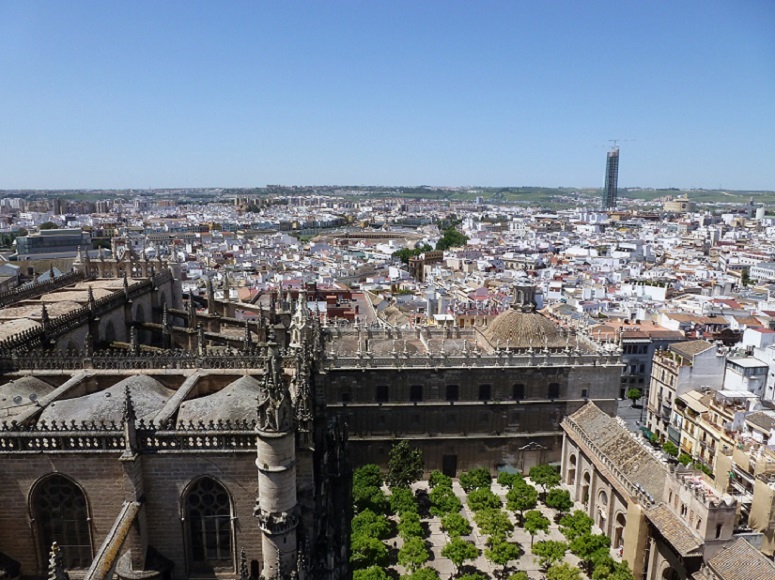
We joined dozens of others climbing up the gently sloping ramps which are just wide enough to allow two way traffic. There are window alcoves you can stop at for views or a break. Near the top, you meet a few stairs and then you are out in the open where you get stunning views of the city, the roof of the cathedral and below you the Patio de los Naranjos (Courtyard of the Orange Trees).
View from top of the Giralda. Cathedral roof and Patio de los Naranjos in foreground; the Pelli Tower in the distance.
Towards the west, and across the Guadalquivir, you can’t help noticing a 180 metre (590 feet) skyscraper dwarfing everything around it. This has caused a lot of controversy, even threatening Seville’s UNESCO’s World Heritage status (at a meeting in June 2012, UNESCO withdrew its objections, but sought assurances that no more skyscrapers would be built in Seville. See http://www.theolivepress.es/spain-news/2012/06/28/sevilla-escapes-unescos-world-heritage-black-list/. Until the construction of the skyscraper (aka Pelli Tower), the Giralda was Seville’s highest building.
With the visit to the cathedral and the Giralda over, we still had a fair amount of walking to do, but first a break for lunch was in order (and I need a break from writing this page!!). For a continuation of our visit to Seville, see: Travel Seville 2
April 24, 2013. Day 8. La Hoya to Carmona. See Travel Itinerary for a rationale of this trip, and a who’s who of those travelling.
We left Fuente del Sol reluctantly, wishing we had another day there. Our destination today was the beautiful old town of Carmona, about 60 kilometres east of Seville. Most of the route was along secondary roads, via Alora, Campillos, Osuna and Marchena.
We departed early after a good buffet breakfast at Fuente del Sol. It was a beautiful day, with wisps of cloud drifting high in the sky.
On road between La Hoya and Alora
We think spring is the best time to visit Andalusia, with the countryside clothed in green and sparkling with wild flowers, and the temperature warm and comfortable. In the summer you can expect temperatures in excess of 40 centigrade, the vibrant colours are muted, the green turns ochre and even high in the mountains you’ll be looking for shade. John: We reluctantly left the village of La Joya and drove the back roads to Carmona along the A343 and the MA444. If you have the time, this is a beautiful drive. The road is a windy one that takes in a number of elevations, but the views are well worth the extra time. We were there in April and the wild flowers were in full bloom. When the windows are open, the smell of Spanish Broom is intoxicating.
As we left Fuente del Sol, we noticed how prosperous the area appeared to be despite the poor economic condition of Spain in general.
La Hoya: Street.
The cortijos (farms) seemed to be flourishing with shining, whitewashed buildings, and some with new, modern additions. There were several new houses dotting the landscape, and the village of La Hoya had an air of well-being with the streets clean and well-cared for.
On the picturesque road to Alora, we passed fields of winter corn and whitewashed cortijos gleaming in the sun. As we approached Alora, the crops changed to aromatic lemon and orange groves carpeted with wildflowers. We were now going through the appropriately named Valle del Sol (Valley of the Sun).
Alora: Citrus trees and wildflowers
Suddenly Alora came into view, the ruins of its 14th-century Moorish castle silhouetted dramatically on a hill above the whitewashed town.
Alora: Castle to the left.
We bypassed Alora, turning sharply right in the outskirts and started our way up the fertile Guadalhorce valley towards the village of El Chorro.
Fairly quickly the valley narrowed, the mountains closed in and the road twisted and turned. We were approaching the Garganta (i.e. neck) del Chorro (also known as Desfiladero de los Gaitanes) a narrow gorge carved out by the Guadalhorce river. In the gorge, I felt trapped by the sheer 180 metre (600 feet) walls rising above us and nothing would induce me to take a walk for which this chasm is famous among rock climbers: El Camino del Rey/ The King’s Path.
The drive through the gorge was spectacular, although if driving you have to have your wits about you since the road is very narrow in parts and meeting oncoming traffic can be daunting. (Fortunately for us, John is an excellent driver.) From the gorge, the road winds its way up past pines and eroded rock. Suddenly, we came to a sign I was looking for: Bobastro. We veered left following the sign and rose some 610 metres (2000 feet) through more pines for 6 kilometres (3.5 miles) until we came to a roadside booth to our right: the stop to get to Bobastro. Bobastro was headquarters of the 9th-century rebel Omar Ibn Hafsun. Hafsun, a Muwallad (Christian convert to Islam) apparently dissatisfied by his treatment from his Moorish overlords in Córdoba, rebelled and withdrew into the mountains surrounding Alora. He overcame all attempts to defeat him and converted back to Christianity and built a church in Bobastro. This is what we wanted to see.
After winding our way between trees and rocks, we suddenly came across the church, not a building but an open-air site with a sanctuary hewed out of a massive, grey limestone rock. It’s hard to believe that there was any building here, since all signs of walls and pillars have completely disappeared. In fact, I wonder if there ever were any walls or pillars at all.
Bobastro, remains of the church cut out of rocks. Seen from above.
What’s interesting of what’s left is the horseshoe arch in the centre of the carved rock. This may have been influenced by the horseshoe arches from Córdoba’s Great Mosque (the first part of which had already been built) but it more likely harkens back to the horseshoe arches of Visigothic churches, which predate the mosque in Córdoba. In fact, it has been argued that it belonged to a Christian community that survived in this isolated mountain spot of al-Andalus (Muslim Spain) after the arrival of the Moors; others feel it was built by Ibn Hafsun after his conversion to Christianity and is therefore a Mozarabic work (Mozarabs were Christians who lived under Moorish rule).
Bobastro. Horseshoe arch in centre.
View from Bobastro
Another view from Bobastro.
Further uphill there are faint ruins of a small fortress, which suggest that the area also had a defensive role. It’s not hard to imagine how difficult it would be for an army to attack successfully any fort in these mountains. The spot looked virtually impregnable with views everywhere that would quickly betray the presence of enemy forces.
After returning to the road, we decided to continue uphill to look for the fortress; it was one of those inspired decisions. The mountain flattened out and we were treated to incredible views. In one spot, we ran into a Welsh expat couple dismantling their short wave radio: they had apparently been talking to relatives or acquaintances in New Zealand. Small world! They and I were from South Wales and inevitably we had a conversation about our respective areas. After leaving them, we continued our way to the very end of the road where we found, to our delight, a bar-restaurant dramatically perched on the edge of a precipitous drop. We had lunch outdoors at Bar La Mesa (as it was called): a hearty, cholesterol-loaded plate of pork, sausages, eggs and thick potato quarters, all swimming in olive oil.
View from Bar La Mesa.Another view from Bar La Mesa.
We needed a walk after that lunch, and went to find the fortress nearby. There was hardly anything visible, only traces of foundation walls engulfed by undergrowth and flowers.
Remains of fortress near Bar La Mesa.
It was exhilarating there, on the mountain top, although we had to be careful not to sprain an ankle on some stones hidden in the long grass. If you are anywhere in this area and have transportation, don’t miss out on this side-trip to Bobastro and Bar La Mesa.
On our way up to Bar La Mesa, we’d noticed to our left a large reservoir. At Bar Mesa, we were told that its water tumbled down the mountain in a huge pipe to generate power for Málaga. In an area so steeped in ancient history, this modern construction looked out of place.
John: Bobastro: While the structure itself was interesting, the drive up the mountain and the views that it provides makes this side trip well worth it. If you have gone this far, don’t return until you have gone to the very top. From there, you can see straight down at the Garganta del Chorro and there is a little restaurant, Bar La Mesa, where you can get old style Spanish country cooking. I can recommend the Spanish tortilla.
From Bobastro our road took us almost to Ardiles, where it joined the A 357 heading for Campillos. For several kilometres, we skirted two (of the three) reservoirs created by the Guadalteba-Guadalhorce dam. Approaching Campillos, we could see, silhouetted in the distance to our left, the castle of La Estrella perched above the hilltop town of Teba. Soon we were bypassing Campillos, an agricultural and leather manufacturing centre. The town seemed to be prosperous, with new buildings and (rather unattractive) row houses, but whether they were occupied is another matter. The construction boom that collapsed in 2008 left thousands of buildings unfinished or empty as contractors ran out of funds or buyers were simply unable to keep up payments.
After we turned left towards Almargen, we were into rolling hills with olives and vineyards, and wildflowers colouring the roadside. At Almargen, we turned north on the A441 towards the historic and former university town of Osuna.
July 2014. Osuna and Seville are to feature as locations for the fifth series of the fantasy Games of Thrones. The news has been greeted with great enthusiasm. Osuna, along with the rest of Andalusia, has very high unemployment, over 25%. Residents hope, not only for jobs as extras etc., but that the popularity of Games of Thrones will also trigger growth in tourism.
I’m sorry we had no time to stop at what one travel writer has recently described as “one of the most beautiful small towns in Andalusia [and] one of the best preserved […] as yet scarcely … affected by tourism” (Jacobs 318).
From Osuna, we quickly made our way on the A 92 (Seville highway) across wheat fields to La Puebla de Cazalla. Here we turned North West on the A 380 to Carmona via Marchena in the wide, fertile Guadalquivir valley.
Approaching Carmona, we could see the town rise dramatically on a bluff overlooking the valley. Dominating the view was the ancient castle transformed by Pedro the Cruel into a sumptuous residence in the 14th century. Now part of it houses the very popular state-run Parador de Carmona, where we had reserved accommodation for two nights.
Carmona. Parador.
It was late afternoon when we checked in to the Parador.
Carmona. Entrance to the Parador. Andrew and Alex keeping guard!
Our accommodation overlooked the valley we had just crossed, but we were unable to appreciate the extensive views at first because both rooms were permeated with strong air-freshener. We had to leave windows and doors open for a cross breeze to get rid of the smell, which fortunately didn’t take long.
After settling in, John, Leslie, Andrew and Alex opted for a walk in the old town; Margaret and I felt a cup of tea on the terrace would be just the thing. We had stayed at the Parador on two previous occasions during which we had strolled through the beautifully preserved town. John: As we drove into Carmona on the A380, we could see the Parador dominating the plain. It is an old palace built by Pedro the Cruel and it is very beautiful. You park in the courtyard beyond the massive stone walls of a ruined castle and you can just feel yourself going back in time. Our rooms looked out over the plain as opposed to the city, but I would say that the best views were out over the pool and beyond. The pool itself is situated below the restaurant and looked gorgeous, unfortunately, despite it being very warm, the pool does not open until May.
We had dinner at the Parador, talked about what we had seen on our trip from La Hoya and the drifted off to bed. Tomorrow we were off to Seville, and as the Sevillanos say, “Quien no ha visto Sevilla, no ha visto maravilla,” “Who hasn’t seen Seville, hasn’t seen a marvel” (Afraid the English doesn’t rhyme as well as the Spanish!)
April 23, 2013. April 23. Day 7. Granada to La Hoya. See Travel Itineraryfor a rationale of this trip, and a who’s who of those travelling.
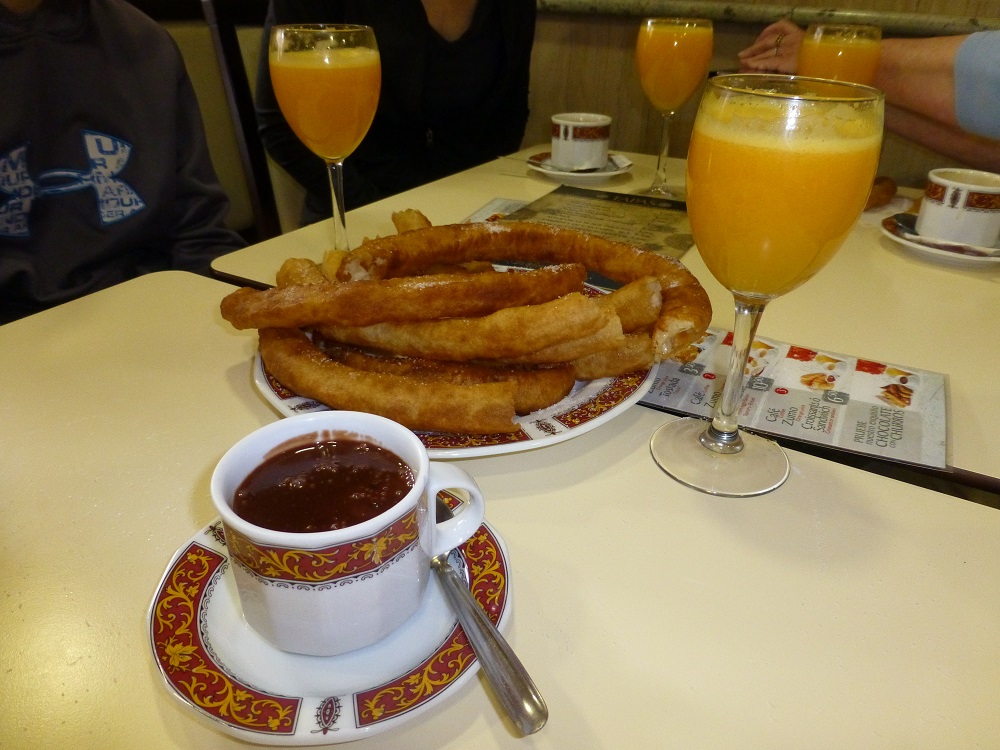
It was time to leave Granada, but first a walk to the Plaza Bib-Rambla for breakfast. We had a particular place in mind: John had seen a churrería in one corner of the square and churros are a favourite of ours. They are made of the simplest of ingredients: flour mixed with water, deep fried oil, a pinch of salt and perhaps a touch of baking powder for leavening.
Churros in Granada
Traditionally, the dough mixture was pressed into large loops or strips through a big pastry bag into very hot oil and fried until golden brown. Nowadays, machines have replaced the pastry bag, although in country fairs you might still see the old method used.
Churros should be eaten hot, immediately after purchase; they are usually sprinkled with sugar or cinnamon and accompanied by hot, thick chocolate into which you dunk the sweetened churros. When I was teaching in Granada in 1987-88, I used to stop at a corner near the market where an older lady made the most delicious churros the traditional way (no chocolate, although I could pop along to a nearby bar for that if I wished). I stopped there for my morning ration almost every day and we got to know each other. There were now, she said sadly one time, far fewer people selling churros on the streets like her. When I called by a few years later, she had gone, and so it seems have others like her.
All isn’t lost, however. Churros continue to be a breakfast tradition in bars and restaurants. You can also get them in the late evening, and any public fiesta is sure to have a churro stall.
The churrería in the Plaza de Bib-Rambla, didn’t disappoint. We were there early, and Churrería/ Chocolatería Alhambra was just opening and the oil just heating.
Churrería Alhambra Plaza Bib-Rambla
We watched the fascinating process of preparing the churros from beginning to end, and by the time the piping hot churros appeared on the table my mouth was salivating overtime. Nutritionally churros are limited, but with some exquisite freshly-squeezed orange juice, and a large portion of delicious churros con chocolate, we were ready to face the day. Total cost of breakfast for the six of us: 26 euros.
Bringing out the churros. Perfect!
John: We took a walk over by the Cathedral before leaving Granada and there we had the best churros I have ever had. The place was called ChurreríaAlhambra Chocolatería and our order was made in front of us. The churros were warm, the chocolate dip delicious and the freshly squeezed orange juice refreshing. We felt very Spanish, although it is probably a good thing that we left Granada as I think that I would have spent way too much time there and that would not have been good for my waist line. Andrew: Near our hotel in Granada there was a really yummy place to have churros and chocolate. You could see the lady making it. They also had freshly squeezed orange juice which was delicious.
NOTE: when I first tasted churros in northern Spain years ago, they were thin and furrowed and generally served either in strips or looped like ℓ (so that several churros could be strung together to take home as was often the custom). When I suggested to the lady in the photo in Granada that what she was serving were really porras, she was quite categorical: she was serving churros! Personally, I still call them porras, but in Andalusia apparently they are churros. I wasn’t going to argue.
After breakfast, it was back to the hotel to collect our luggage and sign out. Then we had to get our luggage to our van, which we had left the night before in an underground garage on the western outskirts of the city. There was no way we were going to repeat the experience of getting our wide van down the curved ramp of our hotel, Monjas del Carmen (see Travel 4). We called two taxis to the hotel from the stand in the Plaza Nueva nearby, found the van, quickly loaded it and were on our way.
We were heading for La Fuente del Sol, a hotel/spa near the village of La Hoya (sometimes La Joya) a few kilometres south west of the old town of Antequera, in the province of Málaga. The A 92 Seville road from Granada is fast and within about an hour we arrived at Antequera, having by-passed Loja and Archidona. Just before Antequera, we saw an imposing cliff to our right known locally as La Peña de los Enamorados: The Lover’s Cliff. It was named after a popular legend of two star-crossed lovers, one a Christian soldier, the other a Moorish princess. The princess and the soldier had fallen in love when she cared for him after he had been captured by her father’s soldiers. Since their love was unacceptable to both sides, they fled but were soon pursued by the princess’s father and a band of soldiers. At the same time, the young Christian soldier’s father had decided to attack Antequera. The young lovers, finding themselves trapped between the two armies, climbed to the top of the cliff, embraced and threw themselves over. Grieving, both fathers decided that they would no longer fight over Antequera.
Antequera sits on the edge of a fertile plain and the hills of the Sierra de Chimenea. On its outskirts are three of the most important megalithic dolmens of southern Spain. In the 16th century, it underwent a flurry of building and enjoyed its status as a cultural centre. It declined in the 19th century (as did much of Spain) and only recently has recovered its vitality thanks to tourism and its agricultural products (vegetables, cereals, olives). It is conveniently situated between four major Andalusian cities, Seville (132 kilometres, 82 miles), Granada (109 k, 68 m), Málaga (51 k, 32 m) and Córdoba (98 k, 61 m).
Antequera with La Peña de los Enamorados in the background to the right.
“Olivia,” our GPS, negotiated us successfully through Antequera on to the A 343 in the direction of Alora. We stopped on a hill just outside Antequera for some terrific views of the town, with the dramatic Peña de los Enamorados in the background. The drive from Antequera was stunning: rolling hills, distant mountains, olive groves, spring green fields, liberally mixed with profusions of wildflowers, and the sound of goat and sheep bells echoing in the clear air.
Olive trees and wildflowers on road to La Hoya.
Fuente del Sol Hotel/Spa.
We turned left off the A 343 after about 10 kilometres (6 miles) onto a narrow road to La Hoya, a typically whitewashed Andalusian village. Fuente del Sol, was idyllically situated on a hillside, about two kilometres from the village.
We arrived at Fuente del Sol by lunchtime (http://www.hotelfuentedelsol.com/ for their web site, also available in English, French and German). We quickly settled in, enjoying great views from our respective rooms of rolling hills, olive trees and scattered cortijos (farms) surrounded by fields of spring corn. Andrew: La Hoya: After eating the churros and chocolate we headed to our next destination: La Hoya. There we were staying in a spa in the hills. From our balcony we could see the town very well. I love being in the country side.
Margaret and I decided to have lunch at the resort; John, Leslie, Andrew and Alex walked down to La Hoya to eat at a local restaurant. After a lovely lunch, we strolled around the hotel grounds, admiring the gardens, frog-filled pond, tennis court and outdoor swimming pool.
A walk beyond the grounds took us to a field of olives trees and flowers; it was full of goats many of which, when they saw us, came streaming to the fence for a closer look.
“Our” goats near Fuente del SolGoats in La Hoya.
Curious and intelligent animals, they never cease to amuse me. The goatherd, too, came to the fence. We fell into conversation over Spain’s economy (“dreadful”), farming (“hard”). He told us that there were around 800 goats in the herd and milking them was a quite a chore. John: Goats do roam! We walked from the hotel/spa Fuente de Sol down to the village La Hoya to find a bite to eat. The village is a quiet little place with a bakery and a restaurant where we ate. (Rincón del Hortelano) The food was good and there was a very welcoming feeling about the place. After lunch, as we were walking through town again, our way was blocked by a shepherd and his herd of goats.
The traffic was stopped and the only sounds that we could hear were the bleating of the goats and the melodic sound of the goat bells. It was a sight and sound from my childhood and I was thrilled to be able to share it with my children.
Andrew: We took a walk after settling into our hotel. Then we went down to the town where we saw lots of cats. We had lunch there and afterwards saw a huge goat herd. It was beautiful to see so many goats.
Heading for the hills from La Hoya.
John:We decided to go for a walk from La Hoya across the hills and to Fuente del Sol…..I got us lost and we ended up creating our own trail “over hill and dale” for two and a half hours. Still, we were treated to beautiful views of the area as well as a different perspective of the village and, of course, tons of wild spring flowers (as it was May). We also discovered and named “Dragon” rock ….all part of our Welsh heritage…
“Dragon” Rock, near La Hoya
Walking back to the hotel, Margaret and I suddenly heard voices calling us from the hill behind the hotel. John, Leslie, Andrew and Alex were zigzagging their way down, avoiding fences and the sheep scattered in the undergrowth.
Sheep on hill behind Fuente del SolFuente del Sol from hill behind
After lunch at La Hoya, they had decided on a round-about hike uphill from the village rather than walk directly back. The hike turned out to be longer than anticipated but none the less very enjoyable. A cup of tea to reinvigorate us and by then Andrew and Alex were ready for a swim. Unfortunately, they had to make do with the indoor pool since the outdoor one was not yet ready for summer use; it would open a week later.
After dinner, we all settled in our suite to watch a football/soccer match that all of Spain would be glued to: Barcelona v Bayern Munich in the semi-finals of the European Champions League, the first leg to be played in Germany. By now the sun had set and it was nippy, so we lit a blazing wood fire and snuggled on the settee and armchairs, a glass of wine within reach for the adults and something lighter for Andrew and Alex. Hopes were high since Barça were past champions and had been virtually invincible all season. Andrew –our dedicated Barça fan—was wearing his Barça scarf and cap that he had bought in Barcelona the week before. Alas, it wasn’t Barça’s night, and they were beaten 4-0. The omens weren’t good for the return match a week later, but with home advantage, Barça might still stage a come-back.
April 22, 2013. Day 6. The Alpujarras. See Travel Itinerary for a rationale of this trip, and a who’s who of those travelling.
After a wonderful day in Granada, we now looked forward to a trip to Las Alpujarras, a mountainous region on the south side of the Sierra Nevada from Granada. It’s a very picturesque area dotted with white villages and scattered farms (cortijos). During our year in Granada (1987-88), Margaret and I had made the roughly 80-kilometre trip to Las Alpujarras several times, and fell in love with the area: its natural beauty, the melodious sound of its numerous streams and waterways, the gentle tinkling of goat and sheep bells, the smell of wood fire, the aroma of bread baked in wood-fired ovens, groves of olives, figs, citrus trees, almond, chestnut and oak trees, the crowing of roosters and chickens clucking round doorways… In all a tranquil retreat after the bustle of Granada. If you have transportation, you really shouldn’t miss Las Alpujarras!
The geography of Las Alpujarras is wonderfully varied: dramatic ravines, lush meadows, steep hillsides with fertile terraces fed by irrigation ditches built by Moorish farmers ages ago, and villages that could be taken for Berber communities in the Moroccan Rif. The comparison is fitting because Las Alpujarras were for centuries the home of Moorish farmers whose predecessors were in all likelihood Berbers who participated in the invasionof Visigothic Spain in the 8th century.
The area remained in relative obscurity as part of Muslim al-Andalus, but after the fall of Granada to the Christians (1492) the threat of forced conversion issued in 1499 provoked the Muslims of Las Alpujarras to rebel. The rebellion was put down and the threat of forced conversion became fact in 1501. Nevertheless, given the isolation of Las Alpujarras, the area became a refuge where the Moriscos (the name given to converted Muslims) retained their Moorish traditions, wore Moorish clothes, and continued to speak Arabic and practice their religion, Islam. However, during the 16th century, growing fears of a Turkish invasion, increased Church vigilance and Inquisitorial activity, the destruction of the local silk industry by export bans and increased taxes, and the confiscation of Moorish land led to an explosive and bloody two-year rebellion, 1568-70. After it was over, thousands of Moriscos were transferred to distant areas in Castile and replaced by Christians from Galicia, Asturias and León. It was an unhappy solution: Castilians suddenly found themselves with neighbours whose way of life was alien to them and Las Alpujarras were opened to people ill-equipped to take advantage of the agricultural infrastructure built by the Moors.
After the rebellion, Las Alpujarras slipped back into relative anonymity. Some intrepid travellers in the 19th century commented on its wildness, but it was a British hispanophile, Gerald Brennan, who did much to promote the area abroad with the publication in 1957 of South from Granada, an account of his experiences in the village of Yegen over 6 or 7 years between 1920 and 1934. In the 1960s, Las Alpujarras became popular with hippies and practitioners of alternative medicine and followers of various religious beliefs. Buddhism found a niche there, as did Sufism, a mystical sect of Islam. Lanjarón, at the western entry to Las Alpujarras, has attracted visitors to its thermal baths and its water, while Orgiva, a few kilometres to the east, is widely known for its yoga and well-being retreat.
A number of British expats have also settled there, including Chris Stewart one time drummer of the rock group Genesis. His book, Driving over Lemons (1999), is a lively and entertaining description of his and his wife’s experiences of living on a farm (cortijo) they bought in Las Alpujarras. It’s well worth a read.
March 10, 2019. There is an interesting article in The Guardian newspaper on Las Alpujarras (or Alpujarra as it is known to some) and the danger its natural beauty faces with a projected electric pylon grid being built through it. The article contains comments by Stewart and others opposing the destruction of the natural beauty of the area. See https://www.theguardian.com/world/2019/mar/10/pylon-row-andalucian-residents-oppose-electrical-highway
Nowadays, Las Alpujarras have become a major tourist attraction for hiking, rock climbing/ scrambling, mountain biking and horse trekking, as well as a destination for bird watchers and herbalists. http://www.alpujarras.eu/ Click Video for an attractive presentation of Las Alpujarras.
*************** Getting ready to leave for Las Alpujarras, we first had to get our van out of the underground garage of our hotel, Monjas del Carmen. John had miraculously overcome the “problema gordo” (big problem: our hotel receptionist’s words) when we were nearly stuck descending the ramp two days before. See Travel 4. Now he had to get us out. It was with some trepidation that we boarded the van and there were lots of crossed fingers as we started the ascent. With side mirrors retracted, John gradually inched the vehicle up, slowly negotiated the curve, a jiggle here … a jiggle there… Finally, we had a clear straight run for the exit, and with a collective sigh of relief we made it onto the street. We still had one night remaining at Monjas del Carmen, but we decided that we would not tempt fate (or raise our blood pressures!) by trying to get the van back down the hotel’s garage. We would look for parking under a shopping mall on the outskirts of the city.
We set off, having calibrated our GPS (aka Olivia). The sky was cloudy, but we had high hopes that it would clear by the time we were on the southern side of the Sierra Nevada. Soon we were heading south on highway N323 in the direction of the Mediterranean coastal town of Motril. On the way, we crossed over the Puerto del Suspiro del Moro, a pass where the unfortunate Boabdil, last Moorish ruler of Granada -casting a final lingering look at the Alhambra in the distance- is said to have paused and sighed deeply. Whereupon, his mother reproached him with the crushing rebuke: “Weep like a woman you who were unable to defend your kingdom like a man.”
At Beznar, about 25 kilometres on, we turned left on to the A 348 for Lanjarón and Orgiva, the two largest towns in the western end of Las Alpujarras. This picturesque road, twisting and turning through olive groves, vineyards, orange and lemon trees, hugs the hill sides. It straightens out a bit through Lanjarón and then continues its serpentine course through more orchards to Orgiva.
Orgiva through the mist.
We didn’t stop at either town; we were anxious to get to our three favourites villages, the pearls of Las Alpujarras: Pampaneira, Bubión and Capileira. Just before we reached Orgiva, we turned sharp left and started a steep, winding climb up the GR 421 threading our way through poplars, chestnuts, gnarled holm oaks and past the occasional eucalyptus. We drove besides water channels and there were potable springs, still a source of delicious water (a note of caution: not all the water is drinkable. “Agua no potable” means “not drinkable water”). Water is the lifeline of the Alpujarras, still irrigating orchards and small fields as it did when the Moors constructed the channels long ago.
Unfortunately, our views were limited because of a persistent mist that lifted only occasionally to allow us brief glimpses of the spectacular scenery.
“What a pity,” Margaret, John and I kept repeating, apologising to Leslie, Andrew and Alex for being unable to show them the magnificent views, which we knew were there from our previous visits. I was particularly sorry when we rounded a corner and couldn’t see, in a wedge-shaped cleft that extends upwards towards the peaks, Pampaneira, Bubión and Capileira glistening white against the green trees and verdant hillsides on which they perched. What a photographic opportunity missed! (Note: photos taken this year are indicated by 2013; the other photos were taken on previous visits.) Alex: The drive up to Las Alpujarras was very beautiful even in the mist. I really enjoyed the views I could see, even the steep drops. John: I love the drive up to Las Alpujarras even though it is a steep and sometimes narrow road that is well travelled by a number of vehicles of varying sizes. We had a misty day, which was a disappointment, but the trip was well worth it anyway.
En route to Papaneira. 2013.Pampaneira (bottom), Bubión (upper right) and Capileira (below snow).
Capileira is the last of the 3 white towns (Pampaneira, Bubión and Capileira), but I think it is the most attractive. There were three highlights of this town for me: we found a great leather artisan, we had our best meal in Spain, and there is a really nice walk to take regardless of your fitness level.
We stopped briefly at Pampaneira, at the foot of the Poqueira barranco (ravine), and the lowest of the three villages at 1,058 metres,. Here the road forks, one going up to Bubión and Capileira, the other taking you to Pórtugos, Trevélez and beyond.
Pampaneira now lives mainly off tourism as does much of Las Alpujarras. Among the main village attractions for tourists are their traditions and festivals. Some traditions, such as the bloody matanza (the killing of the pigs between November and March), have virtually disappeared not necessarily because of tourist squeamishness but because villagers now can get pork cheaper at the local groceries without the trouble and expense of raising pigs. Other traditions, however, have been given a lifeline by tourists. Pampaneira, for example, has long been known for its artisan weaving, an art inherited from Moorish times. Colourful blankets, shawls and Alpujarra sweaters are perfect to snuggle into on the chilly evenings that descend on Las Alpujarras in winter. We didn’t buy blankets, shawls or sweaters in Pampaneira, but John did purchase goat bells the sound of which he has always associated with the Alpujarras.
Lower Capileira and flowering almonds. Note steep drop down to the barranco (ravine). 2013.
We bypassed Bubión, where Margaret and I had rented a rustic cottage in 1988, and stopped at a small parking lot at the entrance to Capileira. Capileira cascades down the upper part of a hill which then drops vertiginously down to the Poqueiro ravine.
In the steepest areas of the village, parts of streets pass under the terraces of the houses above, a characteristic of North African villages which can be found in many of the hillside villages of the region.
Capileira: Terraced street
Wandering through some streets, I was happy to see that Capileira hadn’t really changed: the same narrow, rough-paved streets, cube-shaped whitewashed houses with capped chimneys, geraniums covering narrow balconies or balanced on window ledges, hidden corners with fountains …
Capileira. Street and fountain. 2013.
However, I missed the clucking chickens and the roosters, and I didn’t have to side step goat or sheep droppings, but maybe that was because we didn’t have time to walk through the whole village.
We made two discoveries whilst wandering: an excellent leather shop and an outstanding restaurant. We didn’t know what to make of the leather shop when we saw the name: Joe Brown! An English expat? No, it turned out that José Moreno had spent some time in England and had decided that a translation of his name into English might get more attention for the shop. It worked for us.
Entrance to Joe Brown’s. Courtesy of Mike and Suzanne (2015)
In any case, Joe Brown made excellent leather articles, and although we hadn’t planned to buy leather goods, we ended up with many attractive purses and wallets, a handbag, and a beautiful leather skirt, all very reasonably priced. Alex: There was place in Capileira with beautiful leather stuff like purses, bags, wallets and clothing. I bought a purse and change purse. It was beautiful leather. John: The leather store is right on the main street and Joe Brown is happy to show you the quality of his work. I had told Leslie that Spain had wonderful leather goods and it was nice to be able to demonstrate that so early in the trip.
After shopping it was time for lunch. Following a recommendation by José Moreno, we headed for the nearby Corral del Castaño (Castaño = chestnut tree). We would have liked to eat on the terrace, but the mist still hung around, like an unwelcome guest. It was a Monday, and we were the only customers. The room was warm and intimate (there were actually three dining rooms in this 18th-century building) and we were shown to two neighbouring tables near the fireplace. And so began a gastronomic adventure against which we measured all the subsequent meals of our trip.
Corral del Castaño with chef Manuel. 2013
Alex: After shopping, we went to a restaurant with delicious things like cheese croquettes and lamb. It was all really good, and was one of my favourite restaurants. John: The restaurant that I would recommend to anyone is called El Corral del Castaño. The almond soup I had was simply outstanding, and the shoulder of lamb (paletilla), a specialty of the house, was absolutely stupendous. These were followed by delicious eclairs with strawberries and chocolate sauce. All other meals in Spain were held up against this one for comparison. All this was reasonably priced, making this restaurant a “keeper” in every way.
Corral del Castaño: Paletilla. 2013.
After such a wonderful meal, a walk was in order.El Corral del Castaño was fairly close to the far end of the village from our parking lot, and it took us only a few moments to find the path that we had followed on our way down to the barranco on previous visits to Capileira. The mist still hung around, and we couldn’t see down to the barranco, but it didn’t matter. It was a nostalgic walk, and we only strolled a couple of kilometres or so. But it was lovely to see that the path had not changed, the chestnut trees were still there, the almonds were in flower, the water channels flowed beside us following their allotted courses, the old cortijo still stood in its minute fields, we could still hear goat bells, and the cats we met were probably descendants of those which had greeted us on earlier visits.
Mist in Capileira. Margaret and Andrew on path. 2013
Capileira cats in the mist. 2013.
If you are ever in Capileira, do look for this path; you won’t be disappointed. John: To say that I left there stuffed would be an understatement, which is why I was so glad for the walk along an ancient path where you could see old farms and hear the sound of goat bells in the distance, a sound that I have always associated with this part of Spain. Alex: We took a beautiful walk that would take you down to the valley if you wanted to. Today it was very misty so it was hard to see very far. On the walk we saw 3 cats, and we also heard goat bells.
It was late when we got back to Granada. We found parking just off the main Granada-Motril/ coast road, under a complex identified in my notes as Foster’s Hollywood Neptuno! It was a good 25-30 minute walk back to the hotel, and by the time we arrived we were ready for bed. It had been a long, but very rewarding day, and in retrospect the mist was no more than a minor set-back.
April 21, 2013. Day 5. Granada (2) See Travel Itinerary for a rationale of this trip, and a who’s who of those travelling.
After a late lunch, we headed for the Royal Chapel. Passing through the gateway leading to the Chapel, we were approached by a couple of Roma women trying to sell us some sprigs of herbs or wilted carnations with promises of future good luck etc. Don’t let then shove anything into your hand or they’ll demand payment and can be quite persistent. There were fewer of them than I remember from previous visits, but they do add a colourful and exotic air to the place.
The Royal Chapel is tucked into the elbow of the Cathedral and its sacristy. It was built as a mausoleum for the Catholic Monarchs, Ferdinand and Isabella, and replaced the Monastery Church of San Juan de los Reyes in Toledo, where they had earlier intended to be buried. The change of heart occurred after the conquest of Granada (1492), which they thought represented their greatest triumph. Isabella died in November 1504, two years before work began on the building of the Chapel. Both she and Ferdinand (died 1516) were interred provisionally in the Convent Church of San Francisco in the Alhambra, now one of Spain’s most “in demand” paradors, (state-run hotels).
Construction of the Royal Chapel was completed by 1521. Late Gothic in design, it is notable for its plateresque ornamentation, a light, filigree decoration and synthesis of what is called flamboyant Gothic from Northern Europe and the delicate architectural tracery and stylised silverwork by Moorish artisans. Plateresque was particularly popular during the early years of the 16th century, and is frequently called Isabelline, a tribute to the enormous influence of the queen during this period. The best examples here are to be seen in the entrance from the cathedral, and in the beautiful ribbed ceiling of the chapel itself. (Incidentally, one of the most outstanding examples of plateresque/ Isabelline ornamentation in Spain is the church of San Juan de los Reyes in Toledo).
Considering that it is a mausoleum built to house the remains of Spain’s most famous monarchs, the Royal Chapel is modestly sized, in keeping with Isabella’s wishes. She also wanted the interior to be unassuming, but thanks to her grandson, Charles/ Carlos V, and others the Chapel was enriched by several works of art: e.g. the beautifully elaborate wrought-iron screen separating the nave from the chancel (where Ferdinand and Isabella lie), the Renaissance altar adorned with plateresque decoration (stylised leaves and fruit, including pomegranates representing Granada and church unity Royal Chapel), the wonderfully sculptured royal monuments in white Carrara marble.
The tomb of the Catholic Monarchs is an important attraction for all visitors. The most powerful rulers of their day and arguably founders of modern Spain, they have a privileged role of the history of the country. (Nowadays, there is resistance to this idea, especially from autonomous communities such as Catalonia and Euskadi -Basque Country- who associate the Catholic Monarchs with Castilian centralism. In addition, the symbols of yoke and arrows on their shield–which you can see in several places in the Chapel- were adopted by the 20th-century dictator, General Franco, and the Falange, the political arm of Francoism)
I was surprised when I first visited the Royal Chapel years ago to find two monuments above the resting place of Ferdinand and Isabella. Besides the one dedicated to the Monarchs themselves, there is another to their daughter, Juana la Loca (Joan the Mad, died 1555) and her husband, Felipe I, el Hermoso (Philip the Handsome, died 1506), parents of Charles V. Juana and Felipe are interred below, alongside Ferdinand and Isabel.
The picture shows the tombs looking from the high altar. The monument to Ferdinand and Isabel is to the left. It is also lower than that of Juana and Felipe, something that has always puzzled me given that Juana and Felipe scarcely figure as political heavyweights in Spain’s history (Felipe was a Hapsburg from the Netherlands and died almost as soon as he set foot in Spain). The craftsmanship on both tombs –done by different sculptors—is impressive, although the accompanying smaller sculpted figures and decoration, especially on Juana and Felipe’s monument, seem to me to be a distraction from the royal figures themselves.
No such distraction when you descend the steps to the crypt. There are actually five coffins there, the fifth –much smaller—being that of Prince Michael, grandson of Ferdinand and Isabella. Two things have always struck me, looking at the leaden sarcophagi … how plain and how small they are. When Charles V saw the vault for the first time, he is reported to have said: “small room for such great glory.” Ferdinand and Isabella are in the middle, but only a small crown and sceptre beneath the cross on the wall behind them identify them as royalty.
Royal Chapel. The Crypt.
Back up the steps you face the high altar (1520-22), dedicated to John the Baptist and John the Evangelist with scenes from their lives and their martyrdom. Violent scenes abound: the gory beheading of John the Baptist, John the Evangelist being shoved into a cauldron of hot oil (from which he escaped miraculously and lived to old age, apparently … no one really knows), St James, patron saint of Spain (and popularly known as Santiago Matamoros: Slayer of Moors) on horseback, trampling the decapitated heads of some unfortunate Moors.
Royal Chapel: High Altar. Courtesy of Tripadviser.
Spaniards are no more addicted to violence than other people, but they are less squeamish about it. The whole tone of the high altar fits in with the ethos of the time: Christian triumphalism, Christian martyrdom and Moorish defeat and subjugation.
Along the lower level of the altar are depictions of the fall of the city of Granada and the handing over of the keys by Boabdil, last ruler of the kingdom, to Ferdinand and Isabella.
Gilded and polychromed (i.e. multi-coloured), with multiple frames containing plateresque decoration and numerous characters conversing, weeping, gesticulating … the activity contained in the high altar is a lot to take in; its business is overwhelming to put it mildly.
I was glad to escape to the relative tranquility of the sacristy/museum. This is a small treasure trove of articles belonging to the Catholic Monarchs: Isabella’s sceptre and crown (with pomegranates worked into the design), her mirror (now part of a monstrance, a vessel containing the consecrated Eucharist, the bread that is the body of Christ for Catholics), embroideries worked by her hand, her jewelry box, Ferdinand’s sword, banners used at the conquest of Granada.
Royal Chapel: Isabella’s crown and Ferdinand’s sword. Courtesy of Tripadviser.
Hanging on the walls are several Flemish paintings collected by Isabella, a reflection of her taste and the popularity of Flemish artists and artisans in Spain during this period (the Royal Chapel was in fact designed by the architect, Enrique Egas, of Flemish parentage). Still, for me, the most moving object was the brilliantly illuminated missal written for the Queen. The colours are still vivid after all these years, and I could imagine the devout Isabella contemplating the same page that I was looking at, and the centuries that separated us seemed for a moment to evaporate.
It was time to take a break so we gave the cathedral a miss, contenting ourselves with the imposing classical triumphal arches of its façade.
Granada Cathedral Façade.
The whole front radiates power, strength and invincibility. It’s not surprising that the change from the original design of a Gothic church to a Renaissance one coincided with the visit of Charles V to Granada in 1526 and the change of architect from Enrique Egas to the Italian-trained Diego de Siloe. Charles, by then the Holy Roman Emperor, intended the Cathedral of Granada to be the royal pantheon, and such high ambition required a building of appropriate imperial dimensions. This is, remember, the same Charles who commissioned the imperial Palace within the Alhambra.
After our break, we headed on foot for the Plaza San Nicolás in the upper part of the Albaicín, remembering our nightmarish meanderings in our van as we looked for a way to get to our hotel the day before (See Travel. Day 4).
Albaicín from the Alhambra. Church of San Nicolás upper left.
The Plaza San Nicolás is a wonderful place —the place- to get an overall view of the Alhambra, with the snow-covered Sierra Nevada rising dramatically behind it. And the early evening is the best time, with the setting sun casting a golden glow to the reddish stone of the Alhambra buildings. As we walked, it was for me a time of memories, of the number of times Margaret and I had taken pleasant evening strolls through the narrow streets of this old Moorish quarter when we spent a year in Granada. For old time’s sake, we passed along Calle Zenete, paused outside the house we lived in (yes, I had my photo taken!) and then it was up to San Nicolás. The view was, as always, magnificent, and the square –as always- busy.
The Alhambra from the Plaza de San Nicolás in the Albaicín. Sierra Nevada in the background.
There was one big change from our last visit to this spot: a new mosque had been built. After overcoming a lot of local opposition, it was opened on July 10, 2003, becoming the first mosque to be built in Granada in over 500 years. We walked through the garden, briefly patted the resident cat and then headed back to our hotel.
Granada: New Mosque and Gardens
On the way back through the Plaza San Nicolás, we stopped for delicious freshly squeezed lemon and orange juice. Just what we needed after a long hot day!
John: After spending much of the day in the Alhambra grounds, I really enjoyed going to the Plaza San Nicolás in order to look over at the Palace with the Sierra Nevada in the background. We went in the evening and the sunlight worked well for photos. If it is too busy there, you can also get a great view of the Alhambra from the garden of the Mosque which is right beside the Plaza San Nicolás. Having walked up through the Albaicín, we were hot and thirsty and there was a small concession stand there that sold awesome freshly squeezed orange and lemon juice.
On the way down, I noticed signs hanging from the upper balconies of some houses: desahucios no! (evictions, no). They were a reminder of the grim economic conditions Spain is undergoing as banks foreclose homes and eject the owners. This is the other face of Spain that not all tourists are aware of, because tourist attractions are not usually in residential areas. However, with unemployment at over 25% and over 50% for those between 18 and 25, it’s not surprising that there is strong opposition to banking practices, and large demonstrations have been organised throughout the country. If you are interested in the situation in Granada, you can read http://observers.france24.com/content/20130816-spanish-banks-back-down-protesters-fighting-homes