El Buscón. Book II.
Book I ends with Pablos preparing to return to his home town, Segovia, having received news from his uncle, Segovia’s hangman, of the death of both his parents. In the first three chapters of Book II, we follow Pablos on the road from Alcalá to Segovia. En route, he meets absurd individuals who are really grist for Quevedo’s satire. After witnessing a debauched banquet hosted by his uncle, an embarrassed Pablos sets off for Madrid. Along the road, he runs into an impoverished hidalgo (minor noble) from whom he learns something of the strategies for survival in Madrid.

Book II.
Chapter 1. Pablos sets off for Segovia, leaving behind “the best life I ever had.” On the road, he runs into an arbitrista (armchair politician/ economist) who has some ridiculous plans he wants to present to the king on how to capture the Belgian coastal city of Ostend** (by sucking up the water around Ostend with sponges!).

**When the Flemish-born Charles V became king of Spain in 1516, the Low Countries or Netherlands –modern Holland and Belgium—became part of the Spanish Monarchy. In 1566 protestants in the Northern Provinces (Holland) rebelled against Spanish rule which led to a constant state of hostilities well into the 17th century in all of the Low Countries.

Continuing on the road, Pablos comes across a mathematician who has some absurd ideas on sword fencing based on mathematical angles. Both episodes are digressions, the first to mock some of the wild suggestions offered to King Philip III in Spain’s struggles in the Netherlands, the second to ridicule a recently published book on fencing by an enemy of Quevedo. They add nothing to Pablos’s narrative.

Chapter 2. On the road to Madrid, Pablos mulls over the matter of his honour and virtue, which are difficult to attain given his parents’ disrepute. So, he intends to conceal his background and strive to be honourable so that people will think highly of him, all the more so since he has had no honourable/ virtuous model to imitate. The rest of the chapter continues in the same vein as Chapter 1, in this case ridiculing the ignorance of an elderly priest who fancies himself a great poet.

Chapter 3. Begins with Pablos reading a proclamation against poets, satirising poor verse, obscure language, cliches, plagiarism etc. After finishing the proclamation, Pablos leaves Madrid for Segovia. Almost immediately he meets a self-promoting soldier who complains bitterly of a lack of appreciation and rewards in Madrid for his services. He boasts about his exploits, shows off his wounds and flourishes papers attesting to his bravery, all a load of lies.

At this point they run into a gaunt, bearded hermit astride a donkey. At the inn where they are staying that evening, the hermit proposes a game of cards (since “laziness is the mother of vice”). Pablos and the soldier think they are on to a good thing, especially when the hermit claims not to know how to play the game. The soldier suggests they play for a little money, and all three agree. At first, the hermit lets them win but ends up bagging all their money. Pablos spends the night trying to figure out how to get his money back (he is unsuccessful, but the hermit does pay their accommodation).
Continuing their journey, Pablos and the soldier fall in with a Genoese** banker, “one of those antiChrist/ robbers of Spain’s finances”

**Spain was heavily indebted to Genoese moneylenders who had played an important role in financing Spain’s imperial ventures in the 16th century.

As they enter Segovia, Pablos sees pieces of his father on the roadside! Soon after leaving the soldier and the Genoese, Pablos sees his uncle whipping along a group of half-naked men. Pablos is embarrassed when his uncle recognises him and rushes to embrace him, especially since Pablos has just passed himself off as “a very important gentleman…. I thought I would die of shame.” Only the thought of his inheritance keeps him in Segovia, so he accompanies his uncle to the latter’s home.

Chapter 4. Pablos’s uncle lives in a miserable room in a water seller’s house next to the abattoir. The uncle has invited some friends to a grotesque banquet which turns out to be a wild occasion of debauchery and drunkenness. The food they eat includes pastries containing human flesh, which occasions prayers for the souls of those they are about to consume!

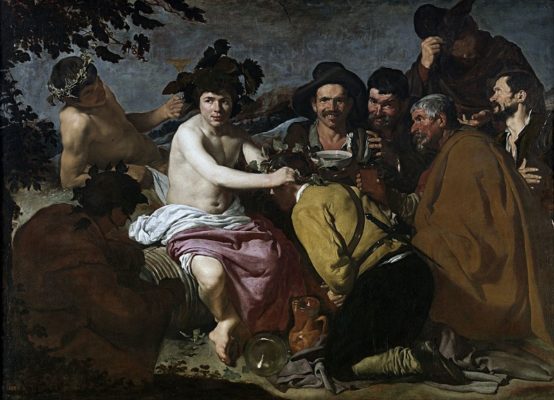
The ruffians to the right of Velazquez’s Los borrachos (The Drunkards) capture something of the spirit of Pablos’s world.

They end up vomiting over each other and flooding the floor with urine. Pablos can hardly hide his shame at the spectacle. He is so scandalised that he is more determined than ever to avoid such company and seek out “more distinguished people and gentlemen.” Pablos finally gets his inheritance, but only 300 ducats instead of the promised 400. He takes off and stays a night at an inn, leaving a note for his uncle telling him not to try and find him because it is important that no-one finds out that they are related.

Chapter 5. Pablos heads for Madrid-”where no one knew him”- riding a rented donkey as if he were a gentleman!

Hidalgo: minor noble. By the 17th century,
hidalgos were a discredited lot, ridiculed for their
pretensions and their perceived uselessness in society.

On the way, he meets a seemingly well-dressed hidalgo** walking along the road. Pablos greets him and assumes that the hidalgo’s coach is following behind. Wondering what coach Pablos is talking about, the hidalgo turns around, but in doing so his breeches/ pants fall down. Disillusioned, Pablos quickly realises that the hidalgo is poverty stricken. The hidalgo walks alongside Pablos for a while holding his breeches up with one hand. Finally, he asks Pablos if he can ride on his donkey. Helping the hidalgo onto the donkey, Pablos sees -under the cape that his companion is wearing- that the breeches have a hole revealing the hidalgo’s bare bottom.”All that glitters is not gold,” the hidalgo comments, before launching into his family history. He has noble blood but is impoverished and heading to Madrid because “you can’t be somebody if you haven’t got anything.” All he has to his name is his title Don and he can’t find anyone to buy it from him. His full name is impressive: Don Toribio Rodriguez Vallejo Gómez y Jordán but empty of significance. In Madrid he hopes to prosper because that’s the place where flattery and quickwittedness open doors.

Chapter 6. The hidalgo, Don Toribio, takes up the narrative, describing the kind of life he and his companions live. They survive using their wits to create a world of appearances. For example, their places are littered with meat bones, fruits peelings and feathers which they have scrounged at night in the streets so that if they have a visitor they can explain offhandedly that they have had some friends in for a meal and the servants haven’t cleared up. If they strike up an acquaintance with someone, they always turn up at his house at mealtime.

They never turn down an invitation. If the host has already begun to dine, they ask if they can share out the food and whilst doing so they compliment the cook and swear it would be an insult not to taste the food themselves. Failing all that, they can always go to a convent and get a bowl of soup which they “don’t eat in public but out of sight.”

Their clothes are all patched up with only their capes for cover. Even so, they hate daylight because people might see the patches when they climb stairs or mount a horse; they even avoid going out on windy days. They recycle their clothes as much as possible, capes being cut down for breeches and so on.

To keep up appearances and be seen, they must ride a horse once a month (or a donkey a pinch) and ride a coach once a year even if it’s only on the back. If they manage to ride inside they must lean out of the window to talk to friends and acquaintances. They always lie making out that they are friends or relatives of some nobles but always making sure that these are either dead or far away. They don’t fall in love unless there’s something in it for them.
Don Toribio’s world of deception, lies and appearances appeals to Pablos, and his companion obliges by promising to introduce him to his companions in crime.
For an introduction to El Buscón, click here.

Sources:
Alpert, Michael (transl.) Two Spanish Picaresque Novels: Lazarillo de Tormes, The Swindler (El Buscón) Penguin Classics 1969
Rey Hazas, Antonio ed. Historia de la vida del buscón Madrid 1983
Velázquez’s Los Borrachos: https://commons.wikimedia.org/w/index.php?curid=15587745

Book II ends with the impoverished hidalgo, Don Toribio, explaining some of the strategies for survival in Madrid. In the first eight chapters of Book III, the action takes place in Madrid. Pablos is introduced to Don Toribio’s companions and learns the art of survival in the capital. In chapter 9, Pablos leaves for Toledo. On the road, he meets and joins a company of actors. Following a period of acting, writing plays and poetry and a frustrating attempt to court a nun, he sets out for Seville, the crime capital of Spain at the time. The last chapter (10) witnesses Pablos’s involvement in … read on!

Book III.
Chapter 1. Pablos meets some of Don Toribio’s companions as they return from seeing what they could find about town. They are all poorly dressed and employ an old crone to collect rags for them in the streets. Pablos notices that when one arrival takes off his cape to delouse himself, he is almost bare and has attached pieces of rounded cardboard to his waist to simulate breeches. Another has had to stay in bed for two weeks for lack of breeches. When it came to bed time, most didn’t undress because they had next to nothing to take off.

Chapter 2. The following morning, they all get “dressed,” each one mending and darning as he puts his clothes together. Pablos is assigned to a district and accompanied by a guide as instructor. As they walk along, his companion resorts to various disguises and crosses the streets back and forth to avoid people to whom he is in debt. By midday, Pablos is hungry and leaves his friend who is busy scattering crumbs on his beard to give the impression that he has just eaten.

Alone, Pablos runs into an old friend from Alcalá, Flechilla. They embrace and when Flechilla lets on that he is going to his sister and brother-in-law’s house for a meal, Pablos insists he cannot let the occasion go without seeing Doña Ana (the sister). Once there, he seats himself at the table uninvited, saying that he was an old friend of the family, and proceeds to stuffs himself. After leaving the house, Pablos abandons Flechilla.

After wandering for a while, he sits on a bench at the entrance of a shop. He overhears two ladies asking about some elaborately embroidered velvet and insinuates himself into the conversation. To impress them and swindle them, he passes himself off as a wealthy gentleman named Don Alvaro de Córdoba. He succeeds in swindling the ladies of a gold encrusted rosary before returning to his quarters. Soon after, his guide arrives bloody and bruised from a beating received from some beggars whom he has cheated of soup.

Chapter 3. A parade of other thieves arrives after a day’s “work.” One brings a new cape which he has swapped for the threadbare one he took with him to a billiards hall. Another appears with a gang of leprous-looking, mutilated boys. He claims to be a religious healer, pretends to scourge himself and makes out that he is wearing a hair shirt. But he is a crook, a card sharp, has fathered six children and has two nuns in the family way! The thieves give the goods they have stolen to the old crone to dispose of. One day, however, when selling some clothes at a house, someone recognises one of the articles and calls a constable. The old woman confesses that she worked for “gentlemen thieves” and the whole school of thieves is jailed.

Chapter 4. Pablos describes life in prison. He sleeps next to the chamber pot and is kept awake by prisoners with diarrhea and constipation using the pot. Pablos complains and an argument ensues between Pablos and another prisoner and the pot is overturned in the dark. The smell is disgusting and the noise wakes up the jailer. Pablos uses some of the money he has to bribe the jailer to place him in another cell. Among the imprisoned in the new cell is a homosexual (El Jayán, the Giant), whose presence motivates Pablos to make homophobic comments about all the other convicts protecting their backsides, even to the point of not farting.

Meanwhile, all the older jailbirds are annoyed that Pablos and his group have not paid their dues and that night set about them (one of the victims of the beating is Don Toribio). They avoid further punishment only by promising to surrender their clothes as security for later payment. Pablos escapes by bribing a series of guards and ends up in the house of the warden. There he witnesses an argument between the warden and his “whale-sized” wife who has been accused by a jailer of not being clean.

The warden’s surname is San Pablo, a name
often adopted by Conversos, Jews who converted to
Christianity. Cf. Book I, chptr. 1.

Angry, the wife turns on her husband for not beating the accuser and then berates him for having Jewish blood. He replies that the accusation of dirtiness was because she did not eat pork and that is why she was dirty, i. e. that she had Jewish blood. Pablos’s bribes eventually release him from prison, but his companions are exiled from Madrid for six years.

Chapter 5.I was alone and without my friends” Pablos says after leaving the jail. He changes his name to Don Ramiro de Guzmán and ends up with a room at an inn where a Portuguese and Catalan are also staying. The daughter of the inn is a spirited blonde who is obsessively proud of her hands and shows them off whenever possible. Pablos fancies her “for a bit of fun.” But security matters too, so he sets about to win the daughter’s hand. However, at first she and her mother will have nothing to do Pablos because he is poor, small and ugly.

**Guzmán was one of the most popular
noble names appropriated by commoners
in Spain in the 16th and 17th centuries.

So, Pablos arranges for some friends to call at the inn when he is out and ask for Don Ramiro de Guzmán**, “a rich merchant” who had signed contracts with the government. To further impress them, Pablos goes to his room after returning, closes the door and starts to count his remaining 50 ducats many times. The repeated chinking of the coins gives the impression that he is indeed wealthy.

The women swallow the deception and now favour him more than the Portuguese (who also fancies the daughter) and the Catalan. These then set about to undermine Pablos, slandering him as a flea-bitten, impoverished, cowardly pícaro. Soon after, Pablos, to press home his case, goes out, rents a mule, disguises himself and, pretending to be Don Ramiro’s steward, returns to the inn and asks for Don Ramiro de Guzmán but adding now the fictitious title “señor del Valcerrado y Vellorete.” The women are ecstatic and, when he returns, reproach Pablos for having concealed his title.

All appears to be going well, especially when the daughter agrees to a tryst with Pablos at 1.00 a. m. To get to the girl’s room, Pablos has to climb onto the roof, but in the dark he slips and falls through the roof of a court clerk/ notary living next door. Chaos follows and he is pummeled by the notary’s servants and brother, arrested and tied up in full view of his lady.

Chapter 6. The beatings continue for Pablos until the Portuguese noble and the Catalan intervene at the request of Pablos’s lady. Finding himself pressured, the notary finally agrees to free Pablos for a payment of eight reales. Pablos is embarrassed and, feeling he has lost face by what has happened, decides to leave the inn, but without paying. With that in mind, he makes a deal with a graduate, Brandalagas, and two friends of his, to call at the inn and, saying that they are from the Inquisition, take Pablos and his belongings away.

Then with the help of these newly acquired friends, Pablos purchases stylish clothes, rents a horse and sets out to snag a rich wife. However, he could not find a footman. While admiring a silver crusted saddle outside a saddle shop in the Calle Mayor (Madrid’s main street), he meets two gentleman on horseback. They are heading for the Prado gardens and Pablos –leaving the saddle and telling the shop owner to command his servants to go to the Prado after him- accompanies them. Pablos is careful to ride between them so that no one could know who the two footmen accompanying them belonged to.

In the Prado, the two gentlemen strike up conversation with two young ladies in their coach while Pablos entertains and flatters their mother and aunt. He reveals that he is in Madrid because he is fleeing his parents who want him to marry an ugly, stupid woman because she is very wealthy. “I,” Pablos adds, “prefer a clean woman with nothing to a rich Jewess.” The aunt follows Pablos’s drift. “Ah, good sir … marry a woman of breeding … my niece … only has 6.000 ducat as dowry, but she owes no one anything insofar as blood goes” (Note there are two possible meanings: 1. She is of good Christian stock, a Cristiana vieja, or more likely 2. She has paid for a patent of nobility and is therefore “clean.” Numerous Conversos did purchase patents of nobility, provoking a strong reaction in Old Christians).
At this moment, the two young ladies hint at lunch. While the two gentlemen hesitate, Pablos jumps in and suggests they meet the next day at the Casa de Campo and he will bring along food. That evening, Pablos scrounges dinner from the two nobles.

Chapter 7. The next day, Pablos pays to get the lunch prepared, including hiring a nobleman’s butler and servants to bring silverware and serve the meal. The two noblemen and the ladies are impressed and very attentive to Pablos, who is known to them as Don Felipe Tristán. Pablos has his eye on one of the girls, Doña Ana, who is very pretty but not too bright. Her companion isn’t bad looking, but seems more wordly.

Everyone is enjoying the meal when Pablos notices a gentleman and two servants approaching. To his horror, the gentleman is none other than Don Diego Coronel, his old school friend and master who happens to be related to the ladies. In front of everyone, Don Diego expresses astonishment that Don Felipe looks so much like his former servant, Pablos, “son of a barber” in Segovia. The mother confounds Don Diego, saying that Don Felipe had entertained her and her sister and that he was a great friend of her husband. Don Diego begs Don Felipe’s pardon, but can’t help adding: “You’d never believe it, sir, his mother was a witch, his father a thief, his uncle a hangman and he, well he was the worst and most ill-inclined man in the world.” Pablos covers up his rage on hearing such things said about him to his face.

Pablos returns to his house where he meets with Brandalagas and a companion. They encourage him to pursue his goal of marriage and the three while away the evening fleecing some card players using marked cards. (Pablos dresses as a monk who is recovering from illness and fancies a game for a bit of fun!) The three share the winnings.

In the morning, Pablos goes to hire a horse but fails to find one. In the street where Dona Aña lives, Pablos comes across a servant holding his master’s horse while the master, a lawyer, is attending mass. Pablos bribes the servant to allow him to ride the horse so that he can parade in front of Doña Ana’s house. Unfortunately, however, when Pablos smacks the horse, it rears and throws him head first into a puddle. Both Doña Ana and Don Diego witnessed Pablos’s fall and the arrival of the lawyer who berates his servant for letting a “nobody” ride his horse. “No flogged guy has ever felt so much shame,” Pablos comments, looking for every excuse. Doña Ana is sympathetic, but Don Diego decides to spy on Don Felipe and find out all he can about him.

Pablos’s ill-luck doesn’t end there. When he returns to his house, he finds that Brandalagas and his friend have made off with all his money. And worse is still to come! Don Diego runs into Flechilla (see Book III, chptr. 2) whom he and Pablos knew in Alcalá. Learning more about Pablos from Flechilla, Don Diego arranges with the two gentlemen from the Prado and Casa de Campo lunch to beat Don Felipe (i.e. Pablos) up when the latter goes to pay court to Doña Ana. They will recognise Pablos from Don Diego’s cape that the latter intends to exchange with Pablos. Don Diego meets with Pablos and they exchange their capes (Don Diego has to go along a certain street and doesn’t want to be recognised.)

Unfortunately, however, two individuals are on the lookout for Don Diego over a woman, and seeing his cape pummel Pablos! Despite his pain, Pablos perseveres and goes to Doña Ana’s house where he is set upon by Don Diego’s accomplices! He is left with his face slashed and his legs so battered that he can’t stand. The chapter ends with Pablos in bed contemplating his situation: “my face in two pieces, my legs … I couldn’t feel, I’d been robbed, I couldn’t pursue my “friends,” nor think of marrying, nor stay in Madrid, nor even leave.”

Chapter 8. Pablos wakes up seeing the landlady of the place he is staying in at his bedside. Although her face is wrinkled like a dried nut and she is getting on in age, she is an active prostitute. Like the famous Celestina, she also specialises in cosmetics, repairing virgins and “seasoning” maidens (for sex). She is an expert in teaching young girls how to best display their physical charms to attract men and wangle jewelry from them. For example, girls with beautiful teeth should laugh and smile a lot; blondes should wear their hair loose; those with pretty eyes should flash them or coyly lower them.

However, the real reason for the landlady’s visit is to ask Pablos for the rent that he owes her. Unfortunately, as Pablos is counting the money to pay her, some officers raid the house to arrest the landlady and a “boyfriend” she is known to live with. Seeing Pablos in bed and the old prostitute in his room, they assume that Pablos is the boyfriend and give him a hiding before dragging him from his bed. In the meantime, the boyfriend -hearing Pablos’s yells- takes flight. Fortunately, the police catch sight of the fleeing boyfriend and chase him after another guest confirms that Pablos is innocent. Both the old lady and her lover are arrested and imprisoned.

After a week recovering from his beatings, Pablos takes stock of his situation. Having paid for his rent and recovery treatment, he is penniless and takes to panhandling after observing how much money a beggar is making in the streets. From the beggar, Pablos learns how to get money out of people. He pretends to be badly crippled, uses crutches and modulates his voice according to the circumstances. He wears a cross and rosary prominently, uses prayers copiously, and makes a lot of money.

From another beggar, he learns the art of flattery, for example addressing a soldier as “captain,” an undistinguished woman as “beautiful lady,” a priest as “archdeacon,” a simple man as “gentleman.” Pablos colludes with the second beggar, exploiting children to beg, even kidnapping children and then claiming the reward for finding them. As a result, Pablos becomes very rich, at which point he decides to leave Madrid and head for Toledo “where I knew no one and no one knew me.”

Chapter 9. On the way to Toledo, Pablos runs into a troupe/ company of actors, one of whom happens to have been an acquaintance (unnamed) of his in Alcalá. Thanks to the acquaintance, Pablos is allowed to travel with the group to Toledo. On the way, he takes a fancy to one of the actresses whose husband –for a price- readily makes way for Pablos to flirt with her. The two talk a lot but put off “action” until they get to Toledo.

After hearing Pablos recite some lines he remembers from his childhood, the actors invite him to join them. Since the acting life appeals to him and the actress is very appealing, Pablos signs a contract for two years with the troupe manager. He also turns his hand at writing plays and verse and becomes so proficient that he makes quite a name for himself. Adopting the name of Alonso, he becomes prosperous writing poetry for blind men to recite, or for young lovers to praise their ladies’ hair or eyes or hands.

Pablos acquires a well-furnished house and even contemplates managing his own troupe. However, as fate would have it, following a comical episode in which a young Galician maid takes as true some lines she overhears Pablos reciting aloud (about being attacked by a bear!), the manager of the troupe is arrested and jailed. As a result, the company breaks up and Pablos goes his own way, intending to have a good time.

With the money he has made, he starts paying court to a nun**, or as he puts it he became “a lattice-window lover.

** The whole episode with its comical description of love-sick suitors and their “postures” is a parody of a conventional literary topic of a lover flirting with a nun through the lattice window of a convent or church. But we should remember that many women at this time entered the religious life not as a vocation but for a variety of reasons, e. g. younger daughters of noble families who wished to avoid paying excessive dowries. For these nuns, flirting was a break from the monotony and sexual repression of such a life.

Pablos assures the nun that he has abandoned the acting profession for her, and seeks the friendship of the abbess or priest or sacristan to facilitate his liaison with her. However, falling for a nun is like “being in love with a caged thrush if she speaks, and if she doesn’t say anything, it’s like falling in love with a portrait.” And so, realising that her “favours are only touches which go nowhere,” Pablos decides to leave for Seville, taking with him 50 escudos he has swindled from the nun by promising to raffle some silk stockings, little amber trinkets and candies/sweets she has made.

Chapter 10. En route to Seville, Pablos makes money using loaded dices and marked cards to fleece unwary victims. Addressing the reader, he lists some of the schemes swindlers engage in and offers advice to the uninitiated on how to detect the strategies employed. He also reveals some of the slang used by cheats: e.g. “To make a killing” means taking all the victim’s money, a “reverse” is to cheat on one’s playing partner, “white” refers to someone gullible.

In Seville, Pablos settles in an inn where he runs into yet another of his fellow students from Alcalá, Mata (from matar: “to kill”, suitably named since he is a cutthroat and specialist in slashings). Pablos is invited to dinner at Mata’s place, where Mata lends him a sword, changes the way he is dressed and lends him a large knife so that he will not look like a queer when his criminal pals arrive.

After initial reserve, the group accepts Pablos, and in the ensuing drunken orgy they propose a toast to Pablos’s honour! Conversation soon turns to swearing and to recalling members killed by the law. A parodic mass is celebrated in their honour, after which they all set out to hunt policemen. A drunken Pablos accompanies them and they all attack and kill two constables, after which they flee to the cathedral to seek sanctuary.

They all have a good time in the cathedral, especially with the arrival of prostitutes, one of whom (named Grajales) becomes Pablos’s “woman.” Despite constant police surveillance of the cathedral, Pablos and Grajales manage to escape and leave for America, but things go worse there. Pablos ends by promising a second part and cautioning that no one will improve his lot by simply moving places; he must also alter his life and ways.

Sources:
Alpert, Michael (transl.) Two Spanish Picaresque Novels: Lazarillo de Tormes, The Swindler (El buscón) Penguin Classics, 1969
Rey Hazas, Antonio ed. Historia de la vida del buscón Madrid 1983

Francisco de Quevedo 1580-1645

Representase la brevedad de lo que se vive y cuán nada parece lo que se vivió.

1. “¡Ah de la vida!” … ¿Nadie me responde?
¡Aquí de los antaños que he vivido!
La Fortuna mis tiempos ha mordido;
las Horas mi locura las esconde.
5. ¡Que sin poder saber cómo ni adónde,
La salud y la edad se hayan huido!
Falta la vida, asiste lo vivido,
Y no hay calamidad que no me ronde.
9. Ayer se fue; mañana no ha llegado;
Hoy se está yendo sin parar un punto;
Soy un fue, y un será, y un es cansado.
12. En el hoy y mañana y ayer, junto
Pañales y mortaja, y he quedado
Presentes sucesiones de difunto.

Translation:
Note: Translations are notoriously problematic, but especially so in poems such as ¡Ah de la vida!… whose impact depends on compressed expressions intended both to demonstrate the poet’s ingenuity and to underline stylistically the theme. The sonnet is preceded by an epigraph which summarises the theme:

Here is depicted the brevity of life in progress and how our past life seems to be nothing.

Hello there, life! Is there no-one answering me?/ Come back those past years that I have lived!/ Fortune has eaten away my time;/ My madness is hiding the hours.
Without knowing how or where,/ My health and lifetime have fled!/ Life is missing; what I have lived is present,/ And there is no calamity that doesn’t haunt me.
Yesterday has gone; tomorrow has not arrived;/ Today is going away without stopping for a moment;/ I am a “was”, and a “will be” and a tired “is.”
In my today and tomorrow and yesterday, I join together/ Diapers and shroud, and I am left/ An endless sequence of a dead being.

The poem is a sonnet, with each of its 14 lines a hendecasyllable (i.e. 11 syllables each line). It is made up of two quatrains, (i.e. each quatrain contains four lines), and two tercets (each made up of three lines). Sometimes we talk of the two quatrains together as an octave and the two tercets together as a sestet. If you have read Góngora’s sonnet Mientras por competir…, you will recognise that this poem by Quevedo has exactly the same rhyme scheme: ABBA, ABBA, CDC, DCD.

Commentary:
Like Garcilaso de la Vega’s En tanto que de rosa … and Góngora’s Mientras por competir …, Quevedo’s sonnet deals with time. But that is all they have in common. Both Garcilaso and Góngora take female beauty as their starting point; Quevedo removes all that is human to focus on life itself (or rather, its absence).

The two earlier poems take their inspiration from the classical themes (topoi) of Horace’s Carpe diem (“Enjoy the day”) and Ausonius’s Collige, virgo, rosas (“Gather, maiden, the roses”). Quevedo’s source is not classical; he takes as his starting point a conversational colloquialism “!Ah de la vida…!” based on a popular expression, !Ah de la casa…! (“Anyone home”) and follows it with another Aquí de…

Central to Garcilaso and Góngora’s sonnet is the passage of time which ruins the beauty of the ladies they address. Not so in !Ah de la vida…! Quevedo focuses exclusively on the absence of life (Falta la vida l. 7). There is no progress from youth to old age, from beauty to death, from colour to nothing. For Quevedo life is paradoxically a “living death.”

!Ah de la vida…! is more pessimistic and harder hitting even than Mientras por competir… which ends with the magnificent climax taking us to the lady’s eventual fate: she will end up as nada (“nothing”). Even so there was a time of beauty and colour that preceded old age, death and nothingness. Quevedo doesn’t give us even that consolation. His sonnet is unrelentingly bleak, predictably so given that life is absent.

The opening address or apostrophe “!Hello there life!” immediately and dramatically launches us into poem. It demands our attention with the poetic “I” addressing life itself but getting no response. The address is a cry for communication. The “I” is knocking on the door of life, and the following rhetorical question, “Isn’t there anyone answering?” underlines the fact that there is no reply. The “I” realises that there is a void where his life should be and wonders where his life has gone.

Alone, the “I” appeals for the return of his past years (l. 2), but as the exclamation mark makes clear, it is a forlorn appeal. Why? Because Fate and his obsession have eaten away and hidden all vestiges of his past (ll. 3-4), leaving the “I” with no idea of how or where his years have fled (ll. 5-6). As a result, life is absent and all that remains is what he has “lived” (asiste lo vivido l. 7), and what he has “lived” is a succession of deaths (ll. 13-14; which explains why life is not answering his call). This is a complicated idea (conceit) which is what makes the poem difficult to understand.

The sestet is grim and stripped of all human warmth. Time is so relentless that his very being is no more than an expression of time, a “was,” a “will be” and a tired “is” (l. 11). His life, compressed to a mere link between birth (pañales) and death (mortaja), is an endless series of deaths (ll. 13-14; i.e. he’s been paradoxically a “dead man living” throughout his life, from birth to old age). This is the climax leading to the last word, appropriately in this context: difunto (“dead man“)**.

**In a letter written to an acquaintance in 1635, Quevedo wrote: “How can I call life my old age, where I myself am the burial place of five deaths” i.e. infancy, early years, youth, mature years and old age.

Language.
Quevedo’s success lies in his use of language. The sonnet is a serious meditation on life (and its absence) and time, which normally would be accompanied by elevated language. This sonnet, however, opens with two unconventional expressions based on colloquialisms: ¡Ah de la vida l.1 from ¡Ah de la casa (“Anyone in”), and Aquí de los antaños l.2 from Aquí de los nuestros (“Come and help”).

They strike a popular tone, typical of sermons of the time, where the message is relevant to all listeners. The vocabulary is straightforward, with no intrusive Latinisms or neologisms or complex puns, all of which were normally very much part of Quevedo’s poetic style.

How exactly does Quevedo convey this idea of life being absent? He does so by creating a kind of poetic “skeleton,” i.e. full of verbs, nouns and verbal nouns (fue, será, es), all related to time, and with a notable lack of adjectives and imagery. In fact, there are only two adjectives, cansado (l. 11) and presentes (l. 14). The former suggests exhaustion from knocking at the door, and is linked to the lost health and lifetime of line 6. The latter alludes to the constant presence of death.

There is a striking paired metaphor, pañales y mortaja (“diapers and shroud“) alluding to birth and death, with textually no “life” in between. The compressed leap from birth to death in these two juxtaposed words captures superbly the idea that life is absent.

Adjectives and imagery create pictures which flesh out a poetic “skeleton.” Here their virtual absence underlines the fact that there is no colour, no warmth, and no picture. There is nothing tangible to grasp, the vocabulary being as abstract as time itself.

In the first tercet, time is compressed to “Yesterday,” “tomorrow,” “today,” whose juxtaposition brilliantly continues the concept of life having been squeezed out; without life, the “I” is no more than time metaphorically made flesh, a “was,” “will be” and “is” (l. 11). “I” is simultaneously past, future and present.

In the second tercet, the four conjunctions y underline the leap conveyed by the juxtaposed hoy, mañana, ayer (l. 12) and move us (thanks to enjambement, ll.13-14) immediately to the “I’s” bleak conclusion and appropriately the last word of the sonnet: difunto, i.e. he is a dead man living.

The language here is straightforward but concentrated or compressed. So, we have to work to make sense of the poem, which was the aim of conceptismo**, a major literary development of the Baroque. Conceptismo demonstrated the writer’s verbal ingenuity or “wit” (agudeza) at playing with ideas, which in turn required the use of the reader’s intelligence to work between the lines or behind the words.

** Conceptismo is often unfortunately contrasted with another contemporary literary development, culteranismo, when in fact they had much in common. Conceptismo played around with ideas (often using word play, puns), culteranismo appealed more to the senses, made abundant use of classical allusions and Latinisms as well as hyperbaton (dislocation of the normal word order). But conceptismo and culteranismo both sought novelty through ingenuity; both aspired to create surprise and wonder in the reader.

Here our common image of life as a passage/ journey from birth to death is turned upside down. This and the artistically arranged temporal contrasts and compression (“yesterday,” “tomorrow,” “today;” “am,” “will be,”is;” “today,” “tomorrow,” “yesterday” (ll. 8-11) are intended to produce surprise, astonishment or –to use the term much used in the Baroque- admiratio. The poet who achieved such an effect was greatly esteemed.
**********
!Ah de la vida…! belongs to those moral poems by Quevedo devoted to the brevity of human life. Its despairing conclusion -that the poetic “I” hasn’t lived but experienced a succession of deaths- places it under the umbrella of desengaño (“disillusion“), a major theme of the Baroque.

What appears to be life is really no more than illusion, a cover for death. The opening line summarises in many ways the Baroque culture of uncertainty, the questioning of assumptions and beliefs, and the examination of appearance and reality. We find it in e.g. Góngora’s Mientras por competir…; in Don Quixote’s difficulty in determining what he sees and what others see; in the questioning of honour of El burlador de Sevilla; in the painting of Las Meninas by Velázquez; and many other works, fictional, religious and political.

Sources:
Gaylord, Mary Malcolm “The Making of Baroque Poetry” in The Cambridge History of Spanish Literature, ed. Gies, David T Cambridge 2009
Price, R.M ed. An Anthology of Quevedo’s Poetry Manchester 1969
Rivers, Elias ed Renaissance and Baroque Poetry of Spain Prospect Heights Illinois 1988 (With English prose translations of the poems.)
Robbins, Jeremy The Challenges of Uncertainty: An Introduction to Seventeenth-Century Spanish Literature New York 1998
Image of Quevedo from: http://en.wikipedia.org/wiki/File:Quevedo_%28copia_de_Vel%C3%A1zquez%29.jpg

The Poema de Mío Cid (probably written around 1200) is known as Spain’s greatest epic poem. Whether that is the case is another matter, and whether all regions of Spain hail him as their hero is open to question.

Epic poetry in the Western tradition is a narrative in verse that generally recounts the deeds of a hero or heroes identified with the history and common destiny of a people.

Since that common destiny was accomplished primarily on the field of battle, the hero usually achieves heroic stature through his military success. He faces numerous challenges and frequently undertakes perilous journeys. He suffers adversity, is fearless in the face of death, and remains resolutely loyal to his cause while overcoming a series of obstacles.

The epic reflects a male dominated world where action overrules reflection and victory is measured in terms of conquest. The hero may be divinely inspired or protected, in which case the community may perceive itself through him to be divinely favoured by God.

The hero acquires larger-than-life qualities through frequently exaggerated accomplishments and chronological distance (the action takes place well in the past), characteristics of myth making.

The world he inhabits is essentially aristocratic and what he does reflects the ethics and concerns of the nobility, the ruling elite; it is not the world of ordinary people. Consequently, the language is elevated and sober, and the message uplifting and morally edifying.

Although the Cid embodies many of the qualities outlined above, he is -as the following summary suggests, a very different kind of hero: one whose very human attributes are as important as his military conquests.

The Poema de mío Cid is based on the life of Rodrigo Díaz de Vivar (ca 1043-1099), a Castilian knight of modest birth. The poem traces the fortunes of the Cid (as he is better known, from his Arabic title, meaning “lord”) following his second exile from Castile, at the command of Alfonso VI, king of León-Castile.

In the Poema, the Cid is also frequently addressed or referred to as “Campeador, probably from the Latin “campi doctus/doctor” “master of the (battle)field.”

The reason for the exile is not specified, but it might have been contained in the opening lines, which are missing in the text that has come down to us. As it stands, the poem opens with the Rodrigo’s tearful departure from his confiscated home in Vivar and his arrival in nearby Burgos, accompanied by a small retinue of loyal followers. There, no one dares speak to him or offer him refuge for fear of contravening the King’s edict, and it is left to a 9-year old girl to explain why.

Page from Cid manuscript.

Socially ostracised and impoverished, the Cid must start immediately to fend for himself and his followers.

His first act is to fill two chests with sand, and with the help of an emissary deceive two money lenders from Burgos into advancing him funds with which to buy provisions. He then sets out, taking tearful leave of his wife, Ximena, and their two daughters, whom he leaves under the protection of the abbot of the Benedictine monastery of San Pedro de Cardeña, near Burgos.

From then on it is by the deeds of his sword that the Cid prospers. Successfully raiding and conquering Moorish villages and towns between Burgos and Zaragoza, he soon becomes famous and his followers increase in number.

Not all of the Cid’s enemies are Moors.
He also defeats the Christian
Count of Barcelona, vv 957-1009)

The booty he wins ensures his survival, and although out of favour with Alfonso, he nevertheless sends the king generous portions of his spoils as proof of his loyalty.

The capture of Valencia (vv. 1170-1220) in 1094 marks the high point of the Cid’s material success. Soon after, the king pardons him, returns his confiscated property and allows Ximena and her daughters to be reunited with him in Valencia. There, the Cid delights in showing his family the city which he has won for them. Shortly after, he defends it in their presence against a powerful Muslim army, demonstrating, as he so aptly puts it, “how bread is won in these lands.”

In the meantime, the Cid’s success has not passed unnoticed amongst the higher nobility in the court of Alfonso. Two brothers, the Infantes de Carrión (first mentioned in v 1372), members of the Leonese nobility, seeing opportunities for enrichment, petition the king for the hands of the Cid’s daughters. The king agrees, but the Cid, uneasy about the arrangement, accepts only because it is the king’s wish, and refuses to give them away himself at the marriage ceremony.

The Cid’s unease proves well founded. The Infantes soon show themselves to be cowardly, as well as vain and avaricious. They hide when a lion gets loose in the Cid’s household (vv. 2281-2307), and are fearful at the news of another Moorish attack on the city (vv. 2317-2337).

Although they do apparently participate in the battle, no one can remember seeing them in the thick of the action. Aggrieved by feeling themselves the butts of jokes among the Cid’s men, the Infantes seek permission to take their wives to Carrión, ostensibly to show them their property.

The Cid showers them with gifts, and presents the Infantes with his two most precious swords -Colada and Tizón- both won in battle. In the middle of a forest, however, the two brothers strip their wives, beat them mercilessly with their belts and leave them for dead (vv. 2712-2752).

When the Cid hears the news, he demands justice, reminding the king that it was he who authorised the marriage. Alfonso calls a meeting of the Cortes (Parliament) at Toledo where the Infantes are shamed and discredited, and obliged to return Colada and Tizón to the Cid.

A judicial duel, fought in the king’s presence between the Cid’s champions (the Cid has returned to Valencia) and the Infantes, completes the latters’ disgrace. As the culmination of the Cid’s success, his daughters are remarried to the heirs to the thrones of Aragón and Navarre, from which union, the poet concludes, “the kings of Spain are descendants today.”

Sources.
Blackburn, Paul transl Poem of the Cid Norman Oklahoma 1966 (1998)
Fletcher, Richard The Quest for El Cid London 1989
Hamilton, Rita & Perry, Janet The Poem of the Cid Manchester: 1975; Penguin 1984. Prose translation, with very useful introduction.
Lowney, Chris A Vanished World: Muslims, Christians, and Jews in Medieval Spain Oxford 2006
Montaner, Alberto ed Cantar de Mío Cid Barcelona 1993
Smith, Colin Poema de Mío Cid Madrid 1996
Image of manuscript from Wikipedia: Cantar de Mío Cid: http://en.wikipedia.org/wiki/Cantar_de_Mio_Cid
A very useful web site -in both Spanish and English- on matters relating to the Cid can be found at: www.caminodelcid.org
Also very useful, the interactive site: http://www.laits.utexas.edu/cid

What is the Poema de Mío Cid about?
The Poema de Mío Cid is fairly easy to summarise. Inspired by the life in exile of the historical Rodrigo Díaz de Vivar (ca1043-1099), it is a fairly short epic poem, consisting of 3733 lines divided into three “Songs” or Cantares. The first Cantar (vv 1-1084) centres on the exile of the Cid, the second (vv 1085-2277) on his conquest of Valencia and the marriage of his daughters, the final (vv 2278-3733) on the abuse and abandonment of the daughters and the Cid’s appeal for justice.

The Poema has come down to us in a single manuscript, dated approximately the mid 1300s, but the date of composition and authorship are matters of controversy. For a long time, following the arguments of Spain’s greatest medieval scholar, Ramón Menéndez Pidal (1869-1968), it was believed that the work was composed anonymously around 1140.

At the end of the poem, however, a certain Per Abbat states that he “wrote” (escrivio) the work in 1207. The problem is that the verb escrivir didn’t necessarily mean “to write” at that time, it could also mean “to copy,” so we don’t really know whether Per Abbat was the copyist or the author. Currently, the consensus is that he was the copyist. As for the date of composition, most scholars now support a date later than 1140, somewhere around 1200.

History or Fiction?
Although anchored in the political events of a frontier society in the last 20 years of the 11th century, the Poema is not a historical document but a literary composition.

Historically, for example, the Cid’s daughters were named Cristina and María -and not Elvira and Sol- and were never married to the Infantes of Carrión. One of the Cid’s most trusted military advisors and confidant in the poem-Alvar Fáñez- was not closely allied to him, and another, Martín Antolínez, who is present throughout the work, is a fictitious creation.

As for Rodrigo himself, although the poet depicts him as battling against the Christian Count of Barcelona, he discreetly draws a veil over the hero’s lengthy service to the Muslim leader of Zaragoza and other questionable allegiances. The historical Cid was, in effect, a mercenary.

Historical accuracy, then, was less important than reshaping the Cid’s life in exile, and a consideration of his relationship with the king of Castile, Alfonso VI. The result is a skilful literary work centred on the loss and recovery of the Cid’s possessions and honour in two general stages:
1) the years of survival (culminating in the conquest of Valencia, v 1212, the arrival of his wife and daughters in Valencia, vv 1592-1609, and the Cid’s successful defence of the city against the Almoravids vv 1712-30).
2) the appearance of the Infantes de Carrión (v 1372) and their marriage to the Cid’s daughters, and the Cid’s appeal to the king for justice following the abuse of his daughters by the Infantes. The first stage is historically inspired, the second fictional.

The Cid: A National, Crusading Hero?
Although simple from a narrative point of view, the Poema de Mío Cid is a rich and complex work that has generated many interpretations. We’ll start by questioning one popular interpretation, the myth of the Cid as Spain’s hero motivated by a crusading spirit and reconquista zeal.

It is not difficult to demonstrate that the Cid of the Poema cuts a heroic figure, but we should be cautious nowadays about the term “Spain’s” national hero because the Cid is if anything a “Castilian” hero.

But even here the poet does not wave a nationalistic flag. Rodrigo is referred to mostly as el Cid (from the Arabic sayyid: “lord”) or el Campeador (possibly from campi doctus/doctor: “master of the battlefield”) or as el Cid Campeador.

Only twice is he identified as a Castilian (Ruy Diaz el Castelano, v 748, and simply as el Castelano in v 1067). Castile is mentioned numerous times, but mostly in relation to the Cid’s travels and not in any nationalistic sense. The point is that the Poema is not about wars between kingdoms or religious conflicts; it follows the life of the Cid in exile and details how he survives and recovers his honour.

We should keep in mind, too, that for some regions of the country, e.g. Catalonia and Euskadi (or Basque Provinces), el Cid has no particular heroic resonance. Historical circumstances can explain this.

Broadly speaking, from the 16th century Castile determined the destiny of the country, so that Castile became synonymous with Spain, and the language of Castile became the de facto language of Spain. It wasn’t a great step, then, for Castile’s greatest hero, el Cid, to be viewed also as Spain’s greatest hero.

This view was reinforced in the 20th century with the publication of a ground breaking edition of the Poema (1908-11) by Spain’s great Medieval scholar, Ramón Menéndez Pidal. He followed this in 1929 with another fundamental study, La España del Cid (Spain of the Cid). Weaving through these works was Menéndez Pidal’s belief that the spirit of Castile was the glue that held Spain together, and that spirit was best exemplified by the Cid.The Cid is, if anything, a Castilian hero, and even here the poet does not beat a nationalistic drum.

It so happens that Menéndez Pidal’s convictions appeared at a time when Spain was undergoing severe political instability and a crisis of identity. This was reflected in growing separatist sentiment in Catalonia and Euskadi, which obviously undermined Castile’s authority. What was happening was, in fact, a renewal of historic struggles in Spain’s history between Castile’s strong centralist tendencies and regionalism.

Menéndez Pidal’s Cid was quickly appropriated by the Franco Nationalist propaganda machine during the Spanish Civil War (1936-39; e.g. Franco was compared to El Cid). Franco’s victory was soon accompanied by repressive measures, which included the suppression of Catalan and Basque freedoms and languages. Hardly surprising, then, El Cid does not resonate with Catalans and Basques!

In fact, the only Catalan figure to appear in the Poema, Remont Verengel, Count of Barcelona, is outwitted and defeated in battle by the Cid and taken prisoner, vv 1000-1009. At the same time, the poet makes it clear that the Count’s Catalan soldiers are “soft” compared to the hardy Castilians vv 992-94. The battle itself is over in a mere five lines vv 1005-1009.

As for crusader, el Cid is indeed a good Christian. He calls on Spain’s patron saint, St James (Santiago) before battle (e.g. v 1138), thanks God for his victories, has a dream visitation from the Archangel Gabriel (vv 405-09) and contributes to Christian territorial expansion at the expense of the Moors (v 1191).

He also has within his entourage a bishop, Jerome, who is openly intolerant of Muslims. However, Bishop Jerome is significantly not Spanish but a French monk drawn by the Cid’s fame (vv 1292, 2371) from the Abbey of Cluny. He has come specifically to kill Moors.

The Abbey of Cluny had long standing links to Spain,
playing for example a major role in popularising the
pilgrimage to Santiago de Compostela. It was also a
former prior of the Abbey, Pope Urban II, who called
for the First Crusade in 1095.

Before every battle Bishop Jerome celebrates mass and urges the soldiers to battle with promises of paradise for those who fall (v 1705). And the Bishop is no mere orator. He begs the Cid the honour of striking the first blow in battle (vv 2371-3), and is such an impressive fighter that he even elicits the poet’s admiration: God, how well he fought! (v 2387). The Bishop brings with him the crusading zeal that swept France at the end of the 11th century (the First Crusade set out for Jerusalem in 1095).

But does this mean that the Cid and his Spanish followers are fired by the same zeal? If we look carefully at the Poema, it soon becomes apparent that nowhere do we read of Christianity’s superiority over Islam. There are no references to Muslims abandoning their faith nor is any attempt made to convert them nor are their beliefs denigrated.

The conquest of Valencia in 1094 and the defeat of the fundamentalist Almoravids by the Cid –the end of the first stage- would surely have been a fitting moment to proclaim the crusading spirit of the Reconquista. But as in previous battles against Muslim adversaries, the Cid’s victory is measured, not in religious terms but by the value of the booty won or the parias (tributes) paid (vv 904, 914). This, in effect, gives us a clue that it is material survival that fires Rodrigo and his men at this moment.

Survival and Wealth.
Exiled by the Castilian king, Alfonso VI, left penniless and disgraced, Rodrigo is forced to take up arms to survive. But first he needs money, so the poem opens with the detailed process behind a loan extended to Rodrigo by two Jewish moneylenders, for which the Cid’s emissary, Martín Antolínez, extracts a 10 % commission!

Soon, military success brings wealth in the form of booty and possessions. Indeed, the word ganancias (spoils) runs through the poem like a leitmotiv, but especially in the first half of the poem. Repeatedly we are informed of the gold, silver, horses, livestock, and clothing won and the wealth earned. Even Colada, the sword that acquires such symbolic value later in the poem, is first identified in terms of its monetary worth, 3,000 marks (v 1010).

And the Cid’s conquest of Valencia –which then becomes his possession- dwells on the hunger suffered by the besieged inhabitants of the city (the Cid took away their bread v 1173) and the countless treasures won by the victors.

The Cid is not the only one concerned about money; so too are the Infantes de Carrión whose marriage to the Cid’s daughters is purely commercial. And King Alfonso is also only too pleased to receive a part of the spoils from the man whom he has exiled.

Rehabilitation.
All the Cid’s success, of course, not only confirms his credentials as soldier, survivor, and leader, but it also demonstrates the power and fame he has achieved. His army grows with each achievement and his renown crosses the seas (vv 1154, 1156).

The conquest of Valencia, the high point of Rodrigo’s material success, completes the first stage of the Cid’s rehabilitation, a matter confirmed by Alfonso’s permission for his family to join him in the city, and a public restoration of all his confiscated possessions (vv 1360-63). It is soon after this (v 1882-83) that the Infantes de Carrión confirm their earlier decision (v 1374) to ask for the Cid’s daughters, Elvira and Sol, in marriage.

This sets in motion the second stage: justice and the restoration of the Cid`s honour. However, being members of the upper nobility, the Infantes direct their request to the king and not to Rodrigo, asserting at the same time that the proposed marriage will honour the Cid. Rodrigo, however, is less than enthusiastic (v 1938), but agrees to obey the king, who also sees the marriage as a source of honour for the Cid (v 1905).

Significantly, when the Cid and Alfonso meet to arrange the marriage, the Cid hands Elvira and Sol over to the king for the latter to give them away (2085-2099). This has been carefully worked out because when Elvira and Sol are subsequently abused by their husbands (vv 2720-2748), the king’s honour is also tarnished.

Following news of the abuse, and before the court gathered at Toledo, the Cid reminds Alfonso that it was he who gave away Elvira and Sol. Nevertheless, when the Cid formally presents his grievance, he does not begin with his daughters’ abuse.

His first demand is for the return of his swords, Colada and Tizón (which he had won, as he pointedly observes, like a man v 3154) and the money he had given the Infantes on their departure for Carrión. Only then does he turn to his greatest grievance … which so dishonoured me (vv 3254-56), and call for a duel.

The duel is fought in the king’s presence between the Cid’s champions (the Cid has returned to Valencia) and the Infantes; their defeat –they are not killed but surrender- completes their disgrace. The Cid is now publicly vindicated and his honour restored. The Poema ends with even greater recognition of his worth: the news that the princes of Navarre and Aragón request the hands of Elvira and Sol in marriage (v 3717).

Sources.
Blackburn, Paul transl Poem of the Cid Norman, Oklahoma 1966 (1998)
Fletcher, Richard The Quest for El Cid London 1989
Hamilton, Rita & Perry, Janet The Poem of the Cid Manchester 1975; Penguin 1984 Prose translation, with very useful introduction.
Lowney, Chris A Vanished World: Muslims, Christians, and Jews in Medieval Spain Oxford 2006
Montaner, Alberto ed Cantar de Mío Cid Barcelona 1993
Smith, Colin Poema de Mío Cid Madrid 1996
A very useful web site -in both Spanish and English- on matters relating to the Cid can be found at: www.caminodelcid.org

The Poema de Mío Cid: A Different Hero.
Quite simply, the Poema de Mío Cid is about Rodrigo de Vivar (better known as the Cid or the Campeador) and his exploits. It does not exalt the crusading zeal of the Reconquista, and although el Cid is a hero, to call him the greatest “Spanish” hero is rather misleading.

He is, if anything, a Castilian hero, but even here the poet does not labour the point. The Poema is not about wars between kingdoms or religious conflicts; it follows the life of the Cid in exile and details how he survives and recovers his honour.

The Poema is divided into three Cantares (Songs), but the work is structured in two general stages: survival and rehabilitation. Stage one establishes the Cid’s military prowess, principally against Moors, after being exiled by Alfonso VI. It also makes clear the loyalty of the Cid to Alfonso who, the poem suggests, is misguided and perhaps undeserving of such a loyal vassal, as v 20 suggests: What a good vassal! May he find a good lord.

The first stage culminates with the conquest of Moorish Valencia and Rodrigo’s successful defence of the city against the Almoravids (vv 1712-30),

But the Cid also has enemies in the court of Alfonso, and these come to the fore in stage two. His main antagonists turn out to be his sons-in-law, the Infantes de Carrión (first referred to in v 1372), and their advisor, García Ordóñez (v 1345), a powerful Castilian noble, specifically identified as an enemy of the Cid, who always sought to do him ill (v 2997).

But García Ordóñez and the Infantes have something else in common, besides their envy of and dislike for Rodrigo. They are members of the upper or entrenched elite whereas the Cid is an infanzón, a member of the second tier of nobility. This has prompted some readers to view the poem as a clash between an older but debilitated and degenerate court aristocracy challenged by a virile and forward looking lower nobility whose military actions on the battle front speak louder than words.

Certainly, the behaviour of the Infantes is in complete contrast to that of the Cid. Rodrigo is brave, generous, loyal, just, honourable, a self-made man respected by all; the Infantes have a long, noble lineage, but they are avaricious, vindictive, cowardly, boastful (vv 2538-34) and selfish. And, unlike the Cid who loves his wife and daughters, the Infantes treat their wives with utter contempt, cruelly whipping them and abandoning them for dead in a forest (vv 2720-2748).

Rodrigo de Vivar: A Different Kind of Hero.
The idea that the poem is about a self-made man who has improved his status through his own effort has appealed to many. Certainly it is something that would resonate with the frontier public of the time.

They could associate easily with the Cid’s dilemma and also delight in his military prowess and eventual rehabilitation. They would have shivered at the opening scene when the Cid and his small band of followers enter Burgos only to find the doors closed and the people hiding from them. They would have sympathised when a frustrated Rodrigo kicks at a door only to have a young girl appear and explain that the king has prohibited any form of help.

The audience would recognise the implications of exile, disgrace and social ostracism, and the subsequent references to hunger (bread) and the obsession with booty as a means of achieving security would be perfectly understandable. Also, they would feel close to the Cid, given the familiarity of the places where so much of the action takes place.

And of course the Muslims against whom the Cid fights were easily identifiable as enemies. As a result, the poem appeals to ordinary people, but it would be hasty to jump from here to the notion of any democratic process at work. The protagonists are nobles and what the poem shows is how bread is won and justice rewarded within that sphere.

Nevertheless, there is ample reward too for all those who risk their lives, and in a frontier environment where risks were high and soldiers at a premium the opportunity to become rich would have had considerable appeal, and the obsessive itemising of the spoils in the Poema would have whetted many an appetite.

Also, with wealth comes status and the possibility of upward social mobility: e.g. following the conquest of Valencia, we read: those who were on foot became knights;/ and the gold and the silver, who could count it all? (vv 1213-14). Still, behind all the enumeration of potential wealth that soldiers could earn, there may also be a call for recruits to fight against the Moors.

Historically, the period the poem was composed -around 1200- was also a time when campaigns were being organised against the powerful Almohad forces from Morocco who had inflicted a heavy defeat on Alfonso VIII the battle of Alarcos at in 1195. But the appeal was heavily directed to material and not heavenly rewards!

Only 3 years after the Cid’s death in 1099, Valencia was recovered by Moorish forces.The city remained in Moorish hands until 1238.

Of course, the success and wealth enjoyed by the Cid`s followers is due to the remarkable skills of their leader. Rodrigo is by all measures an extraordinary individual, but at the same time he is very much a human being in a very real and realistically portrayed world.

These are innovative features that distinguish the Poema de Mío Cid from the fantastic fabrications and exaggerated exploits of the French epics which dominate the genre in the medieval period. Indeed, it has been argued that the poet of the Cid knew all about the French poems and set about writing a new form of epic in response to the preponderance of French heroes and lack of peninsular models.

Be that as it may, the poet has given us a figure whose human dimensions demystify the rarefied world of, for example, Roland and his companions in the Chanson de Roland (Song of Roland). Nothing is more demystifying than a hero who starts out penniless and needs money (which he “borrows” by deceiving two money lenders) and who retains a keen interest throughout the poem in his and his followers’ material well being.

Money is alien to the traditional world of knights or epic heroes, but it is a reality of life and one that would have brought the Cid close to the frontier public of the time through shared experience. And how they would have appreciated the generosity with which the Cid always shares the spoils of battle, even with the king who has banished him!

But there is much more to Rodrigo de Vivar than this. He is characterised above all as prudent, (his mesura), just to the Moors he conquers, and loyal to Alfonso (what a good vassal is repeated like a mantra). Although only an infanzón, he moves easily and confidently into the circle of the aristocracy, assured of his own worth.

But we see him, too, enjoying a good meal, seeking counsel with his closest advisors, and weeping when leaving his family for exile. In perhaps the poem’s most memorable image, the separation is described as the parting of the nail from the flesh (v 375). Here is a man, exiled and dispossessed, whose main concern is the security of his wife and children. And when Rodrigo has established himself in Valencia, he immediately calls for Ximena and his daughters to join him, and when they arrive they embrace and weep for joy.

Quickly he takes them up to the highest spot in the city and proudly shows them what he has won for them (v 1607). Pointedly this is no visionary victory for Christianity or for Alfonso VI; it is a touching family reunion, where a proud husband and father shows what he has managed to do for his family (v 1604-07). Domestic concerns such as these give a very human dimension and a universal and timeless appeal to the Poema.

Life in the battlefield is serious business, but the poet makes it clear that Rodrigo was not without a sense of humour, especially at the expense of his enemies. Like money, laughter has a corrosive effect on epic grandeur or solemnity.

Heroes don’t usually have a sense of humour (which brings them close to us) and distance is normally a prerequisite of myth. Rodrigo, despite his economic concerns or pursuit of justice, still has a dry sense of humour. Following his defeat of the Count of Barcelona and a delightful battle of wills over whether the Count will accept the Cid’s invitation to eat (vv 1017-63), Rodrigo thanks his adversary for all the things he has “left” him (v 1069… the point is that the Count, having been defeated, really had no say in the matter).

And there is a delicious tongue-in-cheek moment when the Cid reassures Ximena -when news of an impending Moorish attack on Valencia reaches them- that the Moors are really bringing gifts, i.e. the booty captured from them will serve as dowries for their daughters’ weddings (v 1649-50).

Although the Cid’s blood now runs in the royal houses of Christian Spain following his daughters’ marriages to the Princes of Navarra and Aragón respectively, the Poema shows him an ordinary human being. Money, food, booty, domestic concerns … these are the stuff of everyday life, easily understood by his audience.

The Cid is one of the most accessible heroes in European literature, never distant from the public that admired him. Even his death is reported quietly, in a matter of fact way, in two lines; there is no apotheosis such as in the case of the French Roland whose soul is taken by the Archangels Gabriel and Michael to heaven. Here there is a simple reporting of the fact, followed by a direct appeal to the public: let us do likewise, both good people and sinners (v 3728).

The bringing together of hero and public is a fitting conclusion for a poem which, by demystifying the hero, departs from the traditional epic norm and establishes a new pattern for heroic exploits. It is not the only time that Spanish literature takes this path against prevailing trends; we will see it again in three other great works, La Celestina, Lazarillo de Tormes, and Don Quixote.

Source:
Blackburn, Paul transl Poem of the Cid Norman: Oklahoma 1966 (1998)
Fletcher, Richard The Quest for El Cid London 1989
Hamilton, Rita & Perry, Janet The Poem of the Cid Manchester 1975; Penguin 1984 Prose translation, with very useful introduction.
Lowney, Chris A Vanished World: Muslims, Christians, and Jews in Medieval Spain Oxford 2006
Montaner, Alberto ed Cantar de Mío Cid Barcelona 1993
Smith, Colin Poema de Mío Cid Madrid 1996
Watt, Montgomery and Cachia, Pierre A History of Islamic Spain Edinburgh 1965
A very useful web site -in both Spanish and English- on matters relating to the Cid can be found at: www.caminodelcid.org

The anonymous Lazarillo de Tormes is a brilliantly ambiguous work, giving rise to many interpretations. Is it a savage satire on the abuses of the Catholic Church, or on Christianity? Does it depict the successful self made man, or the corruption of an innocent child? Is it a parody of romances of chivalry or the lives of saints?

Even if we knew who the author was, there would likely be no agreement about its meaning, any more than there is agreement about Don Quixote whose author we do know (Miguel de Cervantes).

In this page, we’ll look at Lazarillo de Tormes internally, as a letter penned by Lázaro in response to a letter from a certain Vuestra Merced (Your Honour) asking Lázaro to explain in detail el caso (“the matter”). Let’s see what conclusions we arrive at after we have read Lázaro’s letter. (For plot, see summary.)

It is clear from the way Lázaro addresses Vuestra Merced (VM) in the Prologue -and periodically in the letter itself — that the latter is someone influential, whose reading of the letter will be important. As a result, Lázaro’s letter is crafted in such a way that it will satisfy VM’s curiosity about the caso mentioned in the Prologue, and at the same time cast Lázaro in a favourable light.

After adopting the correct posture of an inferior seeking the good will of his superior (“I beg Your Honour to accept the poor service… etc”), Lázaro adds that he will start at the beginning of his life so that VM might know all about him.

Why does Lázaro want to start with his birth? There are two reasons. First, he wants to get VM to react with sympathy and understanding to his letter, given the abuse he suffers at the hands of his different masters. Second, he wants those who have been favoured by Fortune and inherited great estates to recognize how much more he –whom Fortune has not favoured- is to be admired for having “made it” through his own efforts.

This second point is made at the very end of the Prologue as if it were an afterthought, but it is significant because it shifts the focus from the humble narrator obliged to answer VM’s request to someone evidently proud of having risen in society from nothing. Lázaro is determined to show how he has reached a “safe haven,” as he puts it in the final words of the Prologue.

Of the eight masters that Lazarillo serves, only 4 are treated at any length: the blind man (Tratado 1), the priest (Tratado 2), the squire (Tratado 3) and the pardoner (Tratado 5). The friar (Tratado 4) and the chaplain (Tratado 6) are remembered briefly while the other two masters are dismissed in a line or two.

After Lazarillo’s mother hands him over to the blind man, he is introduced very graphically to the hard knocks of life. The first thing his master tells him to do is to place his ear against a stone bull in order to hear a loud noise. When Lazarillo does so, the blind man cracks his head against the bull.

It is a moment of rude awakening from the innocence of childhood, and a recognition that he is on his own (solo soy) and that he has to watch out for himself. The episode also sets the tone for Lázaro’s tale of victimisation and survival, most evident on a physical level in the first two tratados (in his constant fight to stave off starvation) and then in more subtle form in later chapters (in his efforts to understand the world of appearances).

We sympathise with Lazarillo when he is beaten and outwitted by the blind man, and take vicarious pleasure when he finally outwits his master, persuading him to leap across a water-filled gutter straight into a stone post.

Likewise we are on Lazarillo’s side as he engages in a battle of wits with the avaricious and gluttonous priest whose eyes dance in their sockets as if they were balls of mercury. We feel for Lazarillo when he is knocked unconscious by the clergyman at the end of the tratado and then cruelly dismissed.

In Tratado 3, Lazarillo meets a well-dressed squire in search of a servant. Finally, things appear to have improved for him. But it turns out that the squire is so impoverished that he can’t even feed Lazarillo. Not that it matters, because by now Lazarillo can fend for himself, and in fact it is he, the servant, who feeds his master!

Clearly, we don’t have to feel sorry for Lazarillo on this point, although we might be puzzled about why he stays with the squire. Perhaps it’s the fear of jumping out of the frying pan into the fire, which he alludes to. Also, he is entering a world which, in his earlier preoccupation with food, he has not had time to consider: the world of appearances.

The squire is an actor and Lazarillo takes something of a back seat in this tratado as he observes his master make his way in the world. The squire, propelled by an exaggerated sense of honour (which does not permit him to undertake any form of manual labour or commerce), has to live by his wits. He is successful in deceiving people… up to a point, but when reality threatens he beats a retreat. Predictably, when the owners of the house and bed he has rented appear and demand payment, the squire flees abandoning Lazarillo to face the music.

If Lazarillo suffers no beatings in Tratado 3, what is he trying to convey to VM (and to us)? Well, it is clear that he shows himself to be a generous and compassionate fellow. He feeds his master and feels sorry for him: “Considering everything, I liked him … and I felt sorry for him … and I often went without so that he might have something to eat.” This is surely impressive given Lazarillo’s earlier experiences, and of course underscores the irony at the end of the tratado when he is abandoned by the squire and threatened with imprisonment. After all he has done for the squire, this is how he has been treated!

Lazarillo’s role of observer carries over to Tratado 5 in which his fifth master, a pardoner, and his accomplice, a constable, dupe a village into buying Papal indulgences (the purchase of which ensured that the buyer’s soul would serve reduced time in Purgatory).

The two put on such an act that everyone is easily deceived, including Lazarillo! The pardoner is the most immoral of all the masters Lazarillo serves and as a result Lazarillo carefully distances himself from the fraud. He includes himself among those deceived and wonders, as he watches the pardoner and constable share a laugh at their success: “how many frauds of this kind have these swindlers committed on innocent people.

Still, he remains with the pardoner for another four months, but keeps quiet about any possible participation in his master’s swindles, preferring instead to conclude by drawing attention to the “hard times” he suffered!

Of the 4 editions of the book published in 1554, the Burgos edition is considered the oldest. The Alcalá edition adds a substantial paragraph at the end of Tratado 5, detailing a couple more tricks played by the pardoner on gullible villagers.

So far, then, Lazarillo’s life has been difficult. Subject to physical abuse, ridicule and deception, he has received no moral guidance from any of his masters. His first step towards success and respectability is when he buys second hand clothes and a used sword after four years working as a water seller (Tratado 6).

Then he gets a “civil service” job as town crier (Tratado 7), and it has turned out so well that “almost everything goes through my hands, and if anyone in Toledo wants to sell wine or something, he won’t get anywhere if Lázaro de Tormes isn’t involved.”

Finally, with the connivance of the Archpriest of St Salvador, he marries the latter’s mistress, seeing that he will benefit from such an arrangement. This is the “caso” referred to in the Prologue, a “ménage a trois.

We are so caught up in Lázaro’s story that we probably overlook the possibility that VM is not at all interested in Lázaro but rather in the activities of the Archpriest, and that Lázaro’s life story is completely irrelevant! It’s even easy to imagine VM skipping most of the letter, impatient to get to the caso!

The situation suits all three, and is something Lázaro wants to protect, to the point that if he feels anyone is about to comment on his wife, he cuts them short with threats of death. Lázaro ends up, then, a cynical opportunist, a compliant cuckold, something of a bully, and susceptible to bribery. Beneath a veneer of respectability, he is fully integrated into the world of appearances and deceit. Nevertheless, it appears that VM has heard rumours about the threesome and wants to know about it in detail.

We don’t know what VM thinks of Lázaro’s letter, but readers generally react sympathetically. Lázaro is persuasive and his cynicism and opportunism at the end can be attributed to the lack of moral guidance in his life. He is but the corrupt fruit of a corrupt society. As he describes it in Tratado 7, he is prosperous and enjoying good fortune.

Does VM’s letter endanger the cozy arrangement between Lázaro, his wife, and the Archpriest, and thereby jeopardize his security and well-being? Lázaro can’t very well threaten VM as he can his neighbours, so he must take another approach … seek his sympathy.

In such circumstances, how far can we trust Lázaro’s version of events? How reliable is Lázaro if he is driven by self-interest? Everything we know about him is filtered through his eyes, even the words of others. The author of a little known picaresque tale (La pícara Justina) at the beginning of the 17th century sums up the problem: El que cuenta vida propia está a pique de mentir (“He who narrates his own life is close to lying”).

The beginning of the 17th century saw a relative
explosion of fictional picaresque autobiographies
in Spain. One writer who studiously avoided
writing a first person fiction was Cervantes, whose
work is characterised by multiple points of view.

The autobiographical “I” cannot, by its very nature be objective, and here we come to a significant innovation by the unknown author of Lazarillo de Tormes to Spanish Golden Age fiction: the self-conscious unreliable narrator. That is, he is both author of and character in his text.

The fact is that Lázaro –the letter writer—is a liar, and the proof is in the text itself. In Tratado 3, the squire asks Lazarillo about his life. Lazarillo’s reaction is illuminating: “I gave him a longer account than I wished, for it seemed more appropriate to prepare the table… Nevertheless, I satisfied him lying as best as I possibly could, telling him the good things about me and keeping quiet about the rest….

In view of this, is it not possible that Lázaro has emphasised his victimisation and compassion and been quiet about more unseemly matters? What would his masters have to say about him? Has he given more away than he thought? Does he have an inflated opinion of his social improvement when his position as “pregonero” (“town-crier”) was considered a most odious job. Has he satisfied VM’s curiosity? And finally, how safe is that “haven” mentioned at the end of the Prologue?

Lázaro’s situation In Tratado 7 is uncomfortably similar to that of his childhood in that in both cases his well-being and security depend on illicit relationships: in Tratado 1 between his mother and her lover, Zaide, and in Tratado 7 between his wife and her lover, the Archpriest. Is Lázaro’s relationship with his wife any more stable than his mother’s with Zaide? If VM is not persuaded by Lázaro’s explanation of the caso, will Lázaro end up “on the street”?

There are no definite answers to these questions, and the book’s inconclusive ending is made for a continuation. An anonymous one did appear in 1555, the year following Lazarillo’s publication, but it met with very little success owing probably to its far-fetched premise (Lazaro is transformed into a tuna fish) and likely allegorical meaning.

A second continuation was published in 1620 in France, the work of a possible religious refugee who taught Spanish in Paris, Juan de Luna. Together with his own work, Luna also published a “corrected” version of the original Lazarillo. Luna later went to England where he took up holy orders as a Protestant minister.

Sources:
Cruz, Anne J. ed Approaches to Teaching Lazarillo de Tormes and the Picaresque Tradition Modern Language Association 2009
Cruz, Anne J Discourses of Poverty: Social Reform and the Picaresque Novel in Early Modern Spain Toronto 1999
Deyermond, Alan Lazarillo de Tormes: A Critical Guide London 1993 (2nd ed revised)
Dunn, Peter Spanish Picaresque Fiction: A New Literary History London and Ithaca 1993
Maiorino, Giancarlo At the Margins of the Renaissance: Lazarillo de Tormes and the Picaresque Art of Survival Pennsylvania State UP 2003
Rico, Francisco The Spanish Picaresque Novel and the Point of View Cambridge 1984 (Translated from the Spanish by Charles Davis)

Lazarillo de Tormes. Anonymous. Published: 1554.

Lazarillo de Tormes is a short but extraordinary work, published anonymously in 1554. It is structured as a letter in which the narrator, Lázaro –a lowly town crier in Toledo- responds to a request made by an unnamed Vuestra Merced (Your Honour).

Lázaro has to explain in detail to Vuestra Merced, seemingly his social superior, a certain caso (“matter”), the nature of which becomes clear only at the end of the novel/letter.

The book begins with a brief Prologue which is brilliantly ambiguous: 1. It is written by an ostensibly uneducated town crier but alludes to several classical authors and is full of rhetorical devices; 2. Lázaro wants the letter to come to the attention of many readers and be praised, but it is addressed to one individual; 3. he is a mere town crier occupying a very lowly job but rejects money as a reward, craving fame instead! 4. his letter opens promising great things (cosas tan señaladas) but later he calls it a trifle written in a crude style (nonada que en este grosero estilo escribo); 5. he affects modesty (no más santo que mis vecinos) but is proud of his achievement; 6. he is asked to write only about the “matter” but takes it upon himself to give a full account of his life up to that point.

Given that fame is important, it is ironic that the author did not attach his name to the work, possibly because of the religious and social satire it contains. The book was placed on the Inquisition’s Index of Prohibited Books in 1559. Another possibility is that the author wanted to distance himself from a hypocritical narrator and all that he represented.

The Prologue ends with Lázaro suggesting that as a hard working man he has achieved more than those who –thanks to the generosity of Fortune- have “inherited noble estates”- a daring suggestion for the time.

The letter proper is divided into seven sections (tratados) of unequal length. Each tratado details Lázaro’s experience as he serves, in turn, a blind man (Tratado 1), a priest (Tratado 2), an escudero -a very low-born noble (Tratado 3), a friar (Tratado 4), a pardoner i.e. a seller of papal indulgences (Tratado 5), a peddlar and a chaplain (Tratado 6), and a constable (Tratado 7). Of these, the friar, peddlar, chaplain and constable are dismissed in a few lines.

Tratado 1.
In the first tratado, Lázaro informs Vuestra Merced that he was born to a miller and his wife on the banks of the River Tormes, in a village close to Salamanca. Lázaro is still a child when his father is killed in a war to which he has been sent after being convicted of ”bleeding” some sacks brought to the mill for grinding.

His mother subsequently moves to Salamanca and has a relationship with a black stable-man, who becomes Lazarillo’s “stepfather”. This relationship produces a half brother for Lazarillo, and ends when the “stepfather” is whipped and basted with hot fat for theft and his mother lashed and ordered not to have further contact with her lover. Unable to care for Lazarillo (the diminutive –illo refers to Lázaro as child), his mother hands him over to a blind man to serve as his guide.

The bridge at Salamanca. The stone bull is across the bridge to the left.

Lazarillo quickly and literally learns the hard knocks of life. The first thing the blind man does is tell Lazarillo to put his head close to a stone bull and listen for an unusual sound (the stone bull still stands at one end of the Roman bridge over the River Tormes).

Innocently, Lazarillo does as he is told and immediately has his head smashed against the bull by the blind man. It was, as he says, a wake-up call. From then on the relationship between Lazarillo and his master becomes a battle of wits in which the blind man emerges victorious, with one exception… the final battle!

Title page of the Medina del Campo edition, 1554.

Lazarillo’s main concern at this stage is survival, i.e. getting enough to eat. But his first master is astute, deceiving not only the child who was blind to the ways of the world, but also adults who should know better.

He is a master beggar and knows how to make money, having memorised countless prayers for all occasions. Lazarillo uses all the tricks he can to outwit the blind man, stealing from his wine jar, eating more than his share of grapes, replacing a juicy sausage with a turnip, but on each occasion he is found out.

In the wine episode, Lazarillo ends up having the wine jar smashed on his face; he doesn’t suffer physically after the grape incident but learns a valuable lesson on deception; the sausage incident ends with the blind man stuffing his nose so far down Lazarillo’s throat that Lazarillo throws it up all over his master.

Having suffered enough at the hands of the blind man, Lazarillo is determined to move on. The tratado ends with one final trick. On a rainy day, as they are crossing a village square, Lazarillo persuades his master to take a running jump to avoid a wide gutter. The blind man ends up half dead on the ground after crashing into a stone pillar.

Lazarillo’s parting words are “Hey, how come you smelled the sausage but not the post? Olé! Olé!” It’s Lazarillo’s first clear victory, taking us back at the same time to Lazarillo’s initiation into life with the bull incident. The circle is complete; the blind man has no more to teach him.

Tratado 2.
In the second tratado, Lazarillo’s meets a priest who is the epitome of avarice. Lazarillo’s main concern is still the search for food, but now he faces a formidable all-seeing adversary whose eyes are described as “dancing in their sockets as if they were mercury.” Suffering great hunger while his master has plenty, he thinks of running away but is held back because he feels too weak and fears that in fleeing he will be jumping from the frying pan into the fire.

Using what he has learnt from his first master, Lazarillo embarks on a battle of wits with the priest centred on his attempts to steal eucharist bread from a chest which the priest kept locked. Lazarillo persuades a passing tinker to make him a key for the chest, offers him one of the loaves inside as payment and then helps himself to one. When the priest next opens the chest, he suspects that some bread is missing and counts the remaining loaves.

Lazarillo then finds himself in a quandary: how can he take any bread without the priest noticing it is missing? He starts by nibbling morsels hoping that the priest will conclude that mice have got in through the little cracks in the chest. That is what the priest believes, and subsequently he boards up the cracks. Lazarillo then drills a hole in the chest with a knife while his master is asleep. The priest next borrows a mousetrap and begs some cheese from neighbours; Lazarillo takes the cheese and some bread as well. The priest asks the neighbours for advice and one remarks that there used to be a snake in the house.

From then on the priest hardly sleeps, so Lazarillo resorts to raiding the chest during the day, while his master is at church. At night, however, Lazarillo hides the key in his mouth in case the priest finds it. Ironically Lazarillo is eventually uncovered when his breathing causes a whistling sound through the key handle. The priest believes the sound is made by a snake seeking the warmth of Lazarillo’s body. He smashes at it with a thick stick, and ends up knocking Lazarillo unconscious. When Lazarillo regains consciousness “three days later,” he is unceremoniously dismissed by the priest.

Tratado 3.
By Tratado 3, Lazarillo has arrived in Toledo where he is employed by an escudero (squire), one of the best known figures in Spanish literature. When he first meets the squire, Lazarillo is impressed by his clothes and general composure and has high hopes of having landed on his feet.

He is quickly disabused, however. The house in which the escudero lives has no furniture except a rickety bed, the clothes he wears are all that he has, and there is no food! Fortunately, by now Lazarillo has learnt the art of survival so that finding food in the street is no problem. As a result, he does not abandon his new master and in fact ends up feeding him.

Unlike the previous two tratados, there is no battle of wits in Tratado 3 because the escudero is not cruel. He is impoverished, but as a noble (albeit low born) work is beneath him and his honour compels him to do anything (but work!) to maintain a façade of respectability. As a result, the squire lives in a world of appearances, creating the illusion of well-being when he is in fact destitute.

He rents a house and bed he can’t pay for; he entertains two “ladies” who ditch him as soon as it becomes evident that he has nothing to offer them; he leaves the house each morning with a toothpick in his mouth as if he has crumbs between his teeth when he hasn’t eaten anything. He appears well dressed, but has only one suit of clothing; he carries a sword of which he is very proud, but he extols its ability to slice through a ball of wool rather than its martial qualities! (It is no more than part of his façade.)

Even when watching Lazarillo eat in the privacy of his house, his pride won’t allow him to ask for a bite. Rather he flatters and wheedles his way into an invitation from Lazarillo to join him: “I tell you, Lázaro, you are the most elegant eater I’ve ever seen… that’s a cow’s foot, is it?… I tell you that’s the tastiest food in the world. I’d prefer that to pheasant any day.”

One of the most comical incidents occurs when Lazarillo, given a small coin by the squire -he doesn’t know how his master got it- heads off to get some food. On his way, he runs into a funeral procession. Following the casket, the widow bewails the fact that her husband is being carried to the “sad and miserable house … to the house where they never eat or drink.” Lazarillo jumps to the conclusion that the procession must be heading for the squire’s house, so he rushes back, shuts the door and clings to the squire out of fear. The squire has a good laugh, but only after the funeral group has passed does Lazarillo relax. Ironically, however, he is unable to enjoy his meal that day!

Towards the end of the tratado, the squire gives Lazarillo a short version of his life. Brought up somewhere in Old Castile, he left because he did not want to have to take his hat off first to a neighbour of his, even though the neighbour was his social superior. He denies he was poor, claiming that at home he has a few houses which, if they were still standing would be worth a large sum! He also owns a dovecot which would provide him with more than 200 doves a year if it weren’t in ruins! Now if only he could find a titled lord to serve, he would lie, flatter, deceive to remain in his service.

The squire’s fantasies are cut short by the arrival of a man and a woman, owners respectively of the house and the bed. Unable to pay the rental fees for the house and bed, the squire does what he has done each time reality threatened his contrived world: he flees. Left to face the music, Lazarillo is fortunate that some female neighbours vouch for him and he is spared imprisonment. He is left to lament on the irony that whereas servants normally abandoned their masters, in his case he has been abandoned by his master!

Tratado 4.
In this very brief tratado, Lazarillo is introduced to his fourth master, a friar, by some women he met while living with the squire (either the neighbours who saved him from prison or some spinners mentioned earlier in Tratado 3, who gave him food). In a few words, Lázaro describes the friar as an “enemy” of monastery life, and a lover of worldly activities. He spends so much time visiting people that he wears out more shoes than the rest of his community together. Lazarillo receives his first pair of shoes from the friar, but can hardly keep up with him. For that reason and “for other little things which I shan’t mention, I left him.

Tratado 5.
Lazaro’s fifth master is a pardoner, a seller of papal indulgences, the purchase of which ensured that the buyer’s soul would serve reduced time in Purgatory. The pardoner is described immediately as the most adept and shameless seller of papal indulgences that Lázaro has ever seen or expects to see. Whenever he arrives at a place, the pardoner elicits the local priest’s help in getting people to the church by offering bribes in the form of fruit or vegetables. He spouts Latin (or what sounds like Latin) if the priest is uneducated but Castilian if the priest says he knows Latin.

One evening, after a fruitless attempt to get the local villagers to buy indulgences, the pardoner gets into an argument with a constable over a game of cards they are playing. The pardoner calls the constable a thief; the constable accuses the pardoner of being a forger and claims the indulgences are not genuine. Only the intervention of the townspeople prevents them coming to blows.

On the following day, while the pardoner is preaching the virtues of the indulgences he is interrupted by the constable who claims that he and the pardoner had intended to dupe the congregation and share the spoils from the sale of the indulgences. At that point the pardoner kneels in the pulpit beseeching God to strike him down if what he is selling is false. On the other hand, if the constable is lying he should be the one punished.

Scarcely has the pardoner finished his prayer when the constable falls to the ground howling, with his mouth foaming and face twisted. Only after an indulgence is placed on his head does the constable recover his senses. He then confesses to wanting vengeance for the previous evening and to being in the clutches of the devil who suffers agony at seeing the good that indulgences bring people. Predictably, sale of the indulgences is brisk, not only in that village but in neighbouring villages where news of the miracle spreads quickly.

Even Lazarillo is taken in, and only later, when he sees the pardoner and the constable laughing together, does he realize that the whole thing has been planned by his “clever and wily master.” After four months with the pardoner, Lazarillo moves on to his next master.

Tratado 6.
In this short tratado, the first of the two masters -a kind of peddlar for whom Lazarillo mixes paint- is dismissed in one line. He is remembered only for causing his servant a lot of suffering. The peddlar is followed by a chaplain who, besides his religious duties, makes money on the side renting out concessions to water sellers. He provides Lazarillo with a donkey and pitchers so that he can fetch water from the river and sell it in the streets.

This is Lázaro’s first job. The first 30 maravedís he earns each day go to the priest, the rest and his takings on Saturdays he keeps for himself. During the 4 years he spends on the job Lázaro earns enough to buy himself respectable second hand clothes and an old sword. Seeing himself dressed as an honourable person (hombre de bien -imitating thereby the squire), Lázaro abandons the job.

Tratado 7.
Lázaro next serves a constable but quickly decides that chasing criminals is too dangerous. Thanks to the help of friends, he then finds an official job as town crier (which includes announcing wines and other things for sale and accompanying criminals on their way to punishment and broadcasting their offences). Lázaro is pleased with what he has achieved, since just about everything dealing with these jobs has to pass through his hands, so he gets to make the decisions.

At about this time, Lázaro comes to the notice of the Archpriest of the church of St. Salvador who proposes he marry a maid of his. Seeing that this could only benefit him, Lázaro cynically agrees. He is very happy with the arrangement even when people suggest that his wife does more than just make the Archpriest’s bed and cook for him.

Lázaro is satisfied with the Archpriest’s denial and the assurances that everything he does is for Lázaro’s good. And so the three are happy with the arrangement, a menage à trois, and they say no more about the caso (only now do we know what the caso in the Prologue refers to). And if he feels that someone is about to say something about his wife, Lázaro simply cuts them off or threaten to kill them.

Lazarillo de Tormes is the first of three works generally considered to be fundamental in the formation of the picaresque novel. The other two are Guzmán de Alfarache (Part I 1599, Part II 1604) by Mateo Alemán, and El Buscón (ca. 1604-08, published 1626) by Francisco de Quevedo. For an introduction to the first, click here; for a detailed summary of El Buscón, click here.

English translations:
Alpert, Michael Two Spanish Picaresque Novels: Lazarillo de Tormes and The Swindler Penguin 2003
Applebaum, Stanley Lazarillo de Tormes Dover Dual Language 2001
Frye, David ed. & transl. Lazarillo de Tormes and The Grifter (El Buscón) Indianapolis/ Cambridge 2015
Garcia Osuna, Alonso Lazarillo de Tormes McFarland and Co. Jefferson NC 2005
Recent and fine studies in English on a wide variety of topics regarding Lazarillo de Tormes: Cruz, Anne ed. Approaches to Teaching Lazarillo de Tormes and the Picaresque Tradition Modern Language Association 2009
Image of Medina del Campo edition from http://en.wikipedia.org/wiki/Lazarillo_de_Tormes
Goya’s Lazarillo from commons.wikimedia.org/wiki/File:El_Lazarillo_de_Tormes_de_Goya.jpg

“Realistic” is an adjective frequently used to describe Lazarillo de Tormes (1554), i.e. it is a credible representation of a segment of 16th-century Spanish society.

In contrast to the escapist romances of chivalry or sentimental romances so much in vogue in the first half of the 16th century, Lazarillo de Tormes gives us the underbelly of society, but it is not the first Spanish work to do so. It was preceded by La Celestina (1499), the first sustained prose fiction in Spanish (albeit written in dialogue form) to detail the life of common people around a coherent plot (the love intrigue of two upper class youths, Calisto and Melibea.) La Celestina proved very popular, spawning continuations and imitations in prose and drama. Another dialogued prose work, perhaps inspired by La Celestina, is La lozana andaluza (1528) by Francisco Delicado.

Delicado was a Spanish cleric who moved first to Rome and later to Venice. Interestingly, he published editions of several Spanish works while in Venice,
including La Celestina and Amadis de Gaula.

However, unlike La Celestina, La lozana andaluza has no love intrigue, its setting is Rome, and it contains a substantial anticlerical content. Nevertheless, both have in common their depiction of the sordid world of the street and offer an uncomfortable picture of a corrupt, hypocritical, self absorbed and self serving society, with seemingly no redeeming qualities.

What drives both Celestina and Lozana is self interest; everything is negotiable, love is bought and sold, and behind the pleasures of the body there lurks the constant shadow of passing time, and the need to build up a secure nest egg for old age! This fight for survival is even more believable when set in worlds that are clearly contemporary, with street names, references to churches, squares, wines, varieties of food etc.

But it is language that ultimately defines the characters. They lie, flatter, indulge in gossip, express opinions, and change their minds etc.; their speech is colloquial, peppered with proverbs, and ambiguous… all very real, human characteristics.

Lazarillo de Tormes compares very favourably with La Celestina and La lozana andaluza in these respects, even though it is presented as a letter, with all recorded dialogue passing through the optics of the letter writer, Lázaro. As with La Celestina and La lozana andaluza, there are folkloric and literary influences, but what the unknown author has done is weave together a social tapestry that is both a plausible representation of the world inhabited by the characters and a persuasive picture of the development -or corruption- of a personality.

Lázaro’s society is contemporary, and the towns and villages mentioned geographically identifiable: Salamanca, Almorox, Escalona, Maqueda, Torrijos –Tratados 1,2— and Toledo, Tratados 3, 5. Lazarillo’s four principal masters –the blind man, the priest, the squire and the pardoner (Tratados 1, 2, 3, and 5 respectively)- appear real enough, although none is identified by a proper name. Nor are there those detailed descriptions of the kind so favoured by 19th-century realism. We have no idea, for example, what any the characters -including Lazarillo- look like, and the towns and villages are interchangeable.

The anonymity of the masters may be a device
to attack society in general rather than specific
individuals; it is society that corrupts, and the
society depicted in Lazarillo de Tormes is
singularly lacking in redeeming qualities.

Nevertheless, even without names or detailed physical descriptions, Lazarillo’s masters are not flat, undeveloped figures, because Lázaro has an extraordinary ability to capture their personality. For example, the astute blind man “was an eagle at his job”, the avaricious priest’s eyes “danced in their sockets as if they were mercury.

The honour-obsessed and impoverished squire parades in public “quite well dressed, well groomed, and with measured gait.” The duplicitous pardoner kneels in the pulpit “his hands clasped and eyes directed to heaven, transported by divine spirit…”

The language they use reveals a lot about them. The blind man may be physically handicapped, but he is astute and regularly outwits the socially “blind” Lazarillo. Take the episode of the bunch of grapes, for example. The blind man suggests that they each take one grape at a time. He then reneges and takes two at a time, whereupon Lazarillo helps himself to three. After finishing all the grapes, the blind man accuses Lazarillo of having taken three at a time. Despite denying it, Lazarillo is curious to know how his master has caught him out. The blind man replies: “You know how I spotted you were taking them three at a time? Because I was eating two at a time and you didn’t say anything.

With comical “generosity,” the gluttonous priest offers Lazarillo the scrapings off the Eucharist bread he believes to have been nibbled by mice: “Here, eat this for mice are clean things.” The starving squire, attempting to save face when he is dying to be invited to join Lazarillo at his meal, ingratiates himself as follows: “I tell you, Lázaro, I’ve never seen anyone eat more elegantly than you, and anyone who sees how you do it will want to eat even if he isn’t hungry.” The scheming pardoner oozes sincerity as he brazenly fleeces the gullible: “Oh Lord God, from whom nothing is hidden… You know the truth and how unjustly I am accused…

Lazarillo’s struggle for survival and his ambition to advance up the social ladder pits him against others equally determined to do as well as possible for themselves. To do this, they adopt masks and strategies that help their cause.

They are actors who cannot be trusted. The blind man, for example, aborts prayers that he has been paid to say if those paying leave before he has finished. The priest pretends to be generous to Lazarillo in public, but starves him or at best gives him leftovers. The squire ostentatiously puts on his only clothes each morning and then parades in public as if he were wealthy when he is in fact impoverished. The pardoner is the actor par excellence, bribing village priests and fleecing naïve villagers.

This is the world that Lazarillo has to navigate, an unstable world where words and objects can have shifting values. For example, in Tratado 1, the wine jar –from which Lazarillo helps himself whenever he can- is viewed both as “sweet” and “bitter” (dulce y amargo). “Sweet” for Lazarillo when he was able to get away with stealing some wine, “bitter” after the blind man brought it crashing down on his face.

Another example is the moment when the squire proudly shows Lazarillo his sword (Tratado 3). For the squire it is a sign of his status and honour, more valuable than its weight in gold; its sharpness is such that it could cut through a ball of wool (i.e. proof of its quality). Looking at the same object, Lazarillo immediately associates it with his teeth, which although not made of steel could cut through a whole loaf of bread. This graphically illustrates how our experience determines our interpretation of the world.

The differing interpretation of the sword is
a brilliant forerunner of what will become
a feature of Cervantes’s works: multiple points
of view (e.g. the windmill episode in Don
Quixote
I
, 8. The down-to-earth Sancho

Panza sees windmills; Don Quixote’s obsession
with knight-errantry leads him to see giants).

The squire sees things from his upbringing as a (minor) noble; Lazarillo from his battles with hunger. But Lazarillo learns from further experience, and he ends up, in Tratado 6, imitating the squire by purchasing second hand clothes and a sword as signs of his progress in the world. Like his former master, he too now walks around as if he were someone important.

In a society where action and appearances are so important, language is fluid and words can have more than one meaning. When Zaide, Lazarillo’s mother’s lover, laughingly calls his son (i.e. Lazarillo’s half brother) hideputa (“bastard”) it is said affectionately, but on another level it is literally true since Lazarillo’s mother is a prostitute (i.e. a puta, and hideputa is the shortened form of hijo de puta i.e. “son of a whore”).

Later, when Lazarillo’s mother hands him over to the blind man, she says that Lazarillo is the “son of a good man” (hijo de un buen hombre), a euphemism also for a “cuckold.” When the squire asks Lazarillo if his hands are clean before helping to fold his cape, the question has loaded social implications. On the surface, it is reasonable to require someone with clean hands to handle clothes, but here it also alludes to the 16th-century Spanish obsession on the part of “Old” Christians (e.g. the squire) with purity of blood. “Clean hands” equal “clean” blood, i.e. someone who is not a Converso (a Jewish convert or descendant of converts to Christianity). The same preoccupation turns up shortly after when the squire inquires if the bread he has taken from Lazarillo was kneaded by clean hands.

One of the pitfalls for first-person narrators is the limited knowledge they can have of events which they have not witnessed or experienced. To assert as fact what they have not seen or experienced undermines their credibility. The author of Lazarillo de Tormes clearly had a sophisticated understanding of this problem, and cleverly retained the illusion of reality in instances when Lázaro speculates on what has happened when, for example, he is asleep or unconscious.

The best illustration comes from Tratado 2, when the priest is trying to locate the snake he believes to have nibbled at the Eucharist bread. Lazarillo is asleep, with the key to the chest containing the bread is concealed in his mouth. The verb of probability, deber, is used extensively in this scene: “my mouth must have been open,” “it must have seemed to him,” “I must have made a great noise,” “the key must have been half out,” “the cruel hunter must have said.” Alternatively, Lázaro relies on what he has been told: thus, after recovering consciousness from the blow delivered by the priest, he says: “I can’t vouch for what happened in the next three days… but what I’ve just recounted I heard from my master who talked about it at length to anyone who came by.”

The illusion of reality is also strengthened by the lively, colloquial dialogue between Lazarillo and his masters or, as in Tratado 5, between the pardoner and his accomplice as they set about defrauding the gullible villagers. Sometimes Lázaro uses the present descriptive tense to provide a sense of immediacy and increased drama to the action.

For example, in Tratado 2, we can imagine Lazarillo’s frustration at having the key to the chest which contains the bread he is deprived of by the avaricious priest. He would love to be able to devour the bread, but he has to be careful: “I open the chest… and I begin to crumble the bread… and I take one piece and leave another.

Similarly, in Tratado 3, Lázaro describes the arrival of the owners of the house and bed the squire has rented and which he has failed to pay for: “Back they come with them (a constable and clerk whom the owners have gone to fetch), and they take the key and call witnesses and open the door and put a lien on the property until they are paid.

While the devices employed by the author create the illusion of reality, we should be cautious about accepting the world depicted in Lazarillo de Tormes as being a realistic portrait of Spanish society in the first half of the 16th century. Certainly, the Spanish language, place names, and the proper names of Lazarillo’s parents help to anchor the action in Spain, but poverty, hunger and the struggle for survival were not unique to Spain, and Lazarillo’s masters could be found in other European countries (the only exception being the squire because of the peculiarly Spanish concept of honour and preoccupation with purity of blood). In addition, both high nobility and peasantry (i.e. farmers or workers of the land) are conspicuously absent.

What Lazarillo de Tormes offers, then, is partial portrait of society, which feels authentic and is an excellent example of what is called verisimilitude (i.e. having the appearance of truth). As such, Lazarillo de Tormes forms part of a larger picture of Renaissance debate between historicity/truth/certainty and fiction/lies/instability. The letter format gives Lazarillo de Tormes the appearance of a historical document and the realistic devices used make it believable, but it is in fact all fiction. But it is a fiction that has all the appearances of truth.

The 16th century is a period when the medieval order of things is undermined by challenges and instability and Lazarillo de Tormes, like La Celestina and La lozana andaluza, is part of that radical trend. We can see something similar in other fields: the rise of Protestantism challenged the authority of Catholicism, the Copernican revolution suddenly subverted the idea of the earth as the centre of the universe, the rediscovery of classical, pagan culture offered alternatives to the Christian view of the world, even the discovery of America demonstrated that the world was not what it had seemed to be.

Sources.
Cruz, Anne J. ed Approaches to Teaching Lazarillo de Tormes and the Picaresque Tradition Modern Language Association 2009

Cruz, Anne J Discourses of Poverty: Social Reform and the Picaresque Novel in Early Modern Spain Toronto 1999
Deyermond, Alan Lazarillo de Tormes: A Critical Guide London 1993 (2nd ed revised)
Dunn, Peter Spanish Picaresque Fiction: A New Literary History London and Ithaca 1993
Guillén, Claudio ed. Lazarillo de Tormes New York 1966
Maiorino, Giancarlo At the Margins of the Renaissance: Lazarillo de Tormes and the Picaresque Art of Survival Pennsylvania State UP 2003
Rico, Francisco The Spanish Picaresque Novel and the Point of View Cambridge 1984 (Translated from the Spanish by Charles Davis)

Lazarillo de Tormes: A Cynic’s View of Society.
Lazarillo de Tormes, published 1554, is an extraordinary work, and a must read for anyone interested in Spanish culture. Often called the first picaresque novel (although the word “pícaro” –rogue, scoundrel— never appears in it), it joins La Celestina (pub. 1499) and La lozana andaluza (pub. 1528) in portraying a corrupt, hypocritical, cynical and self serving society, with seemingly no redeeming qualities.

The world Lázaro paints is much like that of La Celestina and La lozana andaluza in that it depicts the every day world of ordinary people, and like them it challenges established literary canons, as well as social and religious assumptions/ attitudes. Also, like its two predecessors, Lazarillo de Tormes, presents an ambiguous, linguistically unstable reality that heralds the Renaissance spirit of individualism as opposed to the exaggerated stereotypes (e.g. the bravest knight, the most beautiful damsel) evident in romances of chivalry.

Both La Celestina and Lazarillo are set
in Spain; La lozana andaluza, however,
is a portrait of Rome.

Where Lazarillo de Tormes most differs from La Celestinaand La lozana andaluza is 1) the protagonist is male, and 2) it is written as a first person narrative, something many feel to be one of the fundamental characteristics of the picaresque novel. It’s also a much shorter work than La Celestina or La lozana andaluza, and being a letter, its structure differs from that of the other two works.

The narrating “I” -Lázaro—recounts his life story from the perspective of a grown-up, beginning at childhood and continuing to the narrative present. It is clear from the Prologue that Lázaro feels obliged to reply to Vuestra Merced (Your Honour), an unidentified but evidently social superior, who has written to him earlier to enquire about a certain caso (“matter”).

We know nothing else about that inquiry, and Lázaro’s response begins with his birth and then details his experience in the service of several masters before concluding with his current situation as lowly town crier, and husband of the mistress of the Archpriest of St Salvador in Toledo (i.e. he is a cuckold). It was evidently a popular work when it first appeared since 4 editions appeared in 1554 and an anonymous sequel followed in 1555.

Until 1992, we used to talk of 3 editions,
but in that year a new edition -Medina del
Campo- was unearthed in the walls of a
house in the village of Barcarrota in
Cáceres province, Extremadura.

Perhaps too popular, because in 1559 it was placed on the famous Inquisitorial Index of Prohibited books, and remained unpublished in Spain until 1573 when a mutilated version, Lazarillo castigado (Lazarillo Punished), appeared.

Suppressed in Lazarillo castigado are Tratados 4 and 5 and passages elsewhere obviously considered irreverent by church authorities. The full text continued to be published in other countries -Italy and The Lowlands-but in Spain it was the expurgated version that persisted -1586 Tarragona, 1599 Zaragoza and Madrid. It was only after the publication of the first part of Guzmán de Alfarache that Lazarillo de Tormes became widely circulated in Spain again. In the next four years 9 separate editions of the Lazarillo were published, which suggests a renewed interest probably derived from the popularity the Guzmán.

In order to clarify the caso, Lázaro takes it upon himself to tell his life story, starting -as he pointedly makes out- not in the middle but at the beginning. Why? Because, he says, he wants to show that he has been successful in life and -in a dig at the privileged who have inherited their estates- he wants to demonstrate that he has made it on his own, a bold assertion at the time on the part of a low-born figure, a mere town crier and the local cuckold.

All this has a sharp ironic edge to it, and by giving the fiction the air of historical truth the author uses a clever device for attacking the hypocrisy and corruption of the society Lazarillo was brought up in. That seems to be the implication in Lazarillo’s deliberate rejection in the Prologue of the Horatian formula of beginning in medias res (“in the middle”) which was a poetic mode used in epics, and drawing on Marcus Tullius Cicero, who is also mentioned in the Prologue (as Tulio). In a passage of De Oratore (“On the Orator”) II, XV, 62-63, Cicero -talking of history- observes: “Who is unaware that the first rule of history is to say the truth… the description of the events requires chronological order… and when the events are important and worthy of recording, it is necessary first to offer the purpose and then the description and finally the result…” (Ynduraín).

Well, we certainly have chronological order, purpose, description and result. But does Lázaro the narrator tell the truth and are the events -the sorry tale of the life of a town crier and cuckold important and worthy of recording? Not unless they have an ulterior purpose … such as criticising the society of which he is the product.

When Lázaro enters the outside world, he is an innocent child, or so he would have us believe. By the time he pens his life story he is a cynical hypocrite and opportunist. We hardly need reminding that most (5 of 8) of his masters are members of the church or make liberal use of prayers for their own ends to deceive ignorant people, for whom religion is not much different from superstition. And one -the famous squire of Tratado 3- is obsessed with a totally false and worthless concept of honour, based on opinion rather virtue, and on that scourge of Spanish life in the 16th century: purity of blood.

What Lazarillo de Tormes paints so brilliantly is a world of actors, of masks, of appearances, of deceit, one in which the senses -which should lead to the truth- are shown to be vulnerable and easily deceived. In the Spain of the 16th century that was increasingly affirming the orthodoxy of its Christian message, this was a most uncomfortable and damaging picture, and the Inquisition acknowledged that by placing it on the Index of 1559. So did the editor of the expurgated version of 1573.

Lazarillo and Christianity.
The full title of Lazarillo is La Vida de Lazarillo de Tormes y de sus fortunas y adversidades (“The Life of Lazarillo de Tormes and of his Fortunes and Adversities”). The formula La vida de was normally attached to the lives of saints from the Middle Ages (fictional narratives were usually called Historia, Libro, Hechos, Crónica), but there is nothing saintly about Lazarillo’s life. True, Lazarillo’s name (meaning ironically “helped by God”) reminds us of two Biblical tales: 1) Lazarus the beggar who lay suffering at the gate of the rich man Luke 16: 19-31; and 2) Lazarus of Bethany, brought back to life by Jesus; John 11: 1-44.

And for the 16th century public there was also the association with leprosy (known as the mal de San Lázaro) and the hospitals where they were treated. Of course this Lazarillo is no saint nor is he resurrected; on the contrary he is “infected” and “buried” in a sordid world bereft of values. Christianity, as it is practiced by Lazarillo’s masters -interestingly all anonymous, but whose very anonymity may represent Christian society at large- kills the spirit.

Lázaro’s barbs are comically irreverent at first: e.g. the blind man’s prayers as sources of income (Tratado 1), the clergyman’s violent defence of the Eucharist bread (Tratado 2). These barbs become increasingly corrosive and finally subversive: e.g. the womanising of the Fraile de la Merced (Friar of the Order of Mercy, Tratado 4), the fraudulent sale of indulgences (Tratado 5), the commercial pursuits of the chaplain (Tratado 6).

It seems that religion is valued only in terms of its financial worth or as a means of ensuring security. The author does not provide any counterbalancing Christian value that might allow us to say that Lazarillo’s masters distort the Christian message; Christ is totally missing in the lives of these individuals, but so too is His message significantly missing in the tale as a possible ideal to aspire to (notably absent, too, are the Virgin Mary, saints or indeed any exemplary figures). If anything, it is the poor people, e.g. Zaide, Lazarillo’s black stepfather (Tratado 1), and the cotton spinners (Tratado 3), who show some generosity of spirit. Small wonder, then, that in the Age of the Counter Reformation Lázaro’s voice should be suppressed by the Inquisition.

Counter Reformation: A reform movement in the Roman Catholic Church to counteract the growth of Protestantism and to address concerns voiced by Catholic thinkers, e.g. the Dutch humanist and scholar Desiderius Erasmus.The reforms were formulated by the Council of Trent, a series of meetings held in the town of Trent in northern Italy between 1545 and 1563)

It was much too uncomfortable, so uncomfortable in fact that nothing similar was able to take root until the end of the 16th century.

Given the disaffected view of society in Lazarillo de Tormes, it has been argued that the author was someone deeply disillusioned by Spain’s spiritual and social malaise. The suggestion has been made that the author was a Converso –a converted Jew or descendant of converted Jews— disillusioned by Christian practices. Another possibility is that the author was an Erasmist, a follower of Erasmus, critical of the abuses practiced by members of the Catholic church.

Lazarillo and Romances of Chivalry.
But at the same time that the anonymous author was taking aim at the social and spiritual degradation surrounding him, he also parodied the main literary form that buttressed the world of those “who inherited noble estates” (Prologue): the romances of chivalry. Lazarillo’s childhood experience diverges totally from the aristocratic literary world view, the orthodox view, if you like.

Like many chivalric heroes, Lazarillo is handed over to another for his upbringing, but there the similarity ends. The great things that eventually transpire for the chivalric hero are parodied in the day-to-day life of Lazarillo de Tormes. Indeed, the opening lines of the Prologue, which declare that “remarkable things never heard or seen before … should come to the attention of many and should not be buried in the tomb of oblivion,” are a pointed put down of the epic/ chivalric world.

The parody continues in the first words of the letter proper with the pompously signalled genealogy of the narrator: “Know first of all, Your Lordship, that my name is Lazarillo de Tormes, son of Tomé González and Antona Pérez.” This is not Amadís from some exotic place like Gaul but a local “kid” (as the diminutive termination -illo suggests) from a local river, son of Tomé González (“Tom Jones”) and Antona Pérez (“Antonia Smith”)!

And the battles Lazarillo is engaged in have nothing to do with the heroic action of Amadís and others but rather with survival, whether at the basic level of feeding himself or navigating his way through a world of pretence and deceit.

The irony intensifies when we realise that from the point of view of the unknown author hiding behind Lázaro’s voice, it was time for the “values” of this corrupt society come to the “attention of many,” and that it was about time to take down that pompous world of “remarkable things never heard or seen before” and show equally remarkable things that had never been heard or seen before: those being the forming or rather deforming of a personality!

Lazarillo’s author, then, has seized on a defining characteristic of both epic/chivalric and aristocratic life and brought it down to street level. He has given the irreverent voice of a low-born town crier the opportunity to broadcast to the public his own life story.

Sources:
Cruz, Anne J. ed Approaches to Teaching Lazarillo de Tormes and the Picaresque Tradition Modern Language Association 2009
Cruz, Anne J Discourses of Poverty: Social Reform and the Picaresque Novel in Early Modern Spain Toronto 1999
Deyermond, Alan Lazarillo de Tormes: A Critical Guide London 1993 (2nd ed revised)
Dunn, Peter Spanish Picaresque Fiction: A New Literary History London and Ithaca 1993
Maiorino, Giancarlo At the Margins of the Renaissance: Lazarillo de Tormes and the Picaresque Art of Survival Pennsylvania State UP 2003
Rico, Francisco The Spanish Picaresque Novel and the Point of View Cambridge 1984 (Translated from the Spanish by Charles Davis)
Ynduraín, Domingo “El Renacimiento de Lázaro,” Hispania 75 (1992): 474-83.