Architecture is not just about buildings. It is affected by a variety of factors: geography, geology, and climate will determine the locations and the materials used, but it is human ingenuity, needs and culture that will determine the forms adopted.
Looking afar at the changing fortunes of Islam (or al-Andalus) and Christianity in the Iberian Peninsula is like looking at a chess board where religious and secular buildings (e.g. mosques, palaces, castles) were put strategically into place, broadcasting their presence and with that the conquest of the enemy.
As the Christians advanced south, they took over, transformed or destroyed mosques, fortifications and houses (as the Muslims had done with Christian buildings during their conquest of the Iberian Peninsula in the 8th century) or built churches, castles, palaces that carried their own identity. As a result, we can trace the fortunes of both sides by studying their building patterns.
In Spain we are particularly fortunate to have had extended contact between two civilisations. Sometimes they were civil to each other, sometimes not so civil, and history shows us that eventually they could not share the same space.
Still, in their architecture they have left a visible dialogue of their encounters and witnesses of their respective ways of seeing the world.
The three jewels of Andalusia: Córdoba,Seville and Granada, offer unparalleled opportunities of seeing both civilisations close up: the Great Mosque of Córdoba with the Christian Church embedded in it,the giant Gothic Cathedral of Seville served by its Muslim minaret, La Giralda, and a Christian Renaissance palace enclosed within Moorish Alhambra.
Cordoba Grand Mosque, with cathedral showing in the middle
Alhambra with Christian palace in the centre
Seville Cathedral with Muslim minaret as belfry.
In each of these cases, it was the Christians who moved in and took over and stamped their presence with their buildings, and with that their culture.But ironically, over the years these Moorish buildings, and many others scattered throughout much of the country, have become part of the fabric of “Spain.” Indeed for many travellers they are “typical” of Spain.
But there is a danger in reducing Spain to Andalusia or to the romantic, exotic country of 19th-century travellers. And too much can be made of the generosity or tolerance of Christians in not destroying totally Muslim buildings, or vice-versa during the pre-eminence of Muslim al-Andalus. There were pragmatic reasons -expenses and manpower saved-, and ideological -buildings as trophies to be used by the conquerors.
The return of Islam to some quarters of Spain today, and especially in Córdoba and Granada, is tolerated but not necessarily greeted with enthusiasm by all. Some Muslims talk nostalgically of the return of al-Andalus (the return of al-Andalus was frequently called for by Osama bin Laden) and in some places attitudes are hardening to their presence.
As a result, permission to build a large mosque in the Albaicín in Granada, for example, was granted only after years of struggle, and obstacles were found to delay its construction. Of course, the mosque forms a statement, and given Spain’s history, what it says to many Spaniards is that “they” are back. Whether Spaniards are ready for that remains to be seen.
Modern Grand Mosque in Granada.
P.S.The horrific Madrid subway bombings of March 11, 2004, were justified in part by the loss of al-Andalus. In a lecture at Georgetown University in the USA in September 2004, the former conservative Prime Minister of Spain, José María Aznar, argued that his country`s problems with Islamic terrorism began when Medieval Christians refused to accept Muslim hegemony, and started a long battle to recover their identity.
Alhambra. The tower to the right is the Torre de la Vela, in the Alcazaba. The Palace of Charles V is the square building in the middle. To its left, the Nasrid Palace complex, very small by comparison
When we look at the Alhambra nowadays (e.g. view it on Google Earth), we see a massive castle-like structure, inside which stands a medley of seemingly disparate buildings. Most are Islamic, with the main attraction being the Mexuar, the Royal or Nasrid palace, and the Alcazaba (fortress).
The summer palace of the Generalife is outside the main walls, but is considered part of the Alhambra
But within these same walls, we’ll also see buildings of Christian provenance: the massive 16th-century, granite Palace of Charles (Carlos) I/V, the baroque Church of Santa María la Blanca, and the former convent but now state-run hotel, the Parador Nacional de San Francisco. Of course, these Christian structures appeared after the fall of Granada –the last remnant of Muslim al-Andalus— to the Catholic Monarchs, Ferdinand and Isabella in 1492, and involved the destruction of earlier Islamic buildings.
In its heyday, the Alhambra was a mini city, separate from the town beneath it. It contained mosques, schools, shops, poor and wealthy quarters, public baths, prisons, barracks, administrative buildings, a royal cemetery, and a mint.
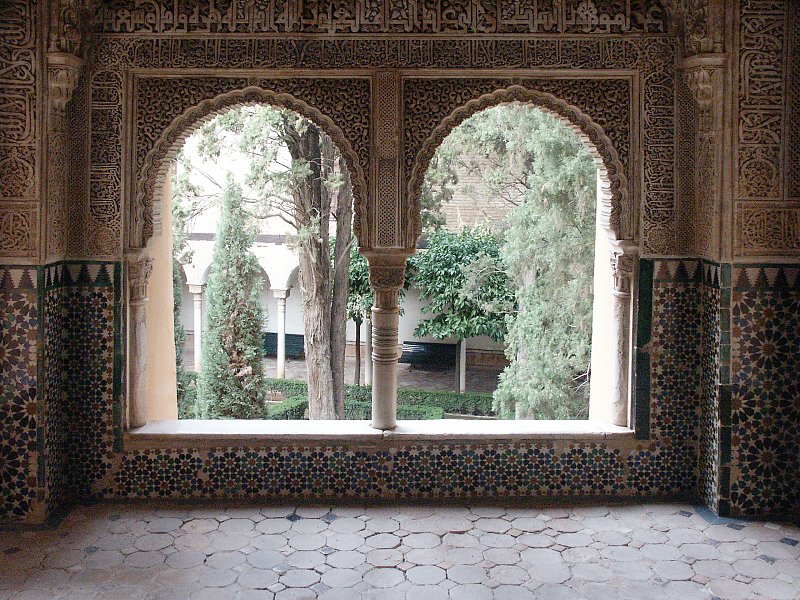
Central to the Alhambra complex is the Nasrid Palace, mostly built in the 14th century. It is a labyrinthine complex, and a sumptuous display of Muslim architecture, with marble floors, colourful azulejos (tiles), arabesque stuccowork, artesonado (elaborately patterned recessed wood) ceilings, muqarnas (hanging honeycomb forms, often compared to stalactites), and beautiful, cursive Arabic calligraphy.
There are also gardens, bushes and trees, and an abundance of water -in pools or flowing from fountains. All these we can still appreciate, but there is a lot that is no longer available to us: e.g. there used to be much more polychromatic variety, there were bejewelled furnishings, splendid silk rugs and cushions to sit on, beautifully embroidered drapes, tapestries that echoed the stucco panels, and ornamental vases. We can only imagine, then, how much more opulent the Royal Palaces were in those days.
One of the first Europeans to record his impressions of the Alhambra after its conquest was the German humanist, Hieronymous Münzer. On a trip through Spain and Portugal in 1494, he was entertained in the Alhambra. After taking refreshment, seated on “silk carpets,” he was taken on a tour and was dazzled by the “numerous palaces … stunning gardens bedecked with lemon trees and myrtle bushes … and pools … and numerous fountains gushing with water … I don’t think there is anything like it in all of Europe” (Münzer 93, 95)
Although the Alhambra also charmed Ferdinand and Isabella, and their grandson Charles V, its upkeep was expensive and it fell into neglect during the 17th century as the fortunes of Granada dwindled.
It was only during the wave of romanticism that swept Europe during much of the 19th century that it was “rediscovered” by foreign travellers. Sketches by some of these early tourists (e.g. John Frederick Lewis, David Roberts) give an idea of the dilapidated condition of the Alhambra at the same time that they captured –in their details—something of the true appearance of the Alhambra’s architectural beauty (although sometimes with more than a bit of exaggeration).
Not surprisingly, given its chequered history, the Alhambra required extensive restoration to return it to anything like its former glory. Even so, the quality and accuracy of much of the restoration has been questioned and criticised by some scholars. Still, what remains attracts and dazzles and enchants the waves of tourists who have made the Alhambra one of the most visited historic buildings in the world.
Getting there: Nowadays, the main entrance is near the Generalife gardens, and the easiest way to get there is by bus or taxi (Google “How to get to the Alhambra”). But there is another option: from the Plaza Nueva, take the Cuesta de Gomérez. It’s up hill, but worth the effort.
You enter the Alhambra’s outer perimeter through the Puerta de las Granadas (Gate of the Pomegranates) built by Charles V. As you make your way up the wooded pathway to you left, the sound of running water compensates for the effort and you may just make out the main Alhambra walls rearing above you through the trees to the left. Passing through the impressive Puerta de la Justicia (Gate of Justice), built by Yusuf I in 1348, you find yourself momentarily disoriented. Don’t worry, you are in a double-elbowed entrance, designed to make direct assault virtually impossible.
Once inside the walls, you might expect to see finally those magical buildings that you have read about, but no … the first building you’ll see is the massive, granite Renaissance Palace of Charles V (i.e. if you walk; if you enter near the Generalife gardens, you’ll miss this dramatic first impresssion).
Charles’s palace is well worth a visit in its own right, but as much as anything else it serves as a wonderful contrast to the Nasrid Palace that lies just beyond it, and over which it towers. The contrast between the Nasrid and Renaissance Palaces is as illuminating as the contrast between the Gothic/Renaissance Church within the Grand Mosque of Córdoba,or the Giralda tower alongside the Gothic Cathedral of Seville.
Charles’s palace strike us as epic in proportions where the Nasrid palaces evoke lyrical qualities (interestingly, lyric poetry is a particular strength of Arabic culture; the epic -in the Western tradition- was not cultivated. Compare below: two courtyards, two visions).
Patio de los leones.
Stand still for a moment or walk around the outermost parts (which you can do without a ticket) to get your bearings. However, to see the real treasures of the Alhambra you have to get your admission ticket, which means that you must make your way to the Generalife entrance. (To get there see the excellent map in http://www.planetware.com/map/alhambra-and-generalife-map-e-agg.htm Number 7 is the Gate of Justice entrance, number 42 is the Generalife entrance) Stand still for a moment to get your bearings. Now you are ready for the visit…
Alhambra. Courtyard of Charles V’s palace.
A point of interest: it was Charles V who authorised the building of a church within the Grand Mosque of Cordoba.
Sources. Barracund, Marianne and Bednorz, Achim Moorish Architecture in AndalusiaCologne 1992 Danby, Miles The Fires of Excellence: Spanish and Portuguese Oriental Architecture Reading 1997 Irwin, Robert The Alhambra Cambridge, Mass 2004 Jacobs, Michael Alhambra London 2000 (paperback 2005) Kuhnel, Ernst Islamic Art and Architecture Ithaca 1966 Meri, Josef W & Bacharach, Jere Medieval Islamic Civilization Vol I New York 2006 Münzer, Jerónimo Viaje por España y Portugal Madrid 1991
On a late afternoon, on June 7, 1926, a shabbily dressed elderly man was knocked down and dragged by a tram as he made his daily trip to pray at the church of St. Philip Neri in Barcelona.
He was unconscious but several taxi drivers refused to drive him to a hospital. Passers-by cared for him until a police officer finally took him to the Hospital de Santa Creu. He carried no identification, so nobody knew who he was. Only after he was reported missing did it become clear that he was Antoni Gaudí i Cornet, Catalonia’s best known architect.
Three days later Gaudí died. The news spread like wildfire and thousands of mourners lined the streets to pay their respect. He was buried in the crypt of the Sagrada Familia (Holy Family), the church (basilica since 2010) to which he had devoted his life since 1883, and exclusively from around 1913.
The nature of Gaudí’s death illustrates something of the last years of his life. He often went unrecognised even though he was famous. He generally shunned publicity, but about everyone in Barcelona knew his works, and his still unfinished Sagrada Familia church is now one of the most visited buildings in Spain, vying with Granada’s Alhambra Palace and Córdoba’s Mezquita (Mosque).
Gaudí’s funeral, 1926
Antoni Gaudí was born on June 25, 1852, in the Catalan town of Reus, just inland from the ancient Roman sea port of Tarragona. There are, however, some who argue he was born in the nearby village of Riudoms, where his parents had a house.
Early in his life Gaudí called Reus his birthplace in his documents, but in 1915 he claimed he was born in Riudoms.The change may have been prompted by the rejection of his plans for the restoration of the Misericordia sanctuary of Reus at around this time.
Son of a modestly prosperous family of metalworkers, Gaudí suffered when still young from bouts of rheumatism. Advised by doctors, he became a vegetarian, and took country excursions to help improve his health. On these excursions, he developed a passionate interest in nature: from the shapes of rocks and stones to the interrelationship and structure of trees, plants and flowers, the detailed forms of birds, insects and animals and the weird and wonderful variety of sea creatures.
These all became integral elements of his architecture, and underlined –as he became more religious- his belief in the sanctity of nature as an expression of God’s omnipotence. In short, Nature was God’s creation, His “building.”
When he was 17 (1869), Gaudí went to Barcelona to study at its School of Architecture. He proved to be an unorthodox student, neglecting course work and spending hours in the school’s library devouring books on Moorish or Indian architecture.
It was here that he was exposed to the writings of the English art critic and social thinker, John Ruskin, and the French architect Eugene Viollet-le-Duc whose book on French Gothic architecture was widely admired.
Gaudí’s years at the School of Architecture coincided with Catalonia’s Renaixença (Renaissance), a cultural rebirth that reflected the European Romantic movement’s love of local colour and historical exoticism. In Spain, one of the strongest offshoots of Romanticism was costumbrismo, a deep interest in local traditions and regional history.
By about 1890, the Renaixença had morphed into another movement called Modernisme as Catalonia absorbed and adapted a widespread European cultural movement known as Art Nouveau. Modernisme combined the Renaixença’s revival of Catalonia’s cultural history with Art Nouveau’s love of aesthetic, decorative elements: e.g. stained glass, ceramics, sculptures, mosaic tiles, wrought ironwork and vibrant colours.
Park Guell. Sculpted “trees” and Nature. Gaudí sought to complement nature which he saw as God’s “building.”
Together with Art Nouveau’s preference for curves over straight lines, Modernisme also combined brick and unfinished stone and wood, and integrated elements of Oriental/Moorish and Gothic architecture. Nature was incorporated into designs, often stylised but recognisable: e.g. plants, leaves, flowers, butterflies, shells, sea creatures, and humble objects such as insects and bugs.
For the modernistas, their products were to be beautiful, not merely functional. Although Modernisme extended to literature, music, art, sculpture, it was in architecture that it made its mark in Catalonia.
Domenech. Casa Lleo Morera. Barcelona
Besides Gaudí, two contemporaries, Lluís Domènech i Montaner (1850-1923) and his student, Josep Puig i Cadafalch (1867-1956), produced remarkable works that would have drawn more attention but for Gaudí’s prodigious inventiveness and originality.
Despite his mediocre academic record, Gaudí impressed the faculty at the School of Architecture sufficiently to graduate in 1878. At his graduation, the chair of the faculty is reported to have said that Gaudi was either a madman or a genius.
Even before enrolling in architecture, Gaudí had developed a great interest in Catalan history, especially the medieval period when Catalonia was a major player in Mediterranean trade and commerce and enjoyed a vibrant literary tradition.
One day, during an excursion into the countryside, the youthful Gaudí and a friend, Eduard Toda, came across Santa María de Poblet**, an abandoned Cistercian monastery and one time royal pantheon.
Moved by the ruined state of arguably Spain’s finest and largest Cistercian abbey, the two drew up detailed plans to restore and repopulate it. For Gaudí and Toda, Poblet symbolised Catalonia’s past identity and greatness and its religious commitment to God; its decay mirrored Catalonia’s fall, the abandonment of its ancient values. Their projected restoration reflected the vibrant activity of the Renaixença, the rebirth of Catalonia’s cultural and, eventually, political identity.
Gaudi as young man, 1878.
As a young man Gaudí was something of a dandy. Blond, blue-eyed, boasting a tinted beard, and elegantly tailored, he cut a fine figure in the streets of Barcelona (a marked contrast to the last years of his life during which he led an ascetic existence).
He enjoyed high society and in 1878 met the industrialist and conservative nationalist Eusebi Güell i Bacigalupi, with whose name Gaudí became indelibly linked. Güell had studied in England and France and in 1878 attended the Paris Universal Exhibition. There he had been very much taken by an unusually designed cabinet and upon enquiry learnt that its designer was one Antoni Gaudí from Barcelona.
Back in Barcelona, Güell quickly tracked Gaudí down in his workshop and soon Gaudí was a welcome guest at the Güell home. Their friendship lasted until Güell died in 1918.Güell was one of several manufacturers dominating Catalonia’s industrial scene during Spain’s Restoration period (1876-1923).
Thanks to Güell’s patronage, family connections and introduction to other business men, Gaudí enjoyed wide support for his ideas.
It was a symbiotic relationship in which both patrons and architect enjoyed the prestige reflected in each other’s achievements. Gaudí’s buildings became eye-stoppers, and their original designs and visual impact fulfilled his patrons’ wishes to be seen and recognised as successful in their careers. In all this, Gaudí’s relationship with Eusebi Güell was similar to that enjoyed by his friend, the poet Jacint Verdaguer, with the family of Antonio López, the first Marqués de Comillas, who as it happens was Güell’s father-in-law! (Eusebi Güell married Antonio López’s daughter, Isabel, in 1871.)
Gaudí and his patrons also shared two important common interests. First, most of the business men were, like Gaudí, Catalan nationalists, even if in their case their nationalism sprang largely from economic concerns (they believed Madrid to be indifferent to their business interests). Gaudí’s nationalism, on the other hand, was inspired principally by Catalonia’s historic culture: its language, history, traditions, architecture etc.
Second, Gaudí’s growing religious conservatism coincided with the industrialists’ use of religion to counter increasing worker radicalism and the rise of anarchism, something that Gaudí associated disapprovingly with liberalism and secularism.
Gaudí’s church/crypt of Santa Coloma for Eusebio Güell’s workers’ estate just outside Barcelona.
To offset that radicalism and create a malleable work force, colonias (i.e. working-class housing estates) were built near factories outside Barcelona (the corrupt hot bed of subversion) where workers received food and housing but were subjected to religious education.
The industrial bourgeoisie even promoted Catholic Workers’ Circles in an attempt to neutralise the anarchist movement. One of the major backers was Claudi López, second Marqués de Comillas, and brother-in-law to Eusebi Güell.
***************** With the support of like-minded patrons, Gaudí enjoyed steady employment. Early on he did do some public work (a design for street lamps for the city of Barcelona in 1878 and a building for a workers’ cooperative in Mataró, also in 1878), but most of his major works were designed for the wealthy of Barcelona. Of his eighteen buildings, twelve are located in or near the city, and seven are designated as World Heritage Sites by UNESCO.
Outside of Barcelona, Gaudí’s main works are to be found, curiously, in the north west of Spain: the Casa (House) El Capricho in the coastal town of Comillas (1883-85), the Bishop’s palace in Astorga (1889-1915) and the Casa de los Botines in León (1891-93). These unexpected locations for Gaudí all have one thing in common: Catalan connections.
The Capricho was commissioned by Maximo Díaz de Quijano, brother-in-law of Antonio López, first Marqués de Comillas (and Eusebi Güell’s father-in-law). The Bishop’s Palace was built at the request of Bishop Juan Bautista Grau, a good friend of Gaudí and also native of Reus, Gaudí’s birthplace. The Casa de los Botines was commissioned by Leonese textile merchants who had formed a business relationship with a Catalan merchant, Joan Homs i Botinàs, who had settled in León. These same merchants also bought fabrics from Eusebi Güell, who recommended Gaudí for the commission.
Over his life, Gaudí fashioned his own style, a synthesis of orientalism (especially Moorish decorative arts, but also Indian and Japanese), Art Nouveau, and Neo-Gothic elements.
Doorway in Casa Batlló.
Into these, he injected his lifelong enthusiasm for nature often intertwined with Catalan nationalistic or religious motifs. Architecture was his passion (which explains perhaps why he never married nor had any amorous scandal attached to his name). He was obsessive about his work, even frequently designing the furniture, doorways, staircases and windows for the buildings he was planning.
“Planning” might not be the right word, because Gaudí did not like to tie himself down to detailed architectural plans but often let his buildings develop organically in imitation of nature.
To illustrate, we can take the description of the art critic, Robert Hughes, of the porch columns of Güell Crypt of Santa Coloma which “are a grove of brick trunks, leaning and striated, sending out branches –the rib vaults—that lace into one another” (Hughes 470).
Crypt of Santa Coloma.
Nature was God’s greatest work and nature came in all shapes and avoided straight lines. “Straight lines belong to men; curves to God,” Gaudí famously explained (in Eaude 96).
As a result, Gaudí’s buildings often seem free of architectural restrictions, expressing the same kind of spontaneous freedom found in nature. Unfinished stone, brick, wood “grow” and light filters through “trees” and “foliage.”Inside, Gaudí’s buildings tend to be intimate and warm, a combination of curves and colours, with ample use of tiles, wrought iron, and stained glass.
Ceilings curve or undulate and roofs are topped by imaginative, even whimsical chimneys. The buildings seem alive, restless, almost fussy in their detailed decoration (e.g. the exterior of Casa Vicens); it can take some effort to absorb it all (e.g. dining room of Casa Vicens, entrance to El Capricho or eastern entrance to the Sagrada Familia).
Chimney pots on roof of Casa Batlló
Gaudi was an innovative architect. He borrowed widely, but his buildings were unorthodox, and he regularly adjusted and modified his ideas for them as he went along. Nevertheless, the complex structural forms were carefully calculated with mathematical precision using models and strings and weights rather than flat drawings or plans. In many ways, this procedure anticipates digital three-dimensional designs done on computers. Gaudí was in many ways a radical architect well ahead of the times.
******************* Reactions to his work have been mixed, and the Sagrada Familia in particular has elicited both condemnation and praise. On the whole, however, opinions are positive. Salvador Dalí and Joan Miró, two fellow Catalans, were enthusiastic in their praise. Even the Swiss-French architect, Le Corbusier –known for his rationalist, straight-lined buildings— in 1928 called Gaudí “the builder of the twentieth century … a great artist” (Eaude 98).
Gaudí’s star dipped with the arrival of Noucentisme in the 1920s with its addiction to straight lines, neoclassical harmony and avoidance of decorative adornments. It also suffered under the dictator Francisco Franco (1939-75) when triumphant civic buildings obeyed the architecture of power, and dreary apartment blocks were reduced to bare-boned functionality.
Nowadays, Gaudí is “in” as endless queues outside the major buildings, and especially the Sagrada Familia, attest.
Since 2000 there has been a formal move to seek the beatification of Gaudí, popularly known as “God’s architect.” The campaign has been favourably received in the Vatican, and the lengthy process of investigation will probably be completed this spring (2015). Gaudí’s piety and humility, his scandal free life and his attribution of his work as a manifestation of the Great Architect (God) all argue in favour of approval.
Beatification, the third step towards sainthood, normally requires evidence of one miracle, canonization –the status of saint—requires proof of two miracles. Whether Gaudí will achieve either of these two ranks remains to be seen; but he will almost certainly be accorded the status of “Venerable,” the second step towards beatification.
The Alhambra** is one of the most beautiful buildings in the world and probably the most popular destination in Spain.
**The Alhambra consists of (1) the Alcazaba or fortress, (2) the Nasrid Palace(s) made up of: the Mexuar; the Court of the Myrtles (Patio de los Arrayanes), the Court of the Lions (Patio de los Leones) and adjoining buildings and gardens; and (3) the Generalife or summer residence.
It weaves its magic on almost all visitors. Muslims from the Middle East and North Africa can relate the Alhambra’s architecture to buildings in their own countries but Westerners find a style very different from what they are accustomed to.
By serendipity, all visitors have a wonderful opportunity to compare both Muslim and Western architectural styles within the Alhambra’s grounds, because standing next to the Nasrid Palace is the Renaissance palace of Charles (Carlos) I/V. The difference between the two palaces is as startling as that between the Great Mosque of Córdoba and the Christian Church in its very centre, or the Cathedral of Seville and its Moorish bell tower, the Giralda.
Charles’s Palace is a majestic granite monument, befitting his imperial title of Holy Roman Emperor. The palace is massive, ordered and symmetrical, and gives a sense of epic grandeur. The Nasrid Palace, on the other hand, is low-slung, labyrinthine and anything but monumental. It conveys an impression of lightness, weightlessness and intimacy and, compared to Charles’s Palace, has a lyrical quality.
Poetry and Calligraphy. The term “lyrical” is appropriate because the Muslim Palace is adorned by lyric verses inscribed in beautiful, cursive Arab calligraphy (decorative handwriting).
Amongst the estimated 10,000 inscriptions found in the Alhambra there are (1) verses from the Qur’an, (2) poems that comment on the features of different rooms, (3) panegyrics (i.e. lavish praise) of various kings of the Nasrid dynasty that ruled Granada, and (4) witty aphorisms.
They run along walls, frame doorways and windows, and are embedded in the stuccoed, arabesque tapestries that stand atop vibrant, multicoloured wainscotings of ceramic tiles (azulejos). The most common inscription is the Nasrid motto: “There is no victor but Allah,” a constant reminder that no human feat surpasses God’s omnipotence.
What is striking about these inscriptions is the beauty of the calligraphy. Calligraphy has always enjoyed high esteem in Arab culture through its association with the Qur’an, the written form of Allah’s final revelation. The word of Allah was holy, and required a beautiful art form worthy of conveying the Qur’an’s message.
We have taken short selections from two poems, both by the poet-statesman (and assassin!) Ibn Zamrak (1333-93). The first can be found in the Hall of the Two Sisters, the most sumptuously decorated room in the Alhambra. It combines praise for the ruler (Muhammad V, ruled 1354-59 and 1362-91) and for the room it appears in.
I am the garden appearing every morning with adorned
beauty; contemplate my beauty and you will be penetrated
with understanding.
I excel through the generosity of my lord the imam
Muhammad for all who come and go….
In here is a cupola which by its height becomes lost from sight,
beauty in it appears both concealed and visible…
The bright stars would like to establish themselves firmly in it,
rather than continue wandering about in the vault of the sky… (Dodds 250)
The second poem -on the rim of the basin in the Court of the Lions—describes the beauty and the attraction of the jets of water: Behold this mass of glistening pearl,
falling within a ring of frothing silver,
to flow amidst translucent gems
than marbles whiter, than alabaster more translucent. (Danby 123)
The Alhambra is, then, more than a series of beautiful buildings; it is literally an anthology of lyric verse, its pages always open and its words waiting to be transformed into jewels of sound. Not surprisingly, the Alhambra has been compared to a book. E.g. “A text-laden building, an inhabitable book” (Irwin 88), the “most luxurious edition imaginable” (Dodds 250)
Although most of us are unable to read the inscriptions of this particular “book,” we can appreciate their beauty and the way they are integrated into the decorative elements of a larger arabesque mosaic, thanks largely to the cursive nature of Arab script which lent itself perfectly to the basic principles of arabesque.
Arabesque. Arabesque is the English term to describe an ornamental style of decoration long associated with Arab culture. Arabesque is basically an art of intricate, repetitive, and symmetrical patterns of intertwined lines. It is, as one critic puts it “characterized by a continuous stem which splits regularly, producing a series of counterpoised, leafy, secondary stems which can in turn split again or return to be reintegrated into the main stem. This limitless, rhythmical alteration of movement, conveyed by the reciprocal repetition of curved lines, produces a design that is balanced and … geometric (D. Jones in Architecture of the Islamic World170-71).
But why did Muslim artists pour their creative energies into such intricate designs? The answer lies in Islam’s general rejection of reproducing anything realistically.
To reproduce human figures ran the risk of idolatry; to attempt to recreate the natural world was to compete with Allah, the one and only creator.
While arabesque is a recognised characteristic of Islamic art, Muslim artists may have been inspired initially by earlier Greek, Roman and Byzantine fondness for scrolling stylised plant or vegetal motifs such as vine tendrils, grapes, acanthus on, for example, the capitals atop of columns.
Byzantine capital from Hagia Sophia, Istambul. Built between 532 and 537 A.D. Wikimedia.
Early examples of arabesque were more modest than those we see in the Alhambra, but even then they were characterised by being “denaturalised” or “dematerialised,” i.e. they lost their individuality in the general decorative, ornamental pattern. With more intricate forms came a wider array of stylised plants – e.g. clover, tulips, roses, almond blossoms, pine cones and palm leaves. In the Alhambra, particular favourites are pine cones and palm leaves.
The vegetal motifs are sometimes referred to as “ataurique,” from the Arabic al-tawriq, meaning vegetation.
Arabesque decoration is not only ornamental, it also breaks up structural mass. Combined, as it is frequently, with muqarnas (a sculptural transition shaped much like a honeycomb or stalactite) or arches, arabesque helps dissolve sharp contours thus creating a sensation of suspension.
In contrast to Western architecture’s emphasis on structure (e.g. Romanesque or Gothic churches), Islamic architecture aims to create the sensation of weightlessness. The Court of the Lions and the Hall of the Two Sisters h ave wonderful examples of this.
What we get as a result is abstract, sensuous art, without the restrictions imposed by figural representation. Consider, as comparison, medieval paintings of Christian saints**. True, they were not normally realistic, and even when they were reasonably so we require some knowledge of the symbols normally accompanying the figures in order to identify them: e.g. a key will identify St Peter. If you don’t know that a key is a symbol of St Peter, you are excluded from the full meaning of the image. Arabesque, on the other hand, is much more inclusive, appealing to our aesthetic spirit. It calls us to enjoy and appreciate “art” without preconditions, and in that sense is amongst the most universal of all art.
**In the Middle Ages, when most people were illiterate, Christian art used sculpture and painting as a visualmemory aid for the faithful to the Bible and to Christian ethics. St Bonaventure puts it this way: Images were made for the simplicity of the ignorant, so that the uneducated who are unable to read scripture can, through statues and paintings of this kind read about the sacraments of our faith in, as it were, more open scriptures…. (Binski).
Nevertheless… It’s easy to forget, as we marvel at the magnificence of the Alhambra palace, that it formed part of a fortress and defensive system erected to face the threat of Christian expansionism from the north.
The kingdom of Granada signalled the last stand of the once powerful Muslim state of al-Andalus. But fierce competing rivalries from within the kingdom also played a significant role in its demise. Violent palace intrigues and assassinations plagued the politics of the country, and the history of the Alhambra –the jewel of Granada- is steeped in skulduggery and blood.
The Alhambra remains the jewel of Granada, one whose splendour beguiles us nowadays while concealing a bloody past. We’ll give the last word to the poet-statesman-assassin Ibn Zamrak, whose image of the Alhambra -atop the Sabika hill- as a ruby cleverly evokes images of both beauty and blood:
The Sabika hill sits like a garland on Granada’s brow,
In which the stars would be entwined,
And the Alhambra (God preserve it)
Is the ruby set above that garland.
Granada is a bride whose headdress is the Sabika, and whose
jewels and adornments are its flowers. (Harvey 219)
Look under “Castles in Spain,” and the Alhambra is certain to figure in any list. It was a castle, and more … in fact, it was a mini city, with the star attraction being the magnificent royal residence complex generally referred to as the Nasrid Palace (sometimes pluralised, Palaces), after the founding dynasty of the kingdom of Granada.
The Alhambra is impressively large, and with powerfully constructed exterior walls it fulfils the general function of castles: fortified structures meant to defend against attackers.
It was built and strengthened at a time when Christian expansionism in the 13th century from the north threatened to overrun what was left of the once powerful Muslim state of al-Andalus.Córdoba(1236), Valencia (1238), Seville (1248), and Murcia (1243) fell quickly, leaving only the kingdom of Granada.
The Nasrid kingdom of Granada The Nasrid kingdom of Granada. Dates indicate year when towns fell to Christian forces.
There are several reasons, amongst them the willingness of the king, Muhammad I (ibn Nasr), to help Christian forces in their conquest of both Córdoba and Seville; he further agreed to become a vassal of Ferdinand III, King of Castile.
Other important factors to explain Granada’s survival as an independent kingdom include e.g. the kingdom’s mountainous terrain, which made it difficult to conquer; Castilian energy was diverted by dynastic wars in the 14th century; also in the 14th century a bubonic plague disrupted social patterns; there was always the fear that fellow Muslims in North Africa might come to the aid of Granada…
Palaces and Power.
The Alhambra was not only the jewel of Granada, it was also the centre of political power in the kingdom, and the Nasrid Palace was its heart. As royal residence, the Nasrid Palace was meant to impress, and despite a prolonged period of neglect (see History), it has worked its charm on most visitors, from the Catholic Monarchs, Ferdinand and Isabella (conquerors of Granada in 1492), to millions of modern tourists.
People have remarked on its delicate arabesques, decorative muqarnas (honeycomb-like niches), slender columns, latticed windows, ornamentation, tinkling fountains, sense of lightness and feeling of intimacy etc.
These features have led many to attribute feminine qualities to the Nasrid Palace. Others, less enthusiastic, have attacked it as effeminate, and compared it unfavourably to the massive, granite Palace of Charles (Carlos) I/V that adjoins it.
Charles’s Palace exudes power and majesty; its size, symmetry, impression of weight, and lack of exuberant ornamentation suggest restraint, dignity and authority.
Palace of Charles V within the Alhambra. M. A. Sullivan
If the Nasrid Palace does not communicate power or authority through size and grandeur, where then did the authority of the kings of Granada rest? Was there anything in the architecture of the Nasrid Palace that signalled power?
Well, the sheer splendour of the Nasrid Palace may be viewed as a source of power. The palace is as awesome in opulence as Charles V’s Palace is in size.
Only two years after the conquest of Granada by Ferdinand and Isabella, the German humanist and geographer, Hieronymous Münzer, praised the palace enthusiastically: “I don’t think there is anything like it in all of Europe. It is superb, magnificent and exquisitely constructed with so many different materials that you could believe yourself to be in paradise” (95).
It’s not difficult to imagine how the awe registered on the faces of visitors could easily be translated into respect for the owner of such splendour, although the materials used were in fact relatively poor: wood, stucco, brick (only the marble paving and columns were of durable materials).
However, these materials were disguised by rich ornamentation that dazzled the eyes, while the ever-present channels of water, fountains and pools entertained the ears. Implied beneath all this splendour, of course, is the idea of wealth, and wealth is often allied with power.
Opulence alone, however, is insufficient as a source of power; it can, as noted, be considered effeminate. But there are further means to convey power. One way was to create uncertainty in the visitor and a sense of mystery regarding the presence of the ruler.
The labyrinthine layout of the Nasrid Palace lent itself perfectly to such ends. There are narrow passages, blind alleys, dead ends, and rooms at odd angles. Visitors (including potential assassins!) would be at a disadvantage, disoriented. The ruler determined the route to be taken, thereby securing power in his hands (something like modern shopping stores that oblige us to wander through several aisles until we reach check-out!).
If opulence and disorientation were not enough to impress or cow visitors, the rulers of Granada had one more trick up their sleeve. The centre of power in the Nasrid Palace was the Hall of the Ambassadors, in the Comares tower. The hall is of very modest dimensions.
To reach the king, seated between the alcoves facing the entrance, did not entail a lengthy and intimidating walk, only a relatively few steps.
However, in the centre of the floor there was (and still is) a protected area in which are inscribed the words of the Nasrid motto “There is no victor but Allah.” Since no one dared walk over the name of Allah, visitors approaching the king were inconvenienced by having to step around the central space or remain on the other side, separated from the king by the name of God. It was a subtle but effective way of reminding visitors of the source of authority: i.e. the king’s power was granted by divine authority.
The ceiling, too, conveys a similar message. It is a magnificent artesonado(wooden recessed –coffered—ceiling) cupola made up of over 8,000 pieces of wood. It looks like a never ending display of fireworks, exploding simultaneously against the night sky.
Half stars along the edges suggest infinity and man’s finite reach, i.e. the impossibility of ever containing the heavens within human dimensions. The whole ceiling is awesome and beautiful, and probably had a functional role of transferring some of that awe to the person who sat beneath it: the king beneath the dome of heaven, so to speak.
The power and authority immediately visible in the size and volume of Charles V’s Palace are expressed differently in the Nasrid Palace. They were no less important to the Nasrid rulers than to European rulers, but different architectural traditions led to different ways of expressing such matters.
You can find something similar in the clearly distinctive architecture for Christian and Muslim temples of worship: the church and the mosque. Simply look at the Great Mosque of Córdoba with a Christian cathedral embedded inside it.
Sources. Barracund, Marianne and Bednorz, Achim Moorish Architecture in Andalusia Cologne 1992 Dodd, Jerrilynn in The Legacy of Muslim Spain, ed Salma K Jayyusi Boston 2000, pp 599-620 Irwin, Robert The Alhambra Cambridge 2004 Jacobs, Michael Alhambra London 2000 (paperback 2005) Munzer, Jerónimo Viaje por España y Portugal Madrid 1991 (Transl Ramón Alba)
The Alhambra from the Plaza de San Nicolás in the Albaicín
According to a famous ballad, when the 15th-century Castilian king, John (Juan) II first saw Granada he so fell in love with it that he proposed marriage to it, offering the cities of Córdoba and Seville as dowry.
The ballad begins Abenámar, Abenámar,/ moro de la morería: “Abenámar, Abenámar,/ Moor from the Moorish area/…” Abenámar(Yusuf ibn-Alahmar) ruled briefly in Granada, and was supported by the Christians. In the ballad, King John asks Abenámar to identify the buildings they can see on the hill ahead of them. It is after Abenámar’s reply that what they can see is the Alhambra that the king addresses Granada offering “her” his hand. “She” replies that she is already married.
The city John wooed was not just the urban centre that lay at the base of the hill on which the Alhambra stands, but more specifically the fortified palace complex itself. King John may not have succeeded in obtaining Granada’s “hand”, but his daughter, better known to us as Isabella the Catholic, Queen of Castile, together with her husband Ferdinand, King of Aragón,took it after a long siege in January of 1492 in what was the final act of the long and chequered Reconquista. And with that a new chapter in Spanish history was about to unfold.
Fortunately for us, the fall of Granada did not witness the kind of destruction that had occurred to the palace complex of Madinat al-Zahra when the caliphate of Córdoba collapsed in 1031.
Even so, much of the Alhambra -mosques, schools, barracks, administrative buildings, public baths, a royal cemetery, and a mint- has disappeared, leaving only the alcazaba (“fortress”), the palatial or royal residences and the gardens. Isabella and Ferdinand liked the palatial residences enough to move in for a period, as did their grandson, Charles (Carlos) I/V (who also added the enormous, square Renaissance palace that visitors unavoidably pass on their way to the entrance to the royal residences).
It was the same Charles who gave permission for the construction of a Gothic cathedral within the Great Mosque of Córdoba.
But then came years of neglect and near disaster when Napoleon’s troops -who were quartered in the buildings- attempted to blow up the complex in 1812 when withdrawing from the city during the Spanish War of Independence (better known outside Spain as the Peninsular War). Squatters, visitors who carved their names on the walls or hauled off tiles and pieces of stucco, fires –some deliberately set — added to the depredation. At various times, the Alhambra housed convicts and galley slaves, and served as a hospital and storage space for gunpowder.
Then came the Romantic Movement with its love for the exotic. Andalusia and its Moorish, oriental past were discovered, and writers and artists paid homage to the Alhambra: e.g. Richard Ford, Théophile Gautier, Prosper Merimée, George Borrow, David Roberts to name a few.
But perhaps the best known is the American writer and diplomat, Washington Irving, of Rip van Winkle and Sleepy Hollow fame, whose Tales from the Alhambra, written in residence in 1829, did much to popularise many of the legends surrounding the Moors of Granada.
By 1870 the authorities recognised that they had a treasure in their hands and declared the Alhambra a national monument. Since then a programme of restoration has brought back some of its former glory, although parts of the restoration are ill-conceived and of dubious quality, according to many scholars. Still, for most visitors the work has paid off; the Alhambra is now probably the most visited building in Spain, and widely recognised as one of the most beautiful in the world.
The history of the building of the Alhambra (from the Arabic al-qala al-hamra or “red castle” the red referring to the colour of its walls) dates from the 9th century with an insignificant fortress perched on an outcrop, known as Sabika, at the foot of the Sierra Nevada.
The fortress was then enlarged and strengthened considerably by the founder of the Nasrid dynasty, Muhammad ibn Nasr, and his descendants in the 13th century. Still, the real transformation took place in the 14th century under Yusuf I (1333-1354) and Muhammad V (1354-1391) who were responsible for the labyrinthine Royal Palace most admired nowadays: the Comares Palace ( including the Hall of the Ambassadors, the Court of the Myrtles and the Sala de la Barca), and the Court of the Lions and its adjacent rooms.
These royal residences were built at approximately the same time that King Peter (Pedro) I “the Cruel” of Castile and Leon (born 1334-69, ruled 1350-69) was remodelling the Alcázar Palace (Reales Alcázares) of Seville, and employing masons from Granada among his builders. Not surprisingly, the Royal Palace of Seville is perhaps the Alhambra’s only rival in Spain in sumptuous decoration, but it cannot match the Alhambra’s location, with the Sierra Nevada mountains towering behind it and the fertile plain (vega) of Granada stretching out before it (so unfortunately do the unattractive high rise apartment blocks of the modern city now!).
Historically, what did the Alhambra complex signify? It stood as a declaration of pride and defiance at a time when the fortunes of Islam in the Iberian Peninsula were in decline, and when the southernmost border of thekingdom of Castile was only 90 kilometres away.
Following the battle of Las Navas de Tolosa in 1212, al-Andalus (Islamic Spain) had collapsed dramatically in the face of the rapid expansion of Christian forces: Córdoba had fallen in 1236; Valencia in 1238 (taken by James (Jaume) I, king of Aragón), and Seville in 1248. Granada was surely next in line.
But Muhammad ibn Nasr was a wily ruler. He had already given the Christians a hand in the conquest of Córdoba and ensured his independence by assisting them later in their conquest Seville, and by paying tributary money (paria) to the Castilians. There was nothing new in paying tributes or in helping the enemy; it had long been a pattern by both Christians and Muslims, depending on who had the upper hand.
And so Granada survived for over 250 years as a Muslim enclave in Christian Spain, with the Alhambra its symbolic heart.
We should take care not to romanticise life in the Alhambra. Politically, life was precarious, with rulers deposed or assassinated with alarming regularity.
Seen from below, the muscular, austere outer walls of the Alhambra are imposing and seemingly impregnable. Only after a prolonged siege by the Catholic Monarchs and secret negotiations with the last Nasrid ruler, Abu Abdallah Muhammad XII (better known in Spain as Boabdil), did the Alhambra finally surrender on January 1, 1492.
When Ferdinand and Isabella entered the Alhambra, they were dressed in Moorish finery, a tacit recognition of respect for a culture that had been an integral part of their country’s history for centuries. They were evidently enchanted by what they saw, and stayed for a while in the Royal Palaces, changing only a little, and even restoring neglected parts, using skilled Morisco (converted Muslims) artisans. Undoubtedly, the Royal Palaces were meant to dazzle and impress; they were an architectural statement carrying a powerful message to the infidel that here was a culture that would not fade away with a whimper.
The Alhambra was a cultural “bang” that still resonates, long after the political players have passed. Ironically it is now claimed by many Spaniards as part of their heritage, although admittedly there are also many who are ambivalent and some even hostile.
This has all to do with a long standing argument involving national identity and the positive or negative contributions of al-Andalus to the national character. Conservative Spanish thinkers have hailed the end of al-Andalus, attributing to its culture the same generalities that Western writers -attached to their Christian, European heritage- have ascribed to it: e.g. barbaric, lacking in civilising ability, effeminate, artless… Liberal writers, on the other hand, lament the loss of a civilising force, whose expulsion had profound economic as well as cultural consequences.
Sources. Barracund, Marianne and Bednorz, Achim Moorish Architecture in Andalusia Cologne 1992 Carr, Matthew Blood and Faith: The Purging of Muslim Spain New York, London 2009 Danby, Miles The Fires of Excellence: Spanish and Portuguese Oriental Architecture Reading 1997 Dodds, Jerrilynn Architecture and Ideology in Early Medieval Spain Pennsylvania and London: 1990 Dodds, Jerrilynn (ed) Al-Andalus: the Art of Islamic Spain New York 1992 Dodds, Jerriynn, Denocal, Rosa and Balbale, Abigail The Arts of Intimacy: Christians, Jews and Muslims in the Making of Castilian Culture New Haven, London 2008 Harvey, L. P. Islamic Spain: 1250 to 1500 Chicago 1990 Irwin, Robert The Alhambra Cambridge 2004 Jacobs, Michael Alhambra London 2000 (paperback 2005) Kuhnel, Ernst Islamic Art and Architecture Ithaca 1966 General guide in English: http://www.alhambra.org/eng/index.asp?secc=/alhambra/educational_centres/educational_tour A very useful general plan of the Alhambra can be found in:http://www.planetware.com/map/alhambra-and-generalife-map-e-agg.htm
It is popularly believed that the Court of the Lions (Patio de los leones), the innermost and most private courtyard of the Nasrid Palace, was reserved for the ruler and his harem.
There is no evidence that this was so, although it is a plausible supposition since, of all the courtyards in the Alhambra, this is the most “feminine” in its intimacy, beauty, delicacy and proportion; it is the most romantic part of a much romanticised palace complex.
The Court of the Lions.
During the Nasrid dynasty, the Court of the Lions formed a separate unit, and was united to Court of the Myrtles by a corridor only during the reign of Ferdinand and Isabella. From the corridor, you pass through a modest side door to the small Hall of the Mozarabs (Sala de los Mozárabes) which then opens into the rectangular Court of the Lions with its adjoining side rooms and upper galleries.
In the centre of the courtyard water sparkles from a fountain basin to fall through the mouths of twelve stylised lions into four streams that run towards the colonnaded sides. The pillars -light, slender trunks- gather together in a pavilion at each end of the patio around tiny fountains. Here they support, like a canopy, filigreed, muqarna (honeycomb) arches that echo the protective role of the palm leaves around oasis pools in the desert.
These muqarnas break up the contours of the arches into small, three-dimensional, decorative elements which merge with the surrounding geometric, vegetal and calligraphic ornamentation. Through these stylised palm forests, light filters in patterns that imitate the water in all but sound.
Nineteenth-century sketches show that much of the patio was also filled with flowers and shrubs, more like a garden fulfilling the Koranic description of paradise (an observation often made). However, neither the German humanist, Hieronymous Munzer, nor the Venetian ambassador, Andrea Navagero -two early Christian visitors to the Alhambra following its conquest in 1492-, records the presence of vegetation in the Court of the Lions. But both do comment approvingly on the amount and beauty of the marble in the palace.
Still, the image of shrubs and aromatic flowers is tantalising and, not surprisingly, of all the spots in the Alhambra, it is this courtyard that most weaved its magic over Romantic writers and artists, evoking exotic images and oriental fantasies more appropriate to legend than to history.
One legend concerns the Hall of the Abencerrajes (Sala de los Abencerrajes), to the right as you look from the Sala de los Mozárabes. It became notorious as the scene for the massacre of the Abencerraje family whose leader evidently dallied with the beautiful Zoraya, the king’s favourite, which subsequently led to the downfall of Granada.
The oxidised smears in the fountain, guides will add cheerfully, are bloodstains still visible from the severed heads of the victims said to have been piled in the basin. It makes for a good story as the background to the fall of Granada, something like the Christian tale of Rodrigo’s uncontrolled passion that accounted for the collapse of Visigothic Spain and the rise of al-Andalus.
However, if we pay too much attention to the fountain, we might miss the literal highpoint of this room, the beautiful, honeycombed ceiling framed by an eight pointed star and illuminated by the light that filters through 16 latticed windows.
Opposite the Hall of the Abencerrajes is perhaps the most extraordinarily sumptuous and elaborate of all the rooms in the Alhambra. Called the Hall of the Two Sisters (Sala de las Dos Hermanas) after the plain twin slabs of marble on the floor, this two-storied hall is breathtaking.
Hall of the Two Sisters. Ceiling.
Like the Hall of the Ambassadors, its walls are totally covered: bright azulejo tiles running along the bottom to waist level, and then upwards floral and vegetal motifs in endless permutations, and multisided stars, all interspersed with calligraphic borders.
But what is remarkable is the change from the basic square to an octagonal shape about half way up thanks to the intricate play of muqarnas that overhang the corners and line the walls. These honeycomb cells, in turn, prepare us for the climax of the room, the muqarna dome, the cells of which -there are said to be over 5000- burst out from a central star and hang, suspended, in the ring of light that filters through 16 latticed windows at the base of the octagonal dome.
Looked at from the tiny fountain sunk into the floor directly below, the dome looks like a giant exploding star, whose downward movement pauses at the light from the windows before finally cascading down in one last burst via the muqarnas lining the walls and corners.
Another image of cupola of the Two Sisters
It is an extraordinarily poetic image in plaster of the heavens caught in a moment of creative activity. Here, perhaps, is Islam’s answer to those heaven-storming Gothic cathedrals.
Muslim buildings might have been earthbound, but their architects -following a Near Eastern tradition- brought the heavens down to earth, as it were, recreating them within their cupolas but without challenging God, whose presence and power is constantly evoked in the calligraphic inscriptions on the walls.
It is a poetic solution to a theological matter, the poetry here being lyric where Gothic churches evoke epic. Both are in praise of God, but the approach taken -as we can see in the Great Mosque of Córdoba— tells us something about the world view of Christians and Muslims.
At the far end of the Court from the Sala de los Mozárabes is the Hall of the Kings (Sala de los Reyes), also known as the Hall of Justice, after the Catholic Monarchs used it as a court room. The most surprising feature here is the ceiling, divided into three vaults by muqarna arches, each vault containing scenes painted on leather. The middle vault shows ten seemingly Islamic dignitaries –possibly writers, or wise men — seated in council. Given the Islamic strictures on figural paintings, this is quite remarkable.
Alhambra. Hall of the Kings.
Even more startling, however, are the two side panels: they contain hunting scenes, with men and women involved in chivalric activities more in tune with Christian traditions.
The very presence of these three paintings clashes sharply with the honeycombed arches and the abstract floral and vegetal arabesques surrounding them. Naturally, their sources of inspiration and what they represent have provoked considerable debate. Possible sources include French Gothic ivory caskets containing scenes from Arthurian tales, native Castilian chronicles or sentimental romances, or luxury textiles that found their way from northern Europe into Christian Spain and al-Andalus from the 13th century on.
The paintings have been interpreted as an example of Muslim/Christian coexistence (convivencia), whereby Christian painters were commissioned -around 1400- to do the work. On the other hand, that Christians painted these works is not as implausible as it may sound, since exchanges between Christians and Moors was not unknown at the time. For example, Peter (Pedro) the Cruel, king of Castile from 1350-1369, used Moorish artisans from Granada in the rebuilding of the most famous parts of the Reales Alcázares of Seville, and Muhammad V (ruled Granada 1354-59; 1362-91) sought temporary refuge in Peter’s court in Seville.
It has also been argued that these paintings are an instance of “Iberian interculture” whereby figural representations would no longer be alien to Muslims because long interaction with Christians would have accustomed them to figural art. But, whatever their provenance and meaning, they are a unique and tantalising exception to the art of the Alhambra.
There is now an intriguing theory that the Hall of the Kings formed part of a madrasa, a centre for learning and scholarly gatherings. The madrasa itself consisted of the Court of the Lions with its adjoining rooms and upper galleries.
The argument is based on contemporary courtyards in Morocco which were very similar in style to the Court of the Lions and were known to be madrasas. A lengthy quote from Irwin gives a good idea of that similarity: The typical Moroccan madrasa was usually quite small and was built around a central patio paved in marble or tiled and overlooked by galleries. It usually had a fountain or a pool at its centre. The upper storeys of the galleries contained cell-like rooms for the accommodation of students and teachers. What is unusual about Moroccan madrasas, as compared to their Eastern counterparts, is their elaborate decoration, which gives them a rather secular look (Irwin 90).
So, the Court of the Lions: an exotic private space for the king and his harem or a centre for studies and contemplation? It doesn’t really matter which interpretation you opt for (including your own) as you look around , you can still enjoy this aesthetic tour de force.
Sources. Barracund, Marianne and Bednorz, Achim Moorish Architecture in Andalusia Cologne 1992 Danby, Miles The Fires of Excellence: Spanish and Portuguese Oriental Architecture Reading 1997 Irwin, Robert The Alhambra Cambridge: Mass 2004 Jacobs, Michael Alhambra London 2000 (paperback 2005) Meri, Josef W & Bacharach, Jere Medieval Islamic Civilization Vol I New York 2006 Munzer, Jeronimo Viaje por España y Portugal Madrid 1991 (Transl Ramon Alba) Navagero, Andres Viaje por España Madrid 1983 (Transl Antonio Maria Fabie) Casselman: http://digital.library.wisc.edu/1711.dl/Arts.CasselmanImage Sullivan, M A http://www.bluffton.edu/~sullivanm/spain/granada/alhambra/alhambraindex.html A very useful map of the Alhambra can be found in: http://www.planetware.com/map/alhambra-and-generalife-map-e-agg.htmScroll to the bottom of page. The books by Irwin and Jacobs are particularly recommended for anyone visiting the Alhambra.
Visitors go to Granada primarily to see the Alhambra, a Muslim palace-citadel whose fame has made it one of the most visited places in Spain. Once inside, however, they are in for some surprises.
What was once a mini Islamic city now has several recognisably Western buildings, built in the century following the fall of Granada to the Catholic Monarchs in 1492. The most prominent of these buildings is the Renaissance Palace ofCharles (Carlos) I/ V. Although it is the Muslim Nasrid Palace -built mostly in the 14th century- that people head for, Charles’s Palace is well worth a look at.
The close proximity of this Western palace to the Muslim palace affords a unique opportunity of comparing two cultures through their architecture. It’s the secular equivalent to Córdoba’s mosque with a Christian church rising from its very centre.
Charles’s Palace, designed by Pedro Machuca (who had received his training in Italy), was begun in 1527, but never completed until the 20th!
Charles V’s Palace within the Alhambra. M.A. Sullivan
It’s an immense granite square, enclosing a large, circular courtyard. It is structurally imposing, as befits the imperial title that Charles wore. Its enormous façade connotes power, dignity, solemnity; it is majestic, aloof. The heavy-looking, bevelled stones of the lower half of the façade settle the building solidly on the ground.
The impression of weight is inescapable. Straight vertical and horizontal lines predominate; square and rectangular windows are larger and more prominent than the small circular ones. A pediment over the doorway and four accompanying half columns betray classical influence, as do the triple pediments and half columns immediately above. Ionic pilasters (a rectangular column attached to and projecting from a wall) between the upper windows maintain the classical flavour.
The double arcaded courtyard is simple to the point of austere.
Alhambra. Courtyard of Charles V’s palace.
Its columns –Doric on the lower level, Ionic on the upper- are solidly grounded and muscular. There is no colour to speak of; it is a formal space, somewhat forbidding, even under the Andalusian sun.
The overall emphasis in this palace is on structure, the way in which loads and stresses are balanced and counterbalanced. Ornamentation is restrained both on the façade and in the courtyard. In this, Charles’s Palace follows well established principles of Western architecture.
The palace now houses two museums. On the ground floor is the Museo Nacional de Arte Hispano-Arabe, with a large collection of artifacts from the vicinity. One treasure is the exquisite “Alhambra Vase” decorated with gazelles. On the upper level is the Museo de Bellas Artes, with an interesting collection of paintings and sculpture.
The Nasrid Palace immediately strikes us a being very different. Its structural skeleton -brick and wood- is covered by stucco ornamentation and tile. It impresses us with its sense of intimacy, weightlessness, airiness, important features of Islamic architecture.
It isn’t a single building (some writers prefer the plural Nasrid Palaces) and doesn’t look big, although in fact its area is quite large. Its layout is labyrinthine and lacks the order and symmetry we associate with the great European palaces, and see in Charles`s Palace.
The Nasrid Palace is broken up into several units centred around two principal courtyards, the Court of the Myrtles (Patio de los Arrayanes orMirtos) and the Court of the Lions (Patio de los Leones). The main rooms are off these, but there are also baths, hidden alcoves, narrow passageways, secluded corners, dead-ends, and gardens, fountains and pools.
The first room we enter is the Mexuar, where the kings of Granada received their subjects.
What strikes us about the Mexuar, however, is not regal omnipotence, but a sense of intimacy underlined by the very modest dimensions of the room and the low ceiling.
From the Mexuar, we pass via the enclosed Court of the Golden Room (Cuarto Dorado, another very intimate space, with a tiny fountain), through a narrow passage before emerging at the Court of the Myrtles. It is from here that we enter the two-storied Hall of the Ambassadors or Throne Room, the largest room in the complex.
The Hall of the Ambassadors was the centre of power, and it was here where dignitaries were received. Nevertheless, it is remarkably small for the role it played. It has four tall walls, which might strike us at first as giving the room a box-like appearance. However, any feeling that we are enclosed by walls is removed by several prominent, recessed alcoves with windows at ground level, and twenty latticed windows below the ceiling.
Light, entering through the windows, plays along the walls and reveals a profusion of different arabesque tapestries which break up the walls into several decorative components.
Geometrically patterned wainscotings and an intricate artesonado ceiling (elaborately shaped, recessed wood) add to the visual splendour of the room. Even so, what we see now lacks much of the colour that was once a feature of the Hall. The windows formerly had stained glass, and the arabesque tapestries and the artesonado ceiling were multicoloured. How much more breathtaking it must have been to enter a room that was both intimate in its dimensions, and light and colourful in its impact!
The feeling of intimacy, weightlessness, and airiness reaches new heights in the Court of the Lions, the most romanticised part of the palace.
The Court of the Lions.
The difference between this courtyard and that in Charles V’s Palace could hardly be greater. This small, rectangular space has often been called a “paradise.” In the middle there is a fountain whose basin is mounted on twelve stylised lions, from whose mouths the water passes along four channels to each side of the Court.
The channels, in turn, symbolically water the numerous, slender pillars which gather at each end like a miniature palm forest, through which light is filtered. Elaborate muqarnas (honeycomb-like ornamentation) and filigree-like arabesque decoration grow out of and spread above the pillars. They evoke palm leaves, beneath which small fountains recall desert oases.
Nineteenth-century sketches of the Court of the Lions show it planted with shrubs and flowers, and it is tempting to think that it contained a garden during the Nasrid period. But there is no evidence that this was so.
The humanist, Hieronymous Münzer, and the Venetian Ambassador, Andrea Navagero, two European travellers visiting the Alhambra shortly after the fall of Granada in 1492, comment approvingly of the beautiful, large marble paving, but have nothing to say of vegetation.
Slender columns, arabesque ornamentation and muqarnas that dissolve solid lines, the interweaving of light and water… the sensation of airiness, weightlessness, and sensuous elegance in this intimate courtyard is intensified in the two lateral rooms off the courtyard, the Hall of the Abencerrajes and the Hall of the Two Sisters. The latter, in particular, is an exquisite visual tour de force whereby the circular cupola is transformed into an octagon, which in turn metamorphoses into a square, thanks to the clever interplay of muqarnas and arabesque.
If we stand by the small fountain immediately below the cupola and look up, the impression we get is that of an exploding star cascading outwards, dissolving corners and taking on different shapes as it moves downwards to walls covered in arabesque.
As in the Hall of the Ambassadors, light from the 16 latticed windows illuminates the muqarnas (an estimated 5,000 honeycombs) in the cupola and increase the sensation of weightlessness inherent in the cascading effect.
Coming from a desert environment, Arab culture appreciated the value of water. So did the builders of the Alhambra. Both Münzer and Navagero noted its importance. Münzer observed: “The palaces are so beautiful with channels of water arranged so artfully everywhere that nothing could be more praiseworthy. From a very high mountain, the water is brought down along a channel and distributed through the fortress ” (95).
Indeed, water is everywhere in the Alhambra; it was used for coolness, for decoration, in ritual functions in the mosques (which no longer exist), and for the practical purpose of bathing, supplying drink and irrigating the numerous gardens. It has a central function in both the Court of the Myrtles and the Court of the Lions. In the latter it symbolically “feeds” the architectural palms (i.e. columns) running around the Court, while in the Hall of the Abencerrajes and the Hall of the Two Sisters, its tinkling sound complements the visual pleasure of the rooms’ ornamentation and helps convey a sense of repose. [The sound and feel of water have a therapeutic value that modern architects have recognised by introducing fountains and pools into shopping malls.]
The Court of the Myrtles has a rectangular pool, with two shallow fountains splashing lazily at each end.The pool itself is the central feature here.
Stand at either end and you will see the buildings magically reflected in the water, and the material reality of the buildings dissolves into insubstantiality as they shimmer in its changing surface. Even when you stand on the long sides of the pool, the water’s mirroring effect opens up the enclosed space.
Exiting the Hall of the Ambassadors, you can see projecting itself just over the southern end of the Court of the Myrtles, the top of Charles V’s 16th-century palace. It’s a timely reminder of how buildings convey messages. Charles was not only building a palace to reflect his imperial status, he was also asserting Western/Christian presence in the heart of the last remnant of al-Andalus, i.e. Muslim or Moorish Spain.
He had done the same when authorising the construction of a Catholic church within theGreat Mosque of Córdoba. The Alhambra was a defiant gesture at a time when al-Andalus was threatened by extinction. It was an assertion of identity, a statement of its cultural heritage. Ironically, long after the demise of the political entity of al-Andalus, the survival of the Alhambra (and other Islamic buildings) has helped keep alive the history of that culture in Spain.
Sources. Barracund, Marianne and Bednorz, Achim Moorish Architecture in Andalusia Cologne 1992 Danby, Miles The Fires of Excellence: Spanish and Portuguese Oriental Architecture Reading 1997 Dodds, Jerrylin D, Monacal Maria R, Balbale, Abigail K The Arts of Intimacy: Christians, Jews, Muslims in the Making of Castilian Culture New Haven, London Yale 2008 Harvey, L. P Islamic Spain 1250 to 1500 Chicago, London 1990 Paperback 1992 Irwin, Robert The Alhambra Cambridge, Mass. 2004 Jacobs, Michael Alhambra London 2000 (paperback 2005) Michell, George ed Architecture of the Islamic World: Its History and Social Meaning New York 1978 Munzer, Jeronimo Viaje por Espana y Portugal Madrid 1991 Navagero, Andres Viaje por Espana Madrid1983 (Transl Antonio Maria Fabie) The books by Irwin and Jacobs are particularly recommended for anyone visiting the Alhambra. Rose Selavy Wikepedia http://en.wikipedia.org/wiki/File:Palacio_Carlos_V_west.jpg M A Sullivan images: http://www.bluffton.edu/~sullivanm/spain/granada/alhambra/alhambraindex.html Casselman image:http://digital.library.wisc.edu/1711.dl/Arts.CasselmanImage A very useful map of the Alhambra can be found in: http://www.planetware.com/map/alhambra-and-generalife-map-e-agg.htm
Like all architecture, Spanish Architecture is about buildings and buildings are not merely physical structures but also a means of communication. Within Spanish architecture, they reflect community values or pursuits (e.g. Roman coliseums or theatres, Christian, Muslim, Jewish houses of worship).
Buildings inform us of the movement of people, who take their architectural traditions with them in the form, for example, of temples. Spanish architecture also conveys the impact of political events in, for instance, the construction of castles or palaces.
The Moorish castle of Trujillo. Extremadura.
These buildings -temples, castles, palaces— communicated in different ways the idea of power and control, and were meant to last. Others buildings, e.g. the homes of ordinary citizens were less important, although many have survived in the historical quarters of many cities.
When cultures come together on a large scale, or “clash” (to use Samuel Huntington’s term), there may be considerable social upheaval and displacement.
In Spanish architecture, this was expressed in the buildings that the dominant culture erected, and the geographical area that these buildings covered helped to identify the extent or limitations of their presence or power. Such buildings often bore an identifying sign or design (e.g. the design of a church and mosque are quite different), and as the community grew so the buildings became larger or more impressive in some way, both as a more pronounced declaration of self identity and as territorial markers.
As in other countries, Spanish architecture also reflected internal ideological divisions or regional rivalry. Castles, for example, didn’t always signify a means of defence against a foreign force; they might be built by a ruler to reinforce his control within his own territory. In other instances, castles were a visible expression of the power, wealth or prestige acquired by an individual, in which case they were more likely to be palatial than military in their structure.
Buildings as expressions of power, prestige etc. are still very much with us. Take, for example, skyscrapers, for long associated with the U.S.A. They are architectural metaphors of the rise of that country as a world power. Now other growing world powers (e.g. India, China, Brazil) or countries wishing to be “seen” (e.g. Malaysia, Dubai), are all busy constructing skyscrapers or hugely impressive buildings (such as e.g. sports stadiums).
Within this context, the destruction of the Twin Towers in New York on September 11, 2001, was intended to undermine the authority and prestige of the U.S.A. and humiliate Americans, especially as it was carried out by a small group of individuals. It was meant to show, graphically, how the mighty can fall! Ironically, one of the leaders of the attack -Mohammed Atta- was an architect who had written a thesis on modernist architecture in the Syrian city of Aleppo. In the thesis, he suggested that tall buildings were symbols of Western colonisation of the East.
*************
What we want to do in these pages is look over the remarkable variety of architecture in Spain. We’ll start with the Romans who controlled Spain for some 600 years, and left one of the richest and most varied architectural legacies of all, including walled cities, theatres, amphitheatres, arenas, aqueducts and bridges.
Roman aqueduct in Segovia.
The Middle Ages are a particularly exciting period in Spanish architecture because of the meeting of two major cultures: Christian and Muslim (Moorish is the usual term in the Spanish context).
Córdoba’s mosque-church. To the left the high vaulting of the church, to the right the low slung mosque. Two views of approaching the same God.
We hope to show how Christian and Moorish architecture reflects their different perspectives of the world or of changing circumstances; this is particularly so in their houses of worship (Romanesque and Gothic cathedrals and churches, and Muslim mosques), palaces and castles. We’ll also explore a very interesting phenomenon in Spanish architecture: Mozarabic and Mudejar architecture, the results of the close proximity in which Christians and Moors lived.
As we move from the Middle Ages, we’ll try to explain how changing political or social factors are reflected in Spanish architecture. For example, what was behind the appearance of Renaissance and baroque buildings in Spain in the 16th and 17th centuries? What was the impact on Spanish architecture of a change of royal dynasty in the 18th century or of Romanticism in the 19th century? Finally, we’ll look at the effects of political instability in the first half of the 20th century on Spanish architecture, then the Franco dictatorship, and finally the resurging vitality of the post-Franco years, with both native-born and foreign architects producing stunning architectural works.




.jpg)


_-_40.jpg#/media/File:Cripta_de_la_Col%C3%B2nia_G%C3%BCell_(Santa_Coloma_de_Cervell%C3%B3)_-_40.jpg)

.jpg#/media/File:Gaud%C3%AD-Ragonesi_(1915).jpg)


