Gothic Architecure: Background.
Gothic Architecture
Of all the buildings associated with the Middle Ages, few conjure up more admiration now than the Gothic cathedral. And yet it was not always so. In fact the description “Gothic”** was coined during the Renaissance as a derogatory term for bad taste when compared to elegant, classical architecture.
**“Gothic” still retains an element of disapproval:
Gothic novels, for example, are often characterised
by desolate settings, stormy skies and violent,
macabre incidents mixing horror and romance.
The Oxford and Webster dictionaries include
“barbarous,” “uncouth,” “rude,” in their
definitions of “Gothic.” Lately it has been vaguely
associated with the vogue for vampires.
Gothic novels, for example, are often characterised
by desolate settings, stormy skies and violent,
macabre incidents mixing horror and romance.
The Oxford and Webster dictionaries include
“barbarous,” “uncouth,” “rude,” in their
definitions of “Gothic.” Lately it has been vaguely
associated with the vogue for vampires.
Gothic architecture first appeared in northern France in the mid 12th century and evolved at a time of far reaching changes: population increase, new trade roots, economic revival, technological advances (from refined water-power techniques to improved commercial enterprises thanks to the introduction of Arabic numerals and the zero --via Spain-- and the introduction of paper --the first paper mill in Europe was opened in Spain in 1151), and a renaissance of intellectual activity best seen in the emergence of the universities in the 13th century: e.g. Bologna, Paris, Oxford, Cambridge, Salamanca. For some 400 years, the Gothic style dominated the architecture of Western Europe, inevitably leaving a profound legacy.
Like Romanesque, Gothic was a phenomenon admitting different kinds of buildings (palaces, castles, hospices, town and guild halls), but found its greatest expression in church related structures, in particular the great cathedrals that span Europe. The Church was after all the most prolific builder of the Middle Ages, and the one body that could move people to a common cause and gather money with relative ease to undertake large scale projects. Unlike Romanesque architecture, however, which radiated from rural monastic orders, and ranged in size from small rural churches to large cathedrals, Gothic churches were the fruit of urban interests and generally built on a large scale. Promoted by bishops, royalty and the city fathers of growing towns, their construction involved the entire urban population --merchants, townsmen, peasants,
"The faithful were for the
first time to be seen
pulling carts laden with stones, wood, wheat
and other supplies needed for the building of a
cathedral. … People everywhere humbled
themselves, did penance and forgave their
enemies. Men and women were seen carrying
heavy loads through bogs, singing and praising
the wonders of God….” “ Since the cathedral was
the symbol of God’s omnipotence, participation
in its construction became something akin to a
mystic experience. This explains the popular
character of Gothic style." Praeger 198.
pulling carts laden with stones, wood, wheat
and other supplies needed for the building of a
cathedral. … People everywhere humbled
themselves, did penance and forgave their
enemies. Men and women were seen carrying
heavy loads through bogs, singing and praising
the wonders of God….” “ Since the cathedral was
the symbol of God’s omnipotence, participation
in its construction became something akin to a
mystic experience. This explains the popular
character of Gothic style." Praeger 198.
*********
Gothic style has several characteristics that distinguish it from Romanesque, but in its general plan it shared many features with its predecessor: e.g. a long nave and two side aisles crossed by a transept, a choir and apse with ambulatory and radiating chapels, the use of towers, a major portal of the west front (usually three doors in the large churches). However, thanks to a new understanding of structural stresses, Gothic buildings rose to unprecedented height.
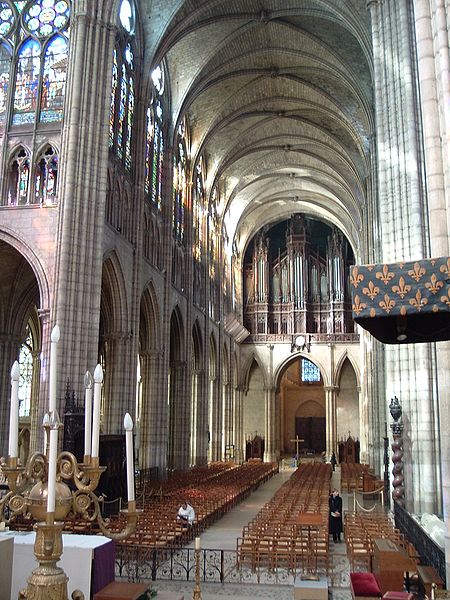
St Denis, Paris. "Template" for
Gothic cathedrals. Enlarge.
Following and adding to the Romanesque pattern, the west front of the large cathedrals was flanked by two impressive towers, now typically topped by spires or pinnacles.

Leon Cathedral: West Entrance. Enlarge.
What strikes visitors to the great Gothic churches is their luminosity, verticality and sense of weightlessness. If the Romanesque church was solidly rooted to the ground, the Gothic soared as if trying to break the bondage of stone to storm the heavens, and our eyes are drawn upwards pulled by the structure points of the arches, the slender pillars and the coloured shafts of light emanating from above. With the passage of time, the glass in some churches became overpowering: the dark blues and ruby reds almost reducing the light itself but at the same time giving it a luminosity that is almost palpable. If Romanesque comforts in its solidity, Gothic moves spiritually, even mystically some say, like a vision of paradise on earth, or a heavenly Jerusalem.
As was the case with Romanesque, Gothic style was not limited to architecture; it encompassed art, sculpture, and illuminated manuscripts.
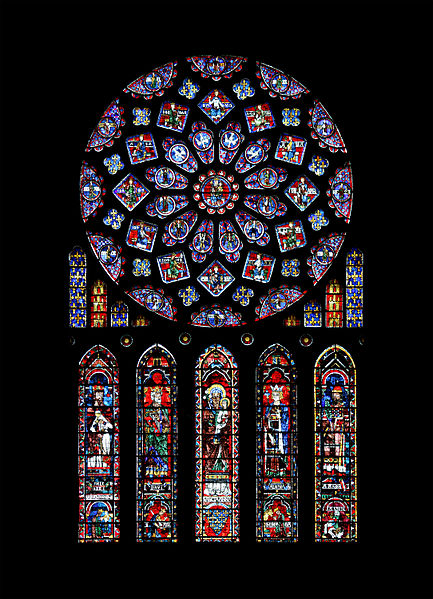
Chartres Cathedral, France.
Example of rose stained glass
window, ca 1235. Enlarge.
*********
As with any form that lasted some 400 years and was prevalent throughout a wide area there was no complete uniformity of style. There was early Gothic, high Gothic, flamboyant Gothic, English, French, German, Italian, Spanish Gothic and so on. Clearly, from the international nature of both Romanesque and Gothic architecture, more cross border travelling took place than is generally credited for in the Middle Ages. Pilgrimages, commerce, royal marriages, alliances, wars (including the Crusades), ecclesiastical studies and appointments, the expansion of churches and monasteries, and the building opportunities offered to itinerant master masons, sculptors and craftsmen all stimulated travel.
Romanesque and Gothic entered Spain largely on the backs of travellers. Romanesque presence in Spain owed much to the cult of St. James (Santiago) and to the Benedictines monks of Cluny who facilitated the popular pilgrimage by building roads, bridges, monasteries, churches and shelters along the north of Spain to Santiago de Compostela. Gothic spread in similar fashion, often overlapping or combining with Romanesque. For example, the central town of Avila is just the place to see this transition from Romanesque to Gothic. It boasts some striking Romanesque churches, e.g. San Nicolás, Santiago and San Pedro.
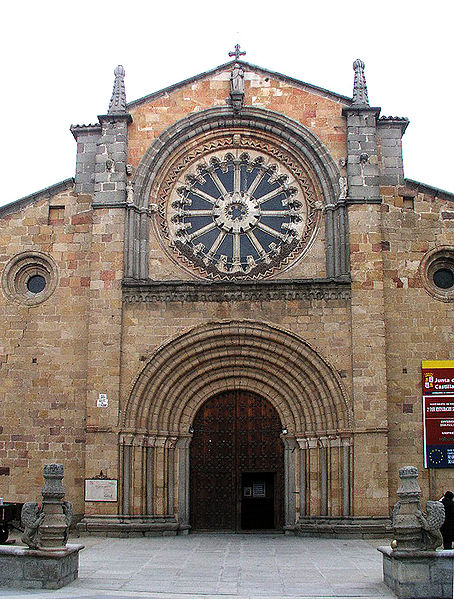
Avila: San Pedro
Click to enlarge.

Avila: Cathedral apse.
Click to enlarge.

Avila: San Vicente. Note Romanesque
pillars separated by rounded
Romanesque arches. In between, Gothic
vaults over the nave. Enlarge.
San Vicente lies outside the walls, and is primarily Romanesque but the nave is Gothic, the change being made when master builder Fruchel took over construction in the second half of the 12th century.
Historical note: The man responsible for the fortified walls of Avila was the French noble, Raymond of Burgundy, son-in-law of Alfonso VI (king of Castile-León (r. 1065-1109), and one of many French knights enlisted by Alfonso VI to consolidate his hold over the recently conquered Muslim taifa (mini state) of Toledo (Toledo was taken by Alfonso in 1085). At the same, several monks from Benedictine Abbey of Cluny arrived, invited by Alfonso VI to undertake reforms of the liturgy. It was they who introduced the Roman liturgy at the expense of the Visigothic liturgy (now known more commonly as the Mozarabic liturgy). French presence, then, was substantial and its impact far reaching.
Cistercian Architecture.
Given the close links between France and the Christian kingdoms of Spain in the 11th and 12th centuries (through e.g. marriage, the activities the Benedictines, French knights helping to repel the Almoravids and Almohads), it was virtually inevitable that French cultural impact would be felt. So it was that Romanesque art and architecture entered the peninsula, and the same applies to Gothic. Many scholars also point to the contributions of the rebellious offshoot of the Benedictines, the Cistercians, who objected to the decadent life style then enjoyed by the Cluniacs. The Cistercians erected some sixty strikingly simple, plain (to the point of austerity) monasteries along the north from Catalonia to Galicia. The most beautiful are probably the monasteries of Las Huelgas 1187 (Burgos), Santa María de Huerta 1179 (Soria), Santa María de Poblet ca 1170 and Santes Creus ca 1160 in Aiguamúrcia, Catalonia.
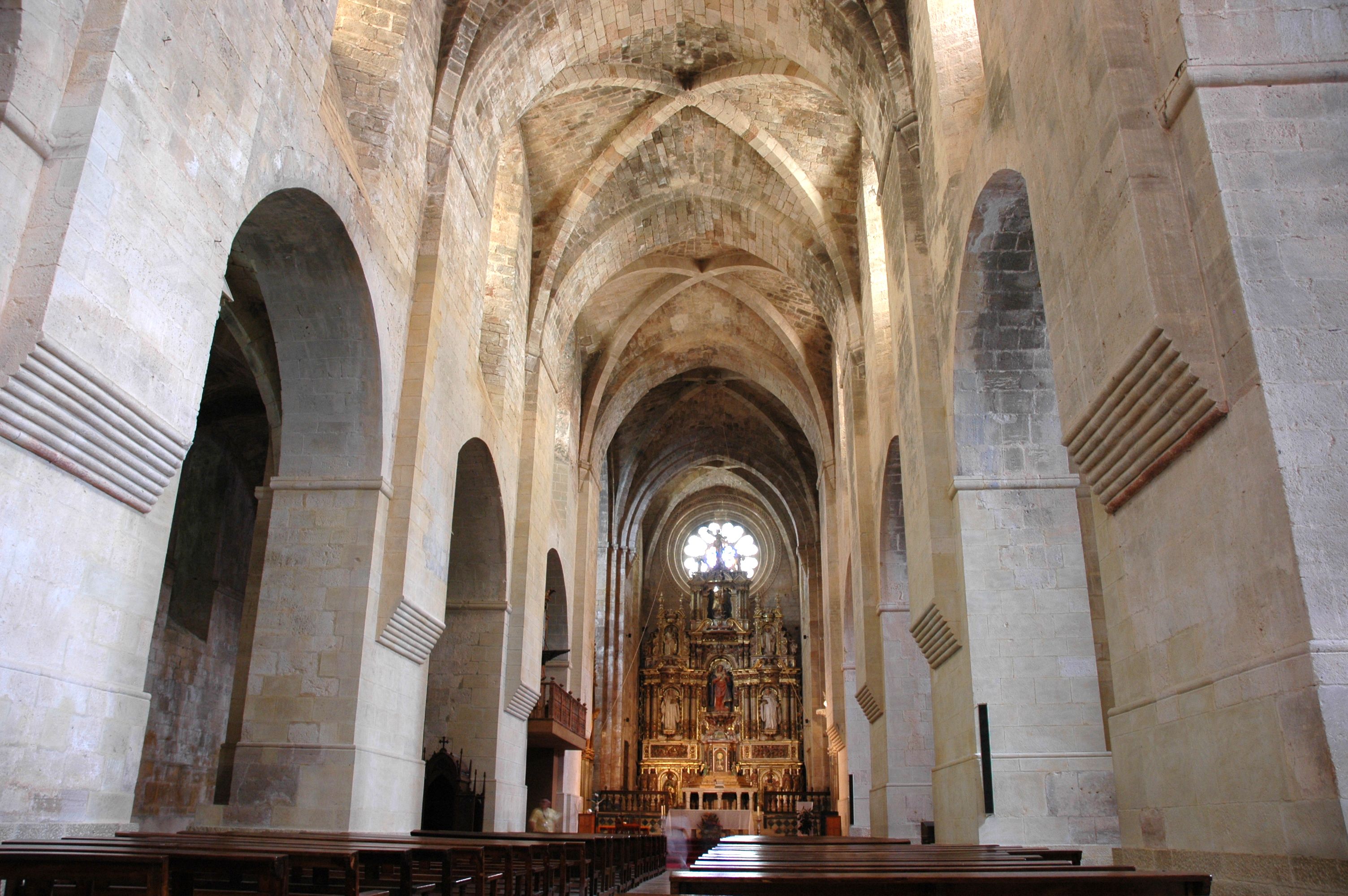
Monastir de Santes Creus, Catalonia.
Note the solid Romanesque pillars and
rounded arches. The nave, however, and
the arch above the altar are Gothic.
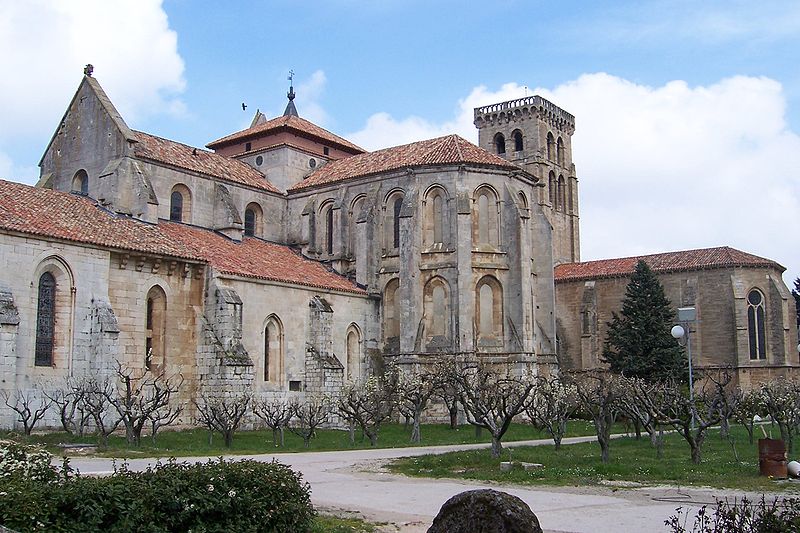
Monasterio de las Huelgas, Burgos.
Note the longer Gothic style windows
and taller apse in a basically
Romanseque outline. Enlarge.

Santa María de Huerta, Soria.
Sources:
Barral I Altet, Xavier ed Art and Architecture of Spain Boston 1998
Coldstream, Nicola Masons and Sculptors Toronto 1991
Dodds, Jerrilynn Architecture and Ideology in Early Medieval Spain Pennsylvania and London 1990
Heer, Friedrich The Medieval World New York 1962
Norman, Edward The House of God: Church Architecture, Style and History London 1990
The Praeger Picture Encyclopedia of Art, New York 1962
White, Robert A River in Spain: Discovering the Duero Valley in Old Castile London, New York 1998
Image of St Denis by Milkbreath: http://en.wikipedia.org/wiki/Basilica_of_St_Denis
Image of Leonby by Rastrojo : http://en.wikipedia.org/wiki/Le%C3%B3n_Cathedral
Image of Chartres by Eusebius (Guillaume Piolle): http://en.wikipedia.org/wiki/Chartres_Cathedral
Images of Avila by Roberto Abizanda : http://en.wikipedia.org/wiki/%C3%81vila,_Spain
Image of San Pedro, Avila by Håkan Svensson: http://en.wikipedia.org/wiki/File:Avila_San_Pedro_View.jpg
Image of San Vicente by Outisnn: http://es.wikipedia.org/wiki/Bas%C3%ADlica_de_San_Vicente_%28%C3%81vila%29
Image of Las Huelgas by Lourdes Cardenal: http://es.wikipedia.org/wiki/Monasterio_de_Santa_Mar%C3%ADa_la_Real_de_Las_Huelgas
Image of Santes Creus by Josep Renalias: http://en.wikipedia.org/wiki/Santes_Creus
Image of Santa María de Huerta by Ecelan: http://commons.wikimedia.org/wiki/File:Monasterio_de_Santa_Mar%C3%ADa_de_Huerta_-_Iglesia_-_Interior_desde_el_pie.jpg?uselang=es


