Granada from the 17th to 20th Century
Following the conquest of Granada in 1492, the victorious Christians quickly established their presence, converting mosques into churches, building new churches, monasteries, convents and a large cathedral where the grand mosque had once stood. Much of what identified the city as Muslim still remained (the Alhambra, the Albaicín), but Christian architecture was evidence of a new direction in the destiny of the city.
The flurry of building in the 16th
century slowed down in the 17th century as the city went into a long
decline, as did much of the rest of
The situation did not improve in the 19th
century. And but for a stroke of fortune
Granada might easily have lost its most prized treasure and source of much of
its economic wellbeing… the Alhambra. In the early years of the 19th
century, the city was taken by Napoleon’s troops during the course of the
Peninsular War (or War of Independence to Spaniards). The French not only stationed
their soldiers in the
What is clear from travelers’ reports at
this time is that Granadinos themselves were indifferent to the beauty of the
Modern Granada
Since the death of Franco (1975),
The high rise buildings that have invaded
the plain ("vega"), and the congested traffic are the scourge of modern urban
sprawl. Modern
Granada: the Albaicín and the Return of Islam
Standing above the noise on their
respective hills overlooking the modern city, the Albaicín (or Albayzín) and
the
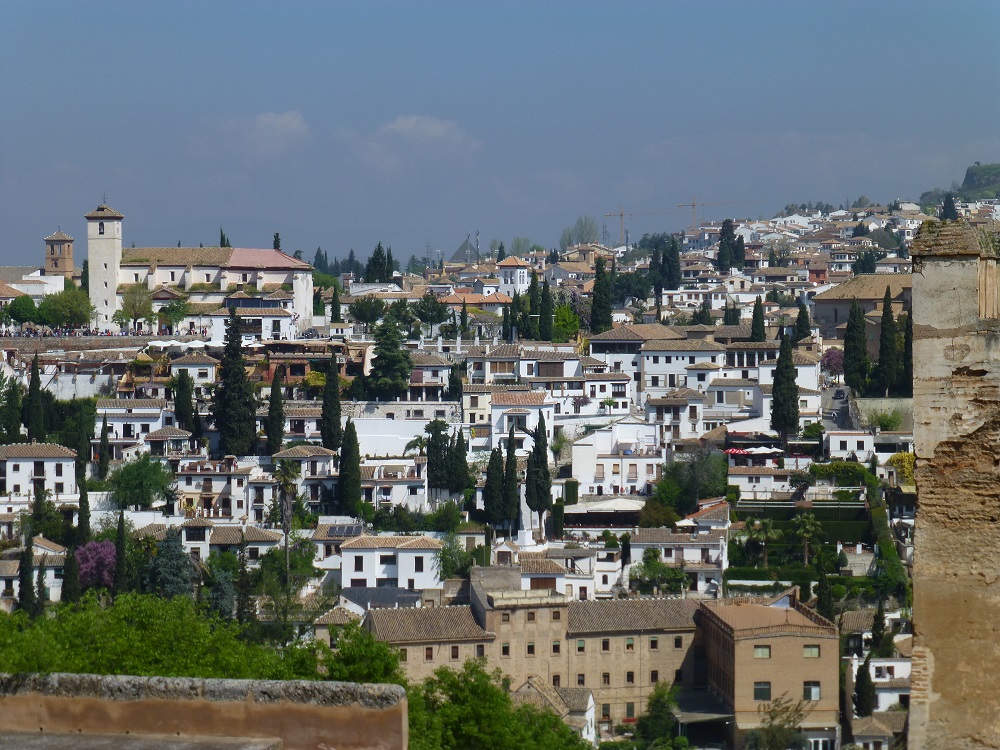
Albaicín. San Nicolás church to the right. The new
mosque's minaret can be made out in the middle top.
This is especially
so in the Albaicín, with its hilly, narrow, winding streets and intimate squares. It is to the Plaza de San Nicolás that many
tourists go for a distant view of the
It is views like this that prompted the 20th-century
Mexican poet and diplomat, Francisco Alarcón de Icaza, to exclaim: “dale
limosna mujer/ que no hay en la vida nada/
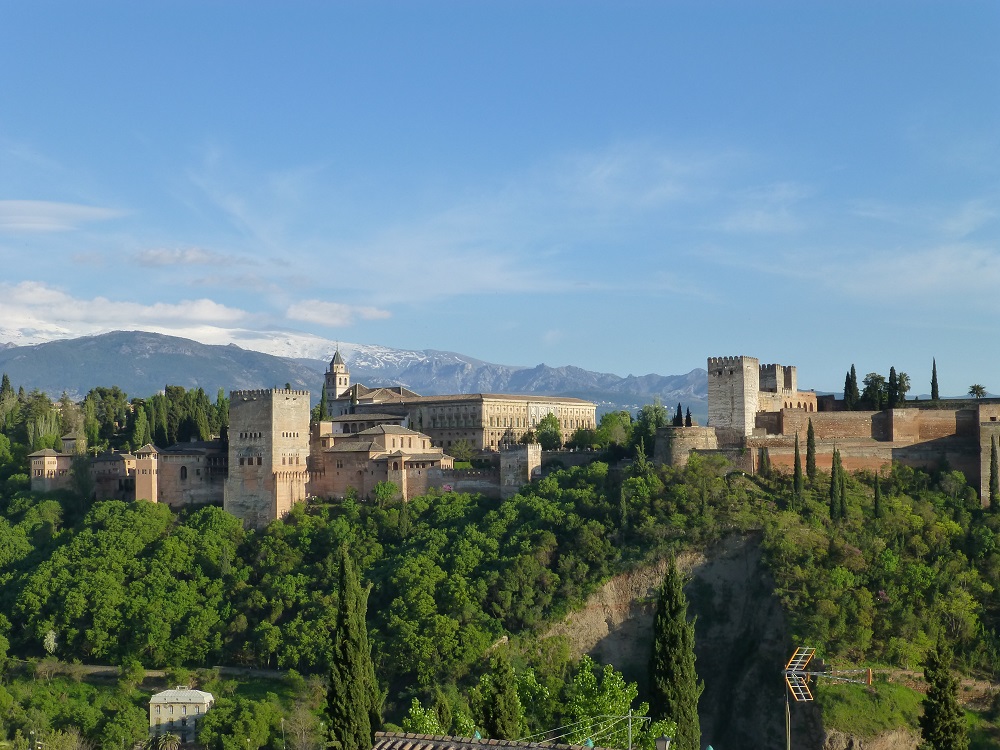
Alhambra from Plaza San Nicolás.
These lines can now be found in several spots in the city.
A feature of the Albaicín are the “cármenes,” Moorish-style houses set in gardens with
flowers, fruit trees, plants, fountains, and slender, vivid green cypresses,
all enclosed by high walls. They are to old
Another much more recent feature of the Albaicín is the presence of Muslims, many of whom are converts to Islam. In the streets of the Albaicín now you can find tea houses serving mint tea, coffee, juices accompanied by Arabic music and Arab news reports on the radio. There are halal butcher shops, and bakeries selling baklava and kenafa (a soft cheese), and shops that sell leather goods, sandals, incense, spices etc. During the holy month of Ramadan some shops display signs in their windows wishing passersby “Feliz Ramadan.”
Nevertheless, the major Muslim attraction in the Albaicín is the new mosque sitting next to a convent close to the Plaza San Nicolas.
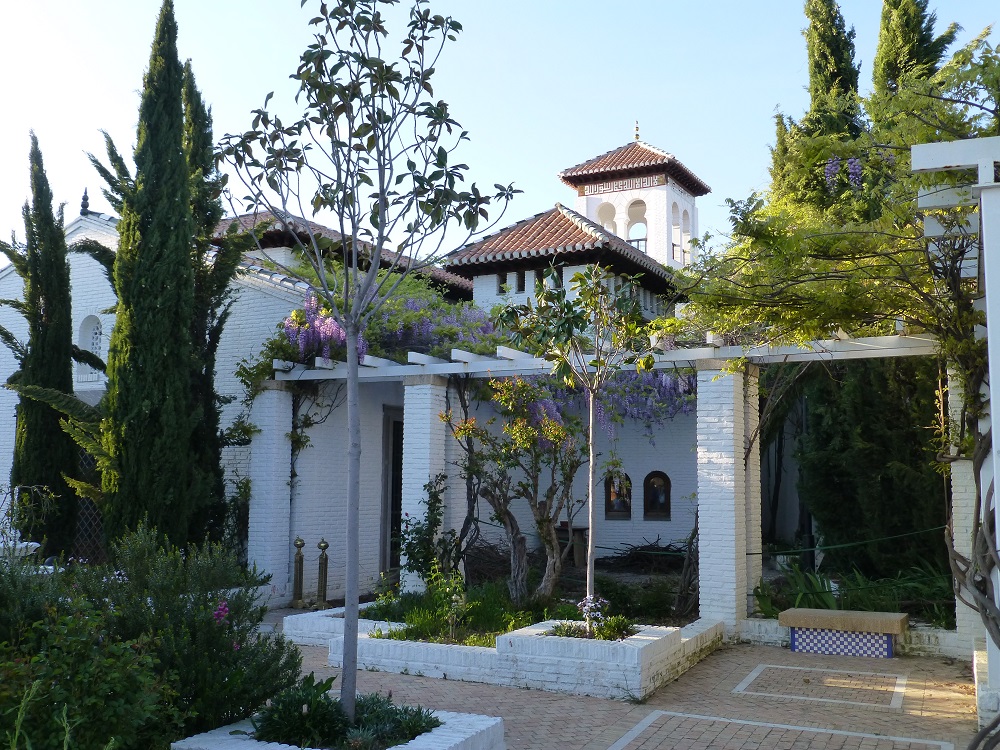
Granada's mew mosque.
The mosque opened in July 2003,
the culmination of 22 years of effort to overcome the various objections raised
by city leaders and by neighbourhood resistance. The opening was attended by various Muslim
and non-Muslim dignitaries, including the mayor of
It is the first mosque built in Granada in
over 500 years (the Muslims of Granada earlier met in makeshift centres) and carries
with it significant symbolic value, not always interpreted in the same way by
Muslims in Spain. Native-born Muslims, who make up most of the congregation,
are anxious not to arouse fears of an Islamic reconquest of
Beyond the Albaicín, on the edge of the town, is the gypsy cave district of Sacromonte, the most popular place to go to for flamenco dancing. There’s a lot of debate about the quality of the shows, but it can be a fun if somewhat more expensive experience than bargained for. Be cautious is the advice usually given to visitors, especially at night.
Sources
Fletcher, Richard Moorish
Fletcher, Richard The
Cross and the Crescent
Ford, Richard A Hand Book for Travellers in Spain London, 1845
Gilmour, David Cities
of
Jacobs, Michael A
Guide to Andalusia
Nash, Elizabeth Seville, Cordoba and Granada: A Cultural History Oxford 2005
An interesting article on the building of the new mosque in Granada can be read in:
http://www.guardian.co.uk/world/2003/dec/06/spain.gilestremlett


